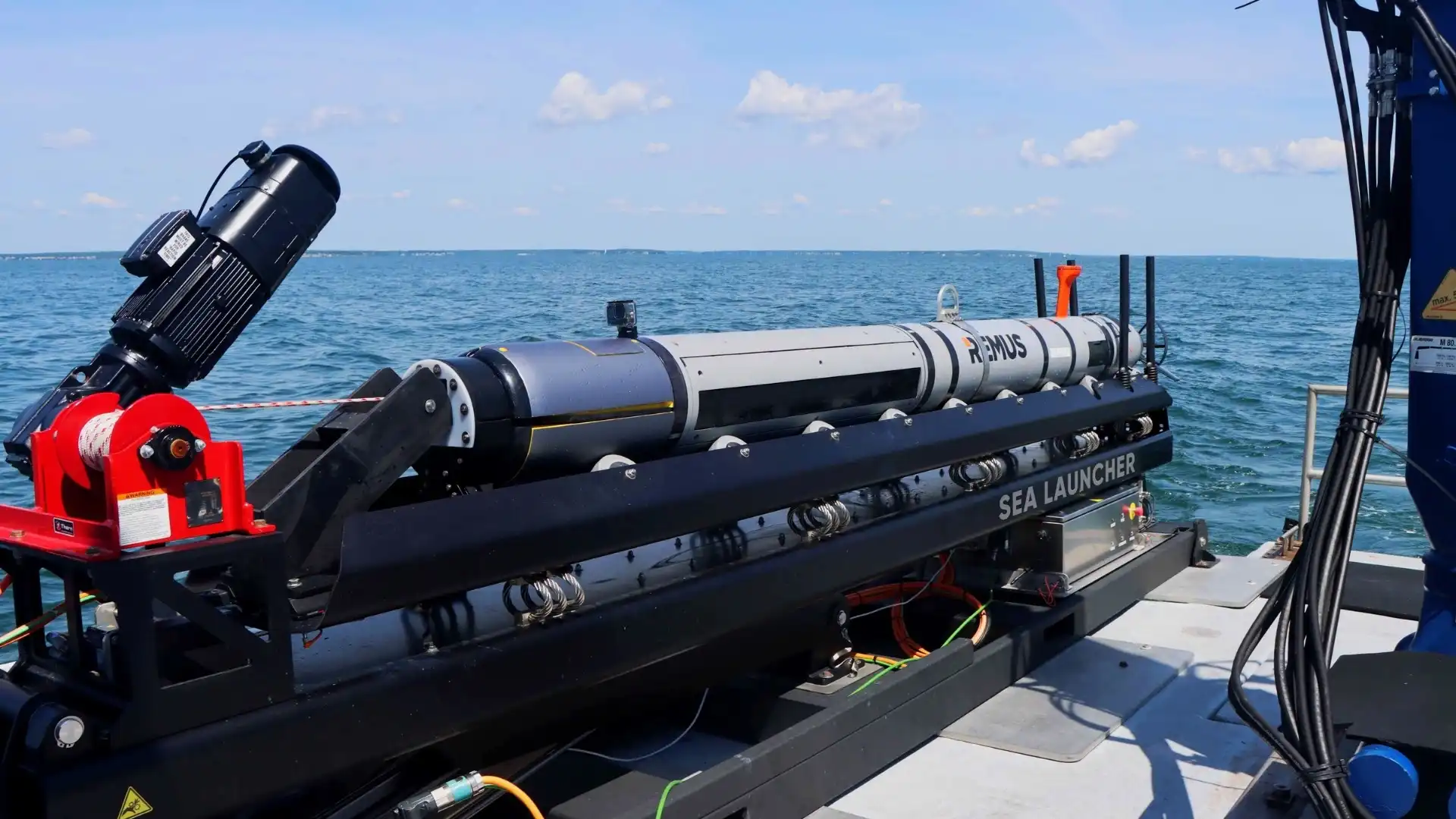
The United Kingdom has awarded HII a £142 million (approximately $186 million) contract for REMUS 620 unmanned underwater vehicles (UUVs) for the Royal Navy, the company announced on November 24, 2026. The award also covers Sea Launcher automated launch and recovery systems, ancillary equipment and support services for the Royal Navy’s Mine-Hunting Capability (MHC) program. The order, placed by the Ministry of Defence’s National Armaments Director Group (NADG), is the largest international award in the 25-year history of HII’s unmanned systems business. The REMUS 620 is rated to 600 meters and can run missions of up to 110 hours.
The contract feeds MHC Block 2, scheduled to deliver incrementally between 2026 and 2032, which is meant to build a digital backbone for mine countermeasures (MCM) data and add mass in hunting, neutralization and sweep systems as the Royal Navy shifts from crewed minehunters to offboard autonomous packages. Procurement documents issued by Defence Equipment and Support (DE&S) during the competition described eight mission systems, each comprising three UUVs and one launch and recovery system, for up to 24 vehicles. The November 24 announcement did not confirm final quantities. Defence Secretary Wes Streeting tied the buy to “the biggest sustained increase in defence spending since the Cold War.”
REMUS 620 Specifications and the Royal Navy Sensor Fit
The REMUS 620 is HII’s second-generation medium-class UUV. It pairs the core electronics of the smaller REMUS 300 with the 12.75-inch (324 mm) diameter hull and overall size of the REMUS 600, a vehicle the Royal Navy already operates. HII’s data sheet lists a 600-meter depth rating, speeds up to 8 knots and inertial navigation accuracy of 0.05 percent of distance traveled (CEP50).
Endurance is set by modular lithium-ion battery sections of 9.6 kWh, 19.3 kWh or 28.9 kWh. In the triple-battery configuration, the vehicle reaches up to 110 hours and 275 nautical miles. When HII unveiled the vehicle in 2022, it cited 70 to 78 hours and roughly 200 nautical miles with a synthetic aperture sonar payload installed. Length and weight scale with battery count: without a payload, the data sheet lists 2.7 meters and 188 kilograms with one battery section, rising to 4.3 meters and 326 kilograms with three.
Neither HII nor the MoD named the Royal Navy’s sensor payload. HII and Thales integrated the Synthetic Aperture Mine Detection and Imaging Sonar (SAMDIS 600) on the REMUS 620 in 2025 at HII’s Pocasset, Massachusetts facility, and that pairing has been reported as the Block 2 configuration. For MCM crews, multi-day endurance matters less as raw range than as fewer recovery cycles: a vehicle that can work a search area for three days ties up the mothership’s deck and crew far less than shorter-endurance systems.
Sea Launcher, SeeByte Software and the Hybrid Navy Mothership Model
Sea Launcher targets the most labor-intensive and weather-sensitive phase of offboard MCM: putting vehicles in the water and getting them back. HII has validated key elements of fully autonomous, end-to-end launch and recovery of the REMUS 620 in shipboard trials on a representative vessel. Under the contract, the vehicles will operate from offshore support vessels acting as motherships, in line with the Royal Navy’s Hybrid Navy concept of mixed crewed and uncrewed forces.
Software integration is the second risk reducer. The UUVs will plug into SeeByte SeaTrack and Neptune, UK-developed software already in Royal Navy service, while the vehicles run on HII’s ODYSSEY autonomy software. “This selection reflects the Royal Navy’s confidence in our proven technology,” said Duane Fotheringham, president of HII’s Unmanned Systems Group.
The deal extends a long relationship. Since 2001, the MoD has bought REMUS 100, REMUS 300 and REMUS 600 vehicles for MCM, and HII announced the sale of three REMUS 100s and five REMUS 300s to the Royal Navy in 2024. The new contract also moves support services previously delivered overseas to the UK, improving equipment availability and supporting 15 jobs, according to HII. Over 25 years, HII has delivered more than 750 REMUS vehicles to more than 30 countries, including 14 NATO members.
Analysis: The award confirms that the Royal Navy’s future MCM force will be counted in deployable packages rather than hulls. If the eight three-vehicle structure holds, each set becomes a modular unit that can embark on commercial-derivative vessels, decoupling mine-hunting mass from the warship build cycle that defined the Hunt and Sandown era. Choosing a vehicle that already works with in-service SeeByte software cuts integration risk and speeds fielding. The constraint now shifts to motherships: the MoD has committed to three Norwegian-designed offshore support vessels, procured through Norway’s P1118 Standardised Vessel Programme with options for three more, but the first is not due until 2031, so the UUVs may arrive well before purpose-designed hosts. With REMUS in service across 14 NATO navies, the buy also strengthens interoperability with allied MCM forces.
Delivery schedules, final vehicle quantities and the contract’s option structure have not been disclosed. Contract award documentation published earlier in November reportedly listed a higher maximum value than the £142 million announced, which may reflect options. The next markers are first deliveries of REMUS 620 packages, confirmation of the sonar payload, and the offshore support vessel timeline that will determine how quickly the Royal Navy can field the new UUV packages at scale.