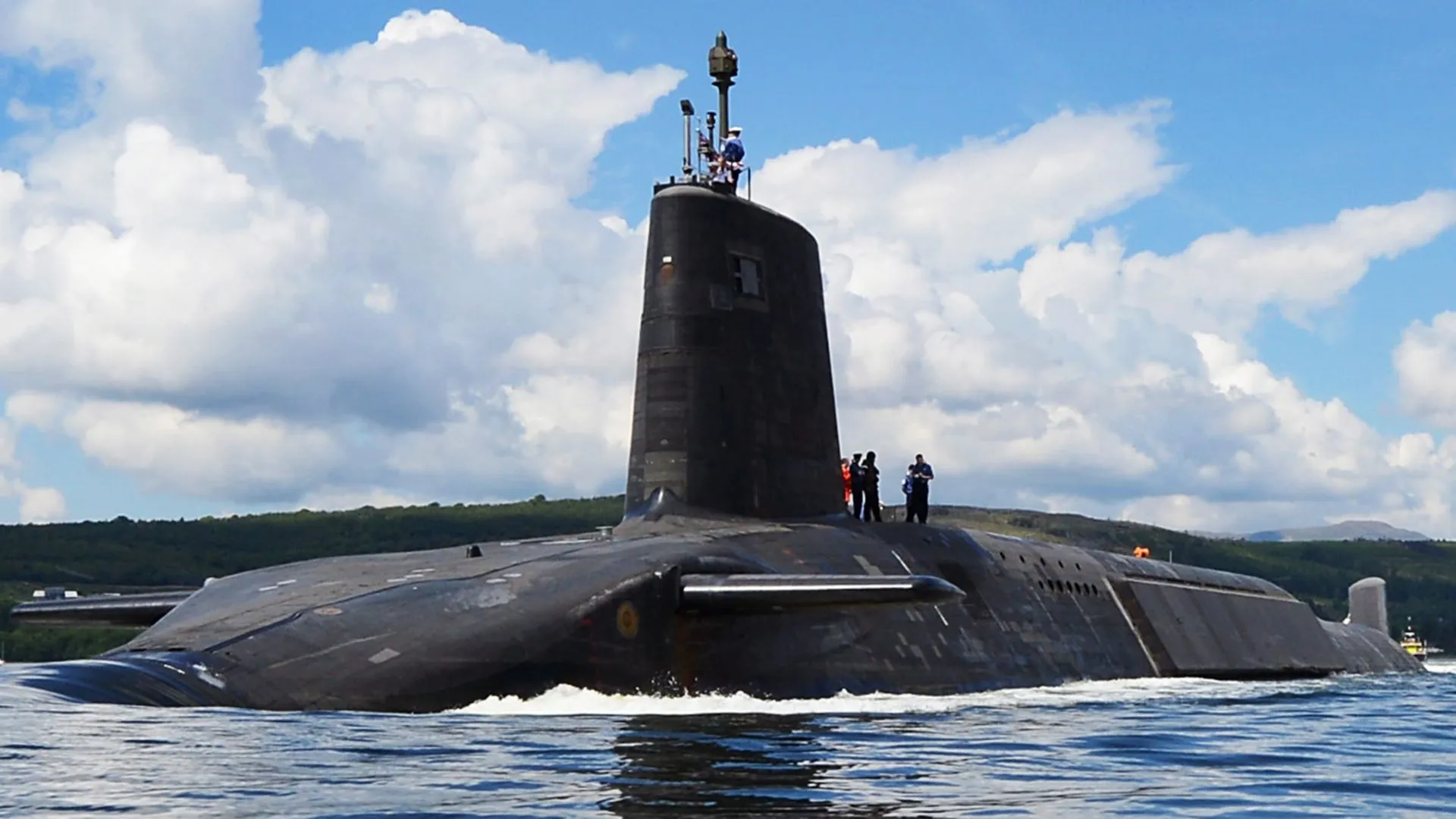
Babcock International Group has signed an £8.7 billion Gateway Agreement (GA) with the UK Ministry of Defence (MOD) to maintain Royal Navy submarines at Devonport and Clyde, the company announced on November 26, 2026. The submarine services framework consolidates maintenance, engineering and naval base support at His Majesty’s Naval Base (HMNB) Devonport, Devonport Dockyard and HMNB Clyde. It takes effect on December 1, 2026, for an initial five-year term, with a potential aggregate term of up to 15 years. It is the largest contract in Babcock’s history.
The agreement succeeds the Future Maritime Support Programme (FMSP), the five-year framework awarded in 2021 that expired on March 31, 2026, and was then carried forward by bridging arrangements ending on November 30, 2026. It lands as the Royal Navy stretches four Vanguard-class ballistic missile submarines (SSBNs), commissioned between 1993 and 1999 against a design life of roughly 25 years, to sustain the Continuous At Sea Deterrent (CASD) until the Dreadnought class enters service in the early 2030s. Patrols have lengthened accordingly: HMS Vengeance returned to Faslane on November 15, 2026, after a patrol of about 217 days, according to UK Defence Journal’s count from its reported April 12 departure.
Babcock Gateway Agreement Scope, Value and Contract Structure
The £8.7 billion figure covers the first five-year period only. According to Babcock, it comprises £8 billion of contract backlog and £0.7 billion of framework value. Babcock valued its share of FMSP at around £3.5 billion over five years, so the new agreement more than doubles the company’s committed submarine support workload. The backlog component alone approaches the group’s total order backlog of £8.9 billion reported at its half-year results on November 19, 2026.
Where FMSP was split into 11 contracts spanning naval bases, surface ship support and submarine work, the GA provides a single, integrated framework covering critical submarine support, maintenance, technical services and naval base services. A separate Memorandum of Understanding (MOU) sets out the strategic framework for the long-term relationship between the MOD and Babcock across the UK Submarine Enterprise. The announcement does not disclose availability targets, performance incentives or pricing mechanisms, nor which boat-specific deep maintenance packages fall inside the five-year envelope.
On workforce, the GA safeguards 8,500 existing Babcock nuclear defence roles and creates 3,000 additional full-time positions. It is also expected to support more than 2,500 apprentice and graduate opportunities over five years and generate over £500 million of social value.
Devonport and Clyde: Sustaining the Vanguard to Dreadnought Transition
The sites covered by the GA perform distinct roles. Devonport is the Royal Navy’s centre for submarine deep maintenance, handling major refits and life-extension work on Vanguard-class SSBNs and Astute-class attack submarines (SSNs). HMNB Clyde at Faslane is home to the core of the Royal Navy’s Submarine Service, including the deterrent force. The agreement explicitly covers the Vanguard to Dreadnought transition, meaning Babcock must sustain legacy boats commissioned in the 1990s while preparing shore support for the Dreadnought class, which publicly available specifications put at around 17,200 tonnes and which will retain the Trident II D5 missile.
Officials tied the deal directly to maintenance throughput. Defence Secretary Wes Streeting said it would get submarines “out of the docks and into the sea faster,” while First Sea Lord General Sir Gwyn Jenkins said it would tackle “the delays that hold us back.” Babcock Chief Executive Harry Holt said the framework would help increase submarine availability.
The GA sits alongside Project Royal Oak, the roughly £26 billion, 10-year programme announced in July 2026 to rebuild docks and waterfront infrastructure at Clyde, Devonport and Portsmouth. Devonport receives £7.1 billion, including work on 10, 14 and 15 Docks, while Clyde receives £15.1 billion under the Clyde Transformation Programme, including three new floating docks. Babcock also cites its own recent investments, including the Submarine Operations Centre, the Babcock Skills Centre at Devonport, an Integrated Logistics Hub and two Scottish Defence Technical Excellence Colleges.
Analysis: The GA matters less for its headline value than for its structure. Consolidating submarine support under a single prime with a 15-year horizon trades competitive tension for planning stability, a choice that reflects where the bottleneck now sits. The constraint on UK deterrent availability is dock capacity and nuclear-qualified labour, not hull numbers, as record patrol lengths show. Long-dated visibility lets Babcock recruit and train at scale, but it also concentrates risk: with no alternative supplier at Devonport or Faslane, MOD leverage will depend on how availability is measured and rewarded, terms that remain undisclosed.
The agreement takes effect on December 1, 2026. Markers to watch over the first term include the return of Vanguard boats from deep maintenance, progress on the Devonport dock works and the Clyde floating docks, and the delivery schedule for HMS Dreadnought. The decision on extending the GA toward its 15-year ceiling will offer the clearest test of whether the integrated model delivers the availability gains both government and industry have promised.