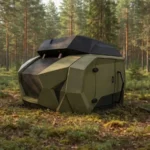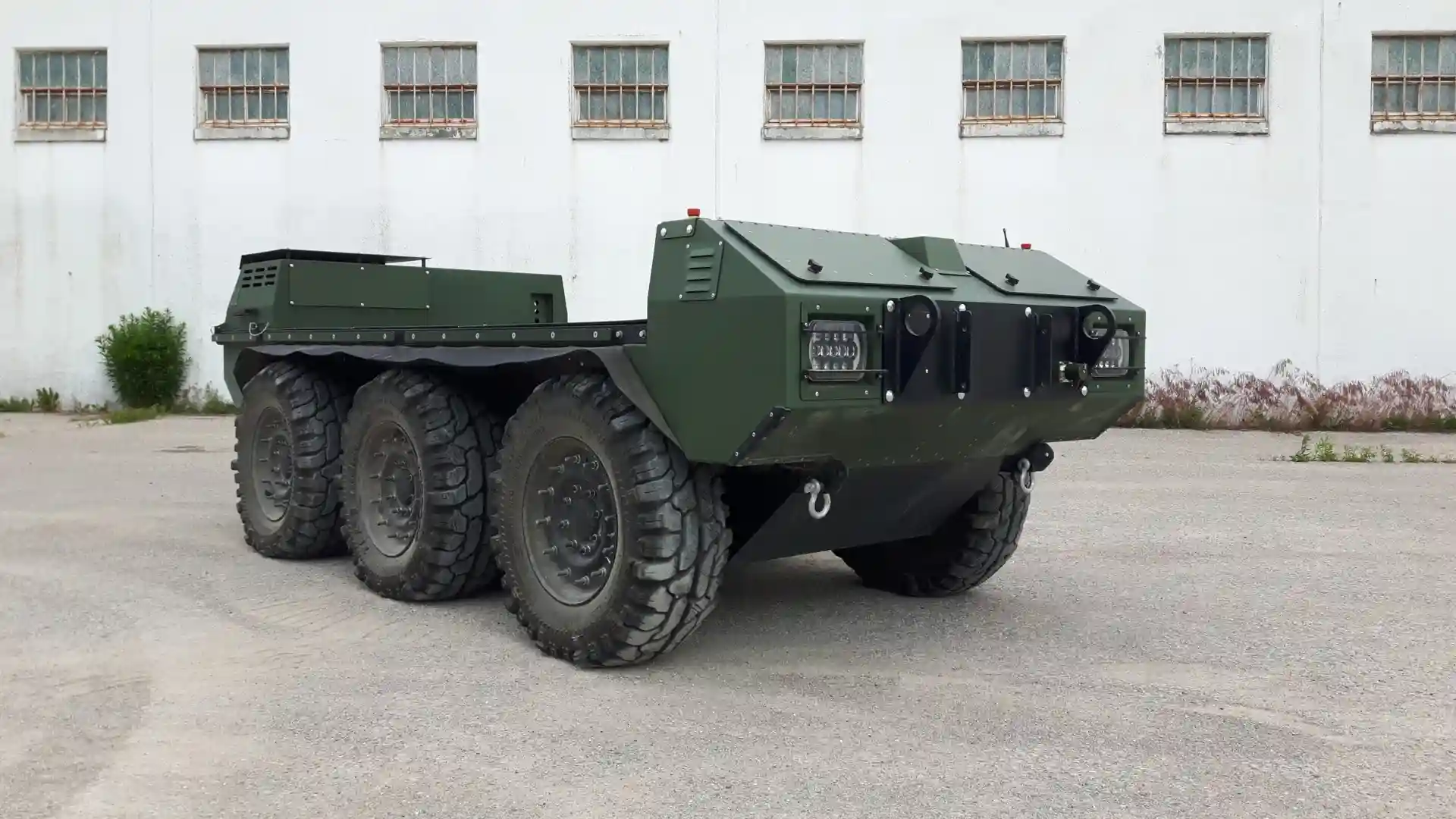
Canadensys Aerospace has received its first order from the U.S. Army for its RAPTOR unmanned ground vehicle (UGV), the Toronto-based company announced on November 25, 2026. The six-wheeled, electric-drive vehicle carries a 3-ton gross vehicle weight rating and can be driven remotely or operate autonomously. Canadensys identifies the buyer as the U.S. Army Combat Capabilities Development Command (DEVCOM) but has not disclosed the order value, the number of vehicles, or the delivery schedule.
President and CEO Christian Sallaberger said RAPTOR has already been sold to multiple U.S. customers, none of which the company has named, and Canadensys shipped the final vehicle of a RAPTOR order to an unidentified European defense customer in October 2024. The deal also arrives as Canadensys looks for new business after Ottawa cancelled the lunar rover it was building.
RAPTOR Unmanned Ground Vehicle Specifications and Mobility Envelope
Manufacturer-published specifications describe a vehicle 3.88 m long and 1.65 m wide on a 2.04 m wheelbase, with a curb weight of 1,350 kg and a gross vehicle weight rating of 2,950 kg. The standard flat deck, 1.4 m by 3.1 m, is rated for 1,000 kg. A payload equal to roughly 74% of curb weight is what makes the platform relevant to Army logistics and support roles: resupply, casualty evacuation, or a sensor or electronic warfare package.
Mobility comes from a 96 VDC electric drive and steering system turning all six wheels, with a patented skid-steer arrangement that allows a pivot turn on the spot. The drivetrain sits in sealed, oil-filled cavities, and the company quotes a service interval of 200 hours or four years. Published figures include 270 mm of ground clearance, ground pressure of about 30 kPa, a 60% climb on hard surfaces, a 35% side slope without payload, approach and departure angles of 48 and 45 degrees, and fording above 1 m without preparation. Run-flat 35-inch tires and a 2,000 kg towing rating complete the package.
The trade-off is pace and reach. Top speed is listed at 20 to 25 km/h and standard battery range at more than 30 km, which places RAPTOR at dismounted-infantry tempo rather than alongside mounted formations. Options include extended battery capacity, an integrated diesel generator, and enhanced export power beyond the standard 5 kW at 24 V NATO, enough to run radios, sensors, or charging stations at a halt. The company markets the electric drive as near-silent and emission-free.
From Lunar Rovers to Army Robotics: The Canadensys Dual-Use Model
Canadensys describes RAPTOR as a spin-off of its planetary work, built with technologies and design methods drawn from its lunar rovers. In November 2022, Public Services and Procurement Canada awarded the firm a C$43 million contract under the Canadian Space Agency (CSA) Lunar Exploration Accelerator Program to build Canada’s first lunar rover, a 30 kg vehicle later manifested on a 2029 Firefly Aerospace mission. The CSA 2026-27 Departmental Plan, released in March 2026, terminated that mission. Canadensys still holds a C$4.73 million Phase 0 study contract, awarded in July 2025, for a larger lunar utility vehicle.
“We are proud that technologies we developed for Moon missions are being used to support North American security and sovereignty goals,” Sallaberger said. The announcement refers to a sophisticated sensor suite without detailing it. The company’s datasheet lists an optional autonomy kit with waypoint navigation, follow, and teach modes, alongside local radio-frequency remote control; the configuration ordered by the Army has not been disclosed. RAPTOR is marketed as ITAR-free, and a sister platform, the HAWC optionally crewed vehicle, adds two seats and automotive-style controls to the same base.
In its weight class, RAPTOR’s most direct peer is the Rheinmetall Mission Master SP2 Cargo, also developed in Canada, which carries 1,000 kg at up to 40 km/h with a 50 km range on a single charge. RAPTOR matches that payload, trails it on speed and range, and offers an all-steel welded chassis with a 2,000 kg towing rating.
Analysis: The absence of a disclosed value or quantity, combined with a research and development command as the buyer, suggests a small evaluation purchase rather than the start of a program of record, though Canadensys has not characterized it. Its value would lie in the test data an Army evaluation generates, which can carry weight in later competitions. For Canadensys, a U.S. Army reference customer arrives months after its flagship space program was cut, validating a dual-use model built on planetary mobility engineering. Canada’s place in the U.S. National Technology and Industrial Base, combined with an ITAR-free design, also lowers the friction for a Canadian supplier entering that market. The open question is doctrinal: at 20 to 25 km/h, RAPTOR fits rear-area logistics, base security, and engineer support more naturally than maneuver formations.
The next disclosures to watch are the number of vehicles, the delivery schedule, and whether the Army integrates its own autonomy software onto the platform. DEVCOM’s Ground Vehicle Systems Center in Warren, Michigan, leads the Army’s development and integration of ground robotics, but Canadensys has not said which DEVCOM organization will evaluate the vehicles. A follow-on purchase would be the first sign that RAPTOR has moved beyond evaluation.