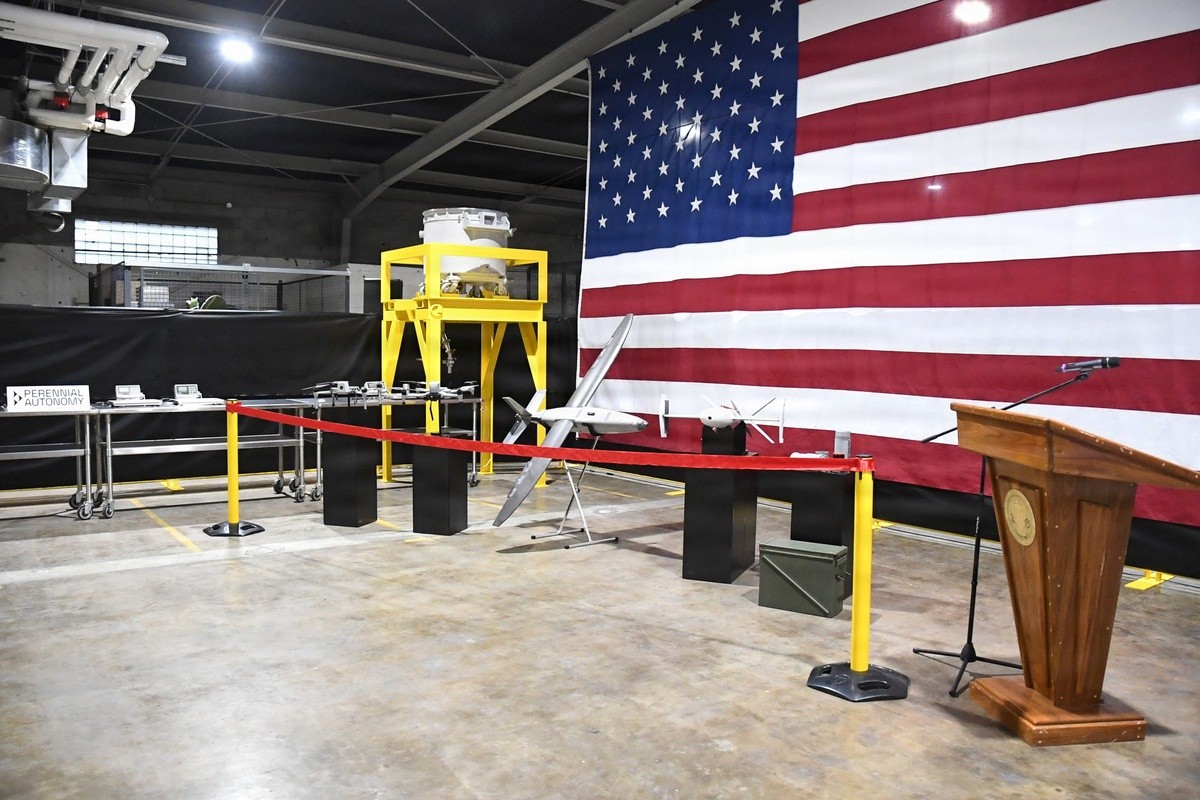
The McAlester Army Ammunition Plant (MCAAP) in Oklahoma will manufacture, load and deliver combat-ready explosive payloads for Perennial Autonomy’s unmanned aircraft under a new defense production partnership, the U.S. Army announced on October 2, 2026, following a ribbon-cutting ceremony at the installation. Perennial Autonomy supplies the airframes and guidance; the government-owned plant supplies the ordnance.
The arrangement lands in the same week the Pentagon moved to institutionalize autonomous warfare. Secretary of War Pete Hegseth announced an Autonomous Warfare Command in his September 30 State of the Force address, and on October 1 Acting Secretary of the Army Adam R. Telle signed a memorandum creating the U.S. Army Futures and Autonomous Systems Command (FASCOM), with orders to field autonomous fires and crewed-uncrewed teaming by fiscal year 2028. The Army frames the McAlester deal as part of Army Materiel Command’s (AMC) push to modernize the organic industrial base (OIB) by adapting legacy munitions production to drone warfare.
McAlester Army Ammunition Plant Takes On Drone Payload Production
Commissioned on May 20, 1943, as the McAlester Naval Ammunition Depot and transferred to the Army in 1977, the installation covers roughly 45,000 acres and holds more than 2,200 earth-covered storage magazines, the Defense Department’s largest explosive storage footprint according to installation figures. A subordinate installation of Army Sustainment Command, it produces, receives, stores, ships, renovates and demilitarizes conventional ammunition, and it has long been a primary U.S. producer of general-purpose aircraft bombs.
The partnership asks MCAAP’s workforce to operate at a radically smaller scale. A plant whose output runs up to the 11-ton GBU-43/B Massive Ordnance Air Blast (MOAB) will now handle payloads sized for small fixed-wing and rotary-wing drones, where publicly reported warhead weights run from roughly 1.5 to 5 kilograms. That work falls to the plant’s chemists, load-assemble-pack (LAP) specialists and quality inspectors, a civilian workforce the Army describes as having years of specialized experience. Brian Lott, MCAAP’s civilian deputy, said integrating Perennial’s guidance with the plant’s ordnance work “directly answers the call to modernize the OIB.”
Key parameters remain undisclosed. The Army has not released the agreement type, its dollar value, production quantities, delivery schedule or the specific warhead designs MCAAP will load, nor whether the work runs on existing production complexes or requires new tooling.
Hornet, Merops and Bumblebee: Perennial Autonomy’s Unmanned Portfolio
The Army also did not specify which Perennial platforms will carry McAlester-built payloads. The company, founded with backing from former Google chief executive Eric Schmidt and previously known as Project Eagle, fields three relevant systems, all covered by a three-year indefinite-delivery, indefinite-quantity (IDIQ) contract with a $500 million ceiling awarded by Joint Interagency Task Force 401 (JIATF-401) on May 19, 2026.
The Merops counter-unmanned aircraft system (C-UAS) launches the AS3 Surveyor, a fixed-wing, propeller-driven interceptor about three feet long. Publicly available specifications indicate a top speed of about 175 mph (282 km/h), a range of roughly 12.5 miles and a unit cost near $15,000, with kills achieved by impact or proximity detonation of a warhead reported at about 2 kilograms. The company credits Merops with more than 4,000 Russian drone intercepts in Ukraine since mid-2024, a figure not independently verified.
The Hornet is a pneumatically launched, fixed-wing strike drone with AI-assisted terminal guidance built to keep working under electronic attack. Perennial has not published specifications; open-source estimates put its takeoff mass near 15 kilograms, its wingspan at 2.2 meters and its payload at up to about 5 kilograms. Wreckage analysis has identified at least four interchangeable warheads, including a 95 mm HEAT-fragmentation charge and a 4-kilogram blast-fragmentation round. Ukrainian forces reportedly launched more than 10,000 Hornets against targets in Russia in the three months to September 2026. The Bumblebee quadcopter interceptor, evaluated under a separate $5.2 million JIATF-401 contract in January 2026, completes the line.
The Hornet’s modular, warhead-agnostic design makes it the most logical consumer of McAlester ordnance, though neither party has confirmed it. Perennial already relies on a European partner, Munich-based Twentyfour Industries, to produce Merops; McAlester gives it a U.S. government-owned source of energetics.
Organic Industrial Base Retools for Drone Warfare Workload
McAlester joins a wider AMC effort to turn depots and arsenals into a drone supply chain. Under the SkyFoundry initiative, Rock Island Arsenal’s Joint Manufacturing and Technology Center builds airframes, Tobyhanna Army Depot handles electronics and brushless motors, Red River Army Depot covers batteries, propellers and final assembly, and Blue Grass Army Depot serves as a prototyping hub, with a stated goal of capacity for 10,000 small drones within a year of funding. None of those sites addresses the explosive end of the kill chain. MCAAP does.
The Army also casts the partnership as an economic stabilizer: industry workload offsets sustainment costs at the plant, opens an avenue for infrastructure improvements and retains specialists whose skills take years to build. Col. Curtis Perkins, MCAAP’s commander, said the effort applies his employees’ “deep technical expertise to next-generation drone munitions.”
Analysis: The bottleneck in mass-producing attritable strike and interceptor drones is shifting from airframes to energetics. Airframes and guidance boards scale in months; explosive loading needs sited facilities, quantity-distance clearances, magazine space and certified LAP crews that take years to build. Ukrainian use suggests a single drone type can consume more than 3,000 warheads a month. Plugging Perennial into McAlester lets the company skip the slowest part of an industrial build-out and gives the Army an organic, domestically controlled source of drone payloads as FASCOM and the Autonomous Warfare Command begin generating demand. The risk: drone warheads iterate in weeks, while OIB processes were built for bomb designs that change over decades.
Several milestones will show whether the model scales. The Army has yet to disclose the agreement’s value, production rates or first deliveries, or whether McAlester payloads will go only to U.S. units or also to partner nations operating Perennial systems. Task orders under the $500 million JIATF-401 IDIQ, FASCOM’s organizational stand-up and the Pentagon’s target of establishing the Autonomous Warfare Command by October 1, 2027, subject to congressional authorization, are the next markers to watch.