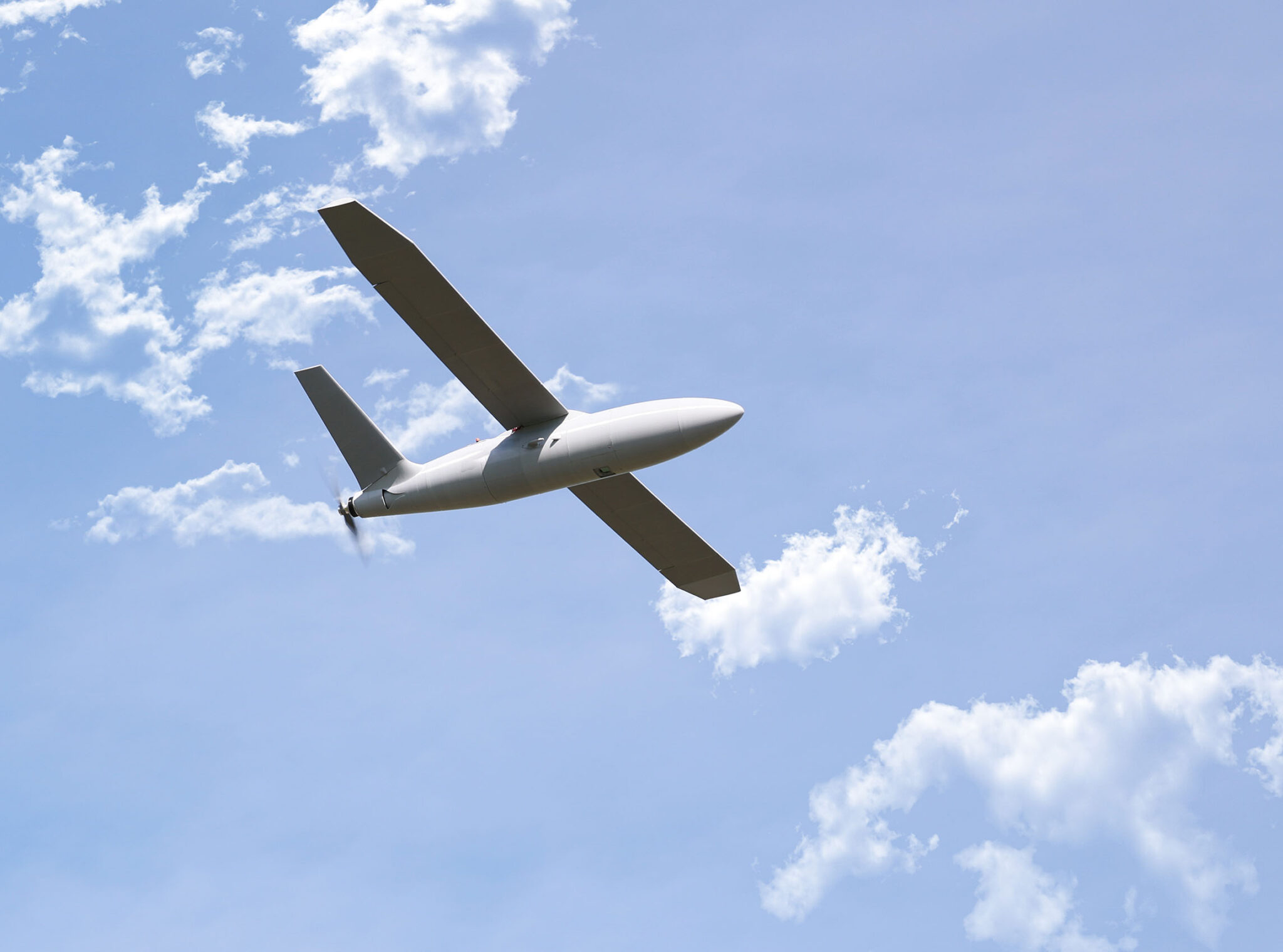
US defense technology company Aevex Aerospace will produce its Vandal and Onyx unmanned aircraft in Taiwan through a partnership with Coretronic Intelligent Robotics Corporation (CIRC), the two companies announced in Taipei on October 2, 2026. Both have been tested in combat in Ukraine, according to Aevex, and the Taiwanese-built versions will pair Aevex airframes with local avionics, payloads, motors and batteries.
The agreement arrives as Taipei accelerates its effort to field a “drone shield” against the People’s Liberation Army (PLA). Economic Affairs Minister Kung Ming-hsin said on October 5 that Taiwan needs more than 200,000 drones to create a deterrent effect, built on a “non-red” supply chain free of mainland Chinese components. His ministry recently raised its 2030 forecast for the drone industry’s value from NT$40 billion (US$1.3 billion) to NT$50 billion, alongside a six-year, NT$44.2 billion unmanned vehicle industry program.
Vandal and Onyx Specifications: How the Aevex Drones Compare
Vandal is the smaller of the two. Aevex describes it as a high-speed, low-signature Group 2 unmanned aircraft system built from carbon composites for intelligence, surveillance and reconnaissance (ISR), electronic warfare (EW) and precision strike. The electrically powered aircraft carries a 4.5-kilogram (10-pound) payload and flies more than 460 kilometers (286 miles), according to the company. Its open architecture accepts sensor, EW and strike packages, letting one airframe cover several mission sets.
Onyx, which Aevex markets as a Group 3 one-way attack drone, carries a 13.6-kilogram (30-pound) payload over a range exceeding 270 kilometers (168 miles), with endurance of up to 2.8 hours. A modular payload bay accepts surveillance, targeting, communications or strike modules. Aevex has not disclosed cruise speed, launch weight, dimensions, launch method, warhead options or unit cost for either aircraft, nor the Onyx propulsion system.
Both aircraft integrate Aevex’s CompassX navigation architecture, which uses computer vision and other techniques to keep flying when satellite navigation is degraded or denied. Aevex executives said intensive electronic warfare in Ukraine shaped that design, a requirement that carries over to the Taiwan Strait, where the PLA would be expected to employ extensive electronic warfare.
The figures invite comparison with the 291 Altius-600M loitering munitions Anduril Industries delivered to Taiwan between August 2025 and early 2026. Publicly available specifications credit the Altius-600M with a payload of up to 3 kilograms, a range of about 440 kilometers and endurance of up to four hours. Vandal offers 50 percent more payload at a similar published range, while Onyx trades reach for roughly triple Vandal’s payload. Both published ranges exceed the width of the Taiwan Strait, about 130 kilometers at its narrowest point.
Zhunan Production and Taiwan’s Non-Red Drone Supply Chain
Under the split described by CIRC chairwoman Ann Wu, Aevex supplies the combat-validated airframes and 3D-printed designs, while CIRC designs and builds the mainboards, flight-control systems, edge computing and payloads. Motors and batteries will come from Taiwanese suppliers. Production will take place at CIRC’s plant in Zhunan, Miaoli County, where Wu said capacity could reach 4,000 aircraft per month depending on demand. CIRC, a Coretronic Group subsidiary, has delivered more than 3,000 drones without Chinese components to the Taiwanese government in about a year, according to Wu. The jointly developed aircraft have been flight-tested in the United States and in Taitung County.
Aevex’s ForgeX additive manufacturing process anchors the model. The company says ForgeX lets engineers modify airframes quickly as battlefield requirements change, and Craig Anders, Aevex senior vice president of growth, said the printed designs can be produced in conventional factories or in micro-factories. Lu De-yun, a former press secretary for Taiwan’s Ministry of National Defense, told the South China Morning Post that the approach could allow Taiwan to print replacement drones by the thousands in wartime rather than depend on overseas resupply. Containerized printing cells, he said, could be relocated to disperse production and sustain a high-low mix of advanced weapons and cheaper mass.
Aevex chief growth officer Murali Krishnan described local production as an answer to the “tyranny of distance” across the Pacific, while Anders said the company intends to build capability inside Taiwan rather than simply sell to it. The deal extends an existing footprint: Aevex signed a memorandum of understanding with Aerospace Industrial Development Corporation (AIDC) in June 2024, and Anders said its Lynx unmanned surface vessel is already operated by Taiwan’s Marine Corps.
Analysis: The partnership matters less for what Vandal and Onyx can do in the air than for where they will be built. Taiwan’s recent foreign military sales experience shows the friction of importing finished systems: chargers for the Altius-600M were left out of the US Letter of Offer and Acceptance because the original units contained mainland Chinese components, according to local reports. Licensed production with Taiwanese avionics and power systems addresses both the non-red requirement and the risk that a PLA blockade would cut trans-Pacific resupply. The constraint is scale. Even at its stated ceiling of 4,000 aircraft per month, Zhunan alone would need more than four years to produce 200,000 drones, and Krishnan acknowledged that technology transfer remains constrained by US restrictions.
The next decision points sit with Taiwan’s Ministry of National Defense and the Legislative Yuan, which is reviewing the 2027 budget. Neither company has announced a Taiwanese military order, unit price, delivery schedule or US export license for the locally built aircraft. Anders said Aevex has met Army, Navy, Marine Corps and Air Force units and is focusing on Vandal and Onyx.