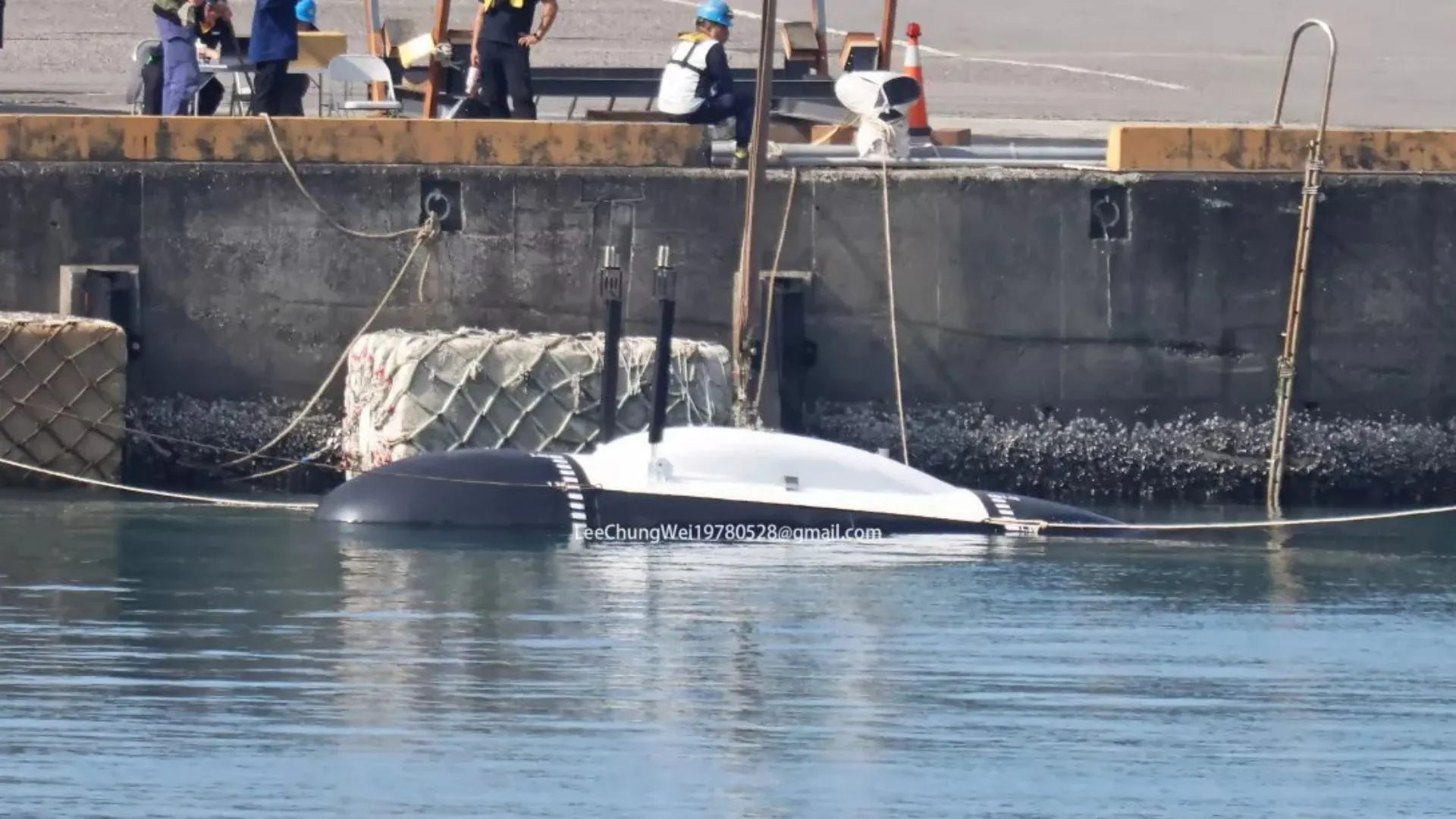
Taiwan’s Black Whale extra-large uncrewed underwater vehicle (XLUUV) entered the water for its first launch test on November 11, 2026, at Su’ao Harbor in Yilan County. Developed by Taiwanese shipbuilder Lungteh Shipbuilding with British firms MSubs and Marine AI, the roughly nine-meter vehicle was lowered into the harbor without any prior official announcement, according to PeoPo, Taiwan’s public broadcaster-run citizen journalism platform, whose reporter Li Chung-wei photographed the trial.
The test opens the in-water evaluation phase of a program Lungteh first displayed at the Taipei Aerospace and Defense Technology Exhibition (TADTE) in September 2025, when hull completion was expected by the end of that year and in-water testing in 2026; the first launch tracks that schedule. It comes as the People’s Liberation Army Navy (PLAN) keeps expanding its activity around Taiwan and as Taipei seeks to diversify its naval capabilities through uncrewed systems designed to operate in contested waters. Neither the Ministry of National Defense nor the Republic of China Navy (ROCN) has announced a procurement decision or a deployment timeline for the Black Whale.
Black Whale XLUUV Design, Dimensions, and British Hull Lineage
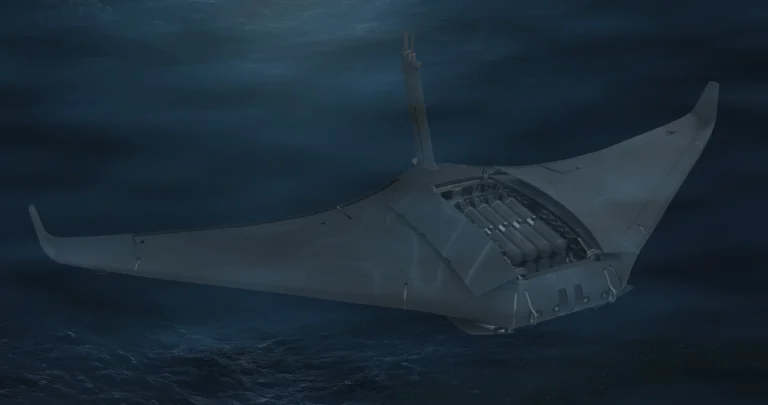
Publicly available specifications indicate the Black Whale measures 9 meters (30 feet) in length with a 2-meter (6.5-foot) beam and displaces about 9 tonnes. Those provisional figures place it at the light end of the XLUUV class, shorter than the Royal Navy’s 12-meter XV Excalibur and far smaller than the 15.5-meter Boeing Orca developed for the US Navy. It uses X-form stern control surfaces and a single propeller.
The design closely resembles the Manta demonstrator that MSubs built for the Royal Navy by converting its existing S201 submersible, a vehicle of about 9 meters. The matching length suggests Lungteh drew on a proven British hull form rather than designing a pressure hull from scratch. That shortens development, but the companies have not specified which technologies, from internal architecture to propulsion and batteries, were transferred.
Marine AI, the British autonomy software specialist whose software also runs on the Royal Navy’s XV Excalibur, is the program’s autonomy partner. Taiwanese reporting describes a system intended to operate where radio communication is unavailable, a baseline requirement since seawater blocks GPS and most radio frequencies. A vehicle in that environment must rely on inertial navigation, Doppler velocity logs, and acoustic aids, and must execute its mission with little or no operator input.
The figures that determine military value remain unpublished: propulsion type, transit and maximum speed, operating depth, endurance, and payload capacity. Local reporting describes the Black Whale primarily as a test and demonstration platform for validating undersea combat technologies, with a modular payload architecture and envisioned roles in intelligence, surveillance, and reconnaissance (ISR), anti-submarine warfare (ASW), and mine countermeasures (MCM). No specific sonar, sensor, or weapon payload has been confirmed.
From Huilong to XV Excalibur: Where Black Whale Fits Among XLUUVs
The Black Whale is Lungteh’s second large undersea drone. The company previously built the Huilong with the National Chung-Shan Institute of Science and Technology (NCSIST), an experimental vehicle presented in 2024 that measures about 30 meters and displaces an estimated 100 tonnes. Huilong features two forward tubes, a five-bladed propeller, and X-shaped stern surfaces, and its test program has covered sonar systems, naval mines, and integration of the SUT heavyweight torpedo. The Black Whale sits at the opposite end of the scale: a compact vehicle that can be transported, launched, and recovered with far less infrastructure.
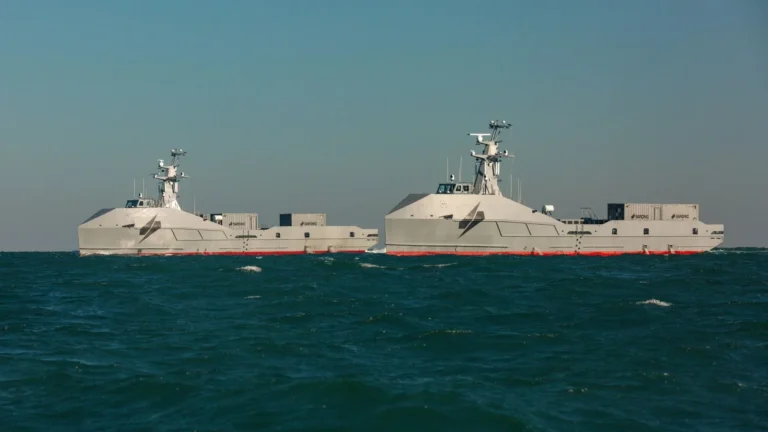
Both undersea programs run alongside Lungteh’s uncrewed surface vessel work, including the Kuai Chi and Black Tide projects, and alongside Taiwan’s indigenous Hai Kun crewed submarine program. Taken together, the Huilong and the Black Whale point to a split approach: one vehicle as a weapons integration testbed, the other as a lighter sensor and technology demonstrator.
Allied programs show where the class is heading. MSubs’ 12-meter XV Excalibur, the Royal Navy experimental testbed named in May 2025, released an inert US Mk 48 Mod 4 heavyweight torpedo carried externally beneath its hull at the British Underwater Test and Evaluation Centre in Scotland on September 13, 2026. In Australia, Anduril is producing the Ghost Shark under an AUD 1.7 billion contract awarded in September 2025, with announced mission payloads that include naval mines. No comparable weapons capability has been demonstrated or announced for the Black Whale.
Analysis: The Black Whale matters less as a vehicle than as evidence of a supply chain. British firms contributing hull expertise and autonomy software to a Taiwanese builder gives Taipei access to mature XLUUV technology it would otherwise spend years developing. Operationally, a 9-tonne XLUUV fits Taiwan’s asymmetric logic: persistent, low-signature sensors watching harbor approaches, suspected minefields, and the undersea cables on which the island depends. A single prototype, however, is not a capability. The ROCN still needs doctrine, launch and recovery infrastructure, data links back to shore, and a sustainment budget before undersea drones can change the calculus for PLAN submarines and mine warfare units.
The next milestones are open-water trials beyond the harbor, validation of autonomous navigation and endurance, and the first confirmed payload integration. Key unknowns remain whether the ROCN will issue a formal requirement, whether funding appears in upcoming defense budget requests, and whether Lungteh and its British partners will publish performance data. Until then, the Black Whale remains a demonstrator under test, not a fielded system.