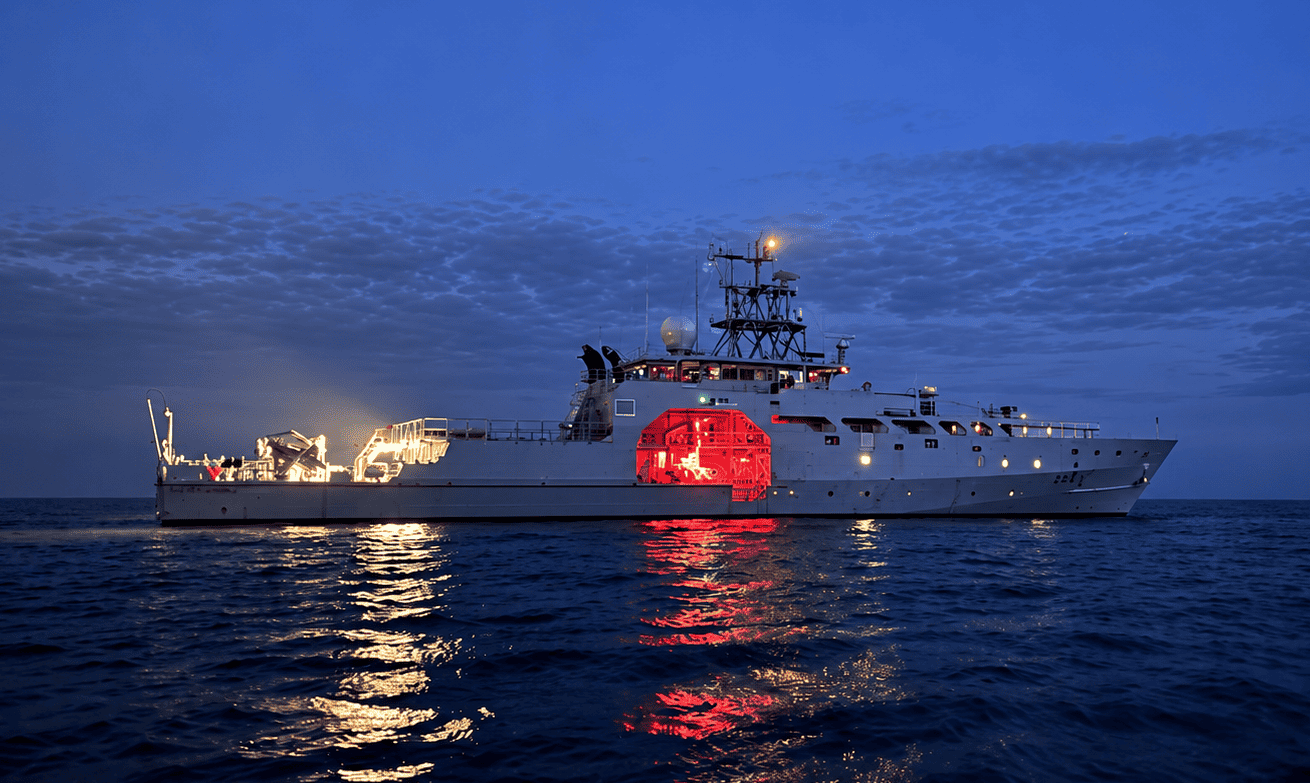
The French Navy’s fifth Patrouilleur Outre-Mer (POM), the future Philippe Bernardino (P783), completed its first period at sea from September 28 to October 1, 2026, sailing from Socarenam’s yard in Boulogne-sur-Mer to the builder’s Calais site. The 1,300-tonne offshore patrol vessel (OPV), penultimate unit of the six-ship Félix Éboué class, will be homeported in Papeete, French Polynesia.
The milestone lands as the program runs well behind its original timetable. The Direction générale de l’armement (DGA), France’s defense procurement agency, ordered the six hulls on December 24, 2019 from a Socarenam and CNN MCO consortium, and the 2019-2025 military programming law (LPM) called for all of them by the end of 2025. Four have been handed over so far: Auguste Bénébig (P779) and Jean Tranape (P782) for Nouméa, Teriieroo a Teriierooiterai (P780) for Papeete and Auguste Techer (P781) for La Réunion. Jean Tranape, delivered on July 10, 2026, was slated to enter active service in September 2026.
POM Patrol Vessel Trials: From Boulogne-sur-Mer to Calais
Beyond the change of shipyard site, the four-day outing served as the ship’s first trials campaign at sea. According to the French Navy, crew and yard teams balanced the operating modes of the propulsion line and calibrated and configured the full suite of navigation instruments. These are foundational checks: the POM switches between diesel and electric propulsion, and every transition must be validated before performance and endurance trials can proceed.
Philippe Bernardino will remain in the Calais area until mid-December 2026 for further outfitting work, a hull careening period and a second series of sea trials planned for late November. The ship will then sail to Brest, from which earlier units departed for their home ports, before the long transit to Papeete. Open-source records indicate the hull was launched in October 2025 and that delivery is expected in 2027; the Navy has not published a delivery date.
The Calais step follows the path of Jean Tranape, christened at Socarenam’s Calais facility in December 2025 before its transit to New Caledonia.
Hybrid Propulsion, Narwhal Gun and Aliaca Drones: The POM Design
Designed by naval architecture firm Mauric, the POM measures 79.9 meters in length with an 11.8-meter beam and a draft under 3.5 meters. Its full-load displacement is roughly three times that of the P400-class boats it replaces. Official figures give a top speed of 24 knots, a range exceeding 5,500 nautical miles at 12 knots and 30 days of endurance. The ship carries a crew of 30 plus 23 additional berths for boarding teams or embarked forces.
Engine supplier Anglo Belgian Corporation has stated that the class uses two of its 16-cylinder diesels; installed power has not been published. Electric propulsion lets the ship hold low speeds indefinitely, according to the Ministry of the Armed Forces, a direct fit for fisheries policing, where a patrol vessel spends long hours loitering near fishing grounds rather than transiting at speed.
Armament is deliberately constabulary: a remotely operated Narwhal 20 mm cannon on the bow, two 12.7 mm and two 7.62 mm machine guns, and no missiles. Sensors include an air and surface surveillance radar, a day and night electro-optical identification system, a tactical situation system and satellite communications; publicly available specifications indicate Hensoldt supplied the Nexeya combat management system and radars. Two 8-meter fast boats launch from a stern ramp and davit.
The flight deck accepts a vertical take-off drone of up to 200 kg. The class operates the SMDM system, built around two catapult-launched Aliaca fixed-wing mini-UAVs of about 16 kg each, with three hours of endurance and a 50 km radius. That reach pushes visual identification of contacts beyond radar range. The DGA ordered a vertical take-off Aliaca variant in February 2026, now entering qualification.
Replacing the P400 Across France’s Indo-Pacific Exclusive Economic Zones
The six POMs replace P400 patrol boats that entered service from 1986, whose gradual withdrawal opened temporary capability gaps overseas. Basing is split evenly: two ships each at Nouméa, Port-des-Galets on La Réunion, and Papeete. Missions span sovereignty patrols, fisheries policing, counter-narcotics operations, search and rescue, emergency towing and pollution response.
French Polynesia shows the scale of the task. Its exclusive economic zone (EEZ) covers roughly 4.8 million square kilometers, close to half of France’s total maritime domain of about 10.2 million square kilometers. Philippe Bernardino will join Teriieroo a Teriierooiterai, admitted to active service at Papeete on July 17, 2024, completing the two-ship allocation planned for the territory.
The ship honors Chief Warrant Officer Philippe Bernardino, born in Mataiea, Tahiti, in 1915. He volunteered for the Bataillon du Pacifique in 1940 and fought at Bir Hakeim, El Alamein, and in Tunisia, Italy and Provence. A Companion of the Liberation, he died on his native island in 1963. The ship’s motto is “Dévoué, courageux, sûr” (Devoted, courageous, reliable).
Analysis: The fifth hull’s first trials confirm that the final POMs will arrive well beyond the end-2025 target set by the LPM, with the sixth ship, Félix Éboué, still to come. For Polynesia, the more important number is two: two 1,300-tonne hulls for 4.8 million square kilometers leaves little margin once maintenance periods and crew rest are factored in. That is why the drone and the electric loiter mode carry so much of the class’s value; they extend persistence and sensor reach rather than firepower. The DGA frames the program against mounting pressure on fish stocks and biodiversity and against challenges to the law of the sea. The POM answers that problem as a policing tool. It is not built to deter a state actor, and heavier tasks remain with surveillance frigates and visiting French and allied combatants.
Next milestones are the late-November sea trials and departure from the Calais area by mid-December 2026, followed by a stop in Brest. The Navy has not disclosed the date of the Papeete transit, the DGA delivery date or the planned admission to active service. Progress on Félix Éboué, destined for La Réunion, will determine when the class reaches full six-ship strength.