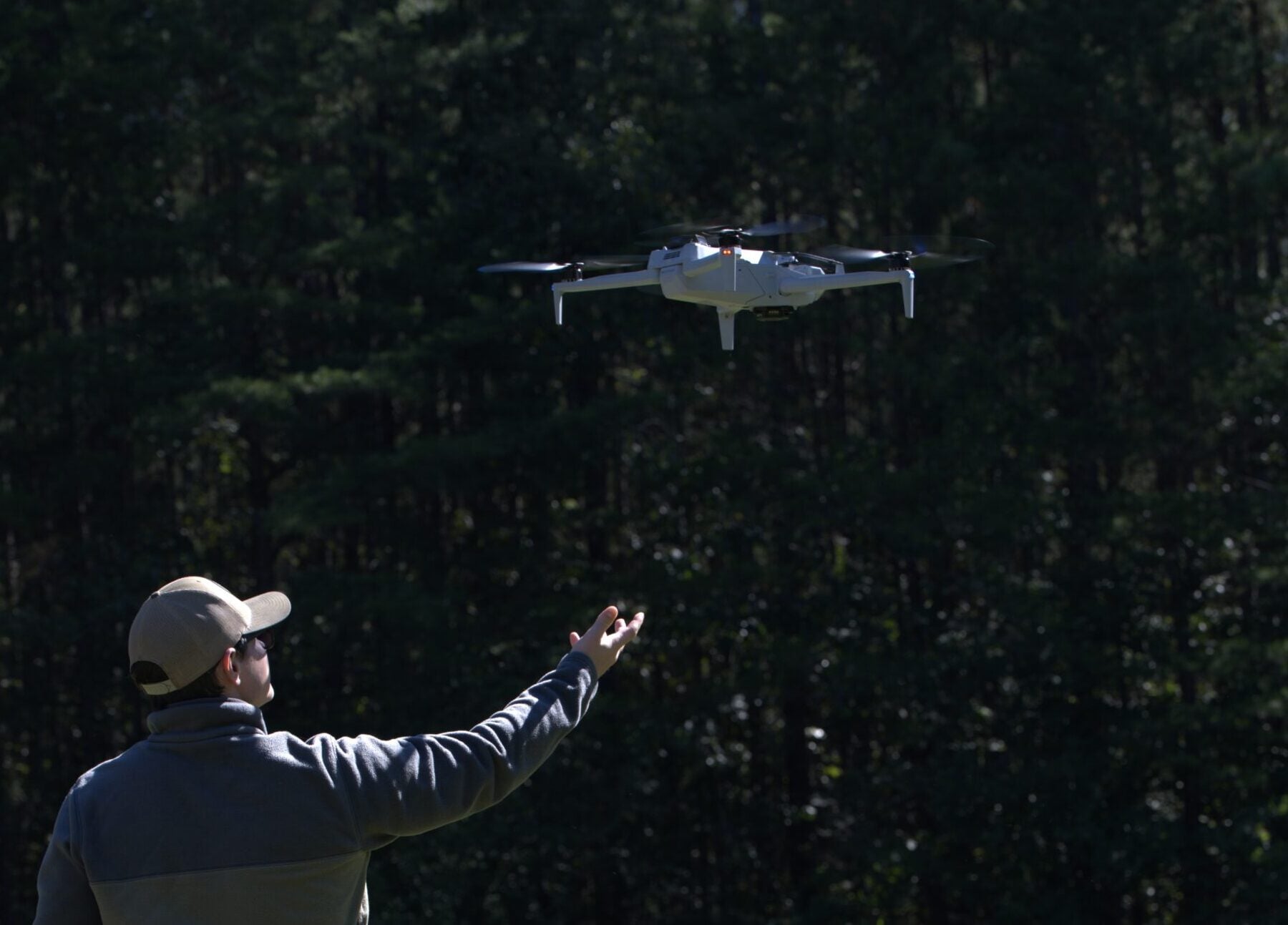
The Air Force Office of Special Investigations (AFOSI) has certified its first cadre of personnel qualified both to fly and to teach the Skydio X10D small unmanned aircraft system (sUAS), ahead of fielding five of the drones to its Technical Operations agents in January 2027. Six personnel completed a weeklong course at AFOSI headquarters in Quantico, Virginia, in September 2026, and all six qualified as operators and instructors, according to the Air Force.
The certification moves AFOSI from investigating drone activity to operating drones itself. The agency, a federal law enforcement and counterintelligence organization with more than 2,000 special agents and over 260 field units, already handles a growing caseload of unauthorized drone flights near Department of the Air Force installations. In May 2026, the AFOSI Center stood up a dedicated sUAS integration cell to support detachments responding to those incidents, while Joint Interagency Task Force 401 (JIATF-401), created in August 2025, synchronizes counter-drone efforts across the Pentagon.
How the AFOSI Drone Program Built Its First Instructor Cadre
The September course combined classroom instruction with field flight operations, according to Special Agent Scott Zawacki, AFOSI Technical Operations program manager and the agency’s new major command (MAJCOM) sUAS program manager. Because the six graduates are certified as instructors rather than as individual pilots, they can return to Technical Operations units and qualify additional operators without routing every student through headquarters. Zawacki said running the training internally lets AFOSI design “highly specialized training scenarios that directly support AFOSI’s unique mission requirements.”
The effort traces back to Detachment 111 at Edwards Air Force Base, California. There, Anthony Zutten, a Det. 111 criminal indexing and investigations specialist, worked with Zawacki to build a local sUAS capability before AFOSI moved to establish an agency-wide program in 2024. Edwards served as a working pilot program and gave AFOSI an early proof of concept for drone support to investigations and other operational needs. Zawacki then folded the Edwards work into the developing AFOSI structure, capping roughly two years of policy work, testing, coordination and funding efforts. Zutten led the first instructor course.
A five-aircraft buy for Technical Operations agents points to a centrally managed pool rather than an aircraft at every detachment. AFOSI has not disclosed which units will receive the drones, the contract vehicle or the unit cost.
Skydio X10D Sensors, Endurance and GPS-Denied Navigation for Investigators
AFOSI has not specified which X10D configuration it is buying. Publicly available manufacturer specifications indicate the folding quadcopter weighs about 4.65 pounds with battery, has a maximum takeoff weight of 5.49 pounds and deploys in under 40 seconds. Rated endurance reaches 40 minutes of flight and 35 minutes of hover under ideal conditions, with a top speed of 45 mph and an IP55 rating against dust and water.
The sensor suite drives the investigative case. Both VT300 payloads pair a 64-megapixel narrow camera with a Teledyne FLIR Boson+ radiometric thermal imager at 640 by 512 resolution and sensitivity below 30 millikelvin. The VT300-Z adds a 48-megapixel telephoto camera at a 190 mm-equivalent focal length for standoff observation, while the VT300-L substitutes a 50.3-megapixel one-inch wide camera and a 1,000-lumen light for close-range documentation. The VT300-L suits indoor and night crime scene work; the telephoto option keeps the aircraft farther from a subject during technical operations.
Six 32-megapixel navigation cameras provide 360-degree obstacle avoidance and visual-inertial navigation without GPS, which the manufacturer rates to 300 meters of altitude. The X10D adds a multi-band radio over the commercial X10, with line-of-sight control ranges of 12 km on the Connect SL link and 10 km on Connect MH. The X10D’s onboard autonomy lowers the piloting burden, which is consistent with a single week producing qualified instructors. The aircraft also appears on the Blue UAS cleared list, the Defense Department’s roster of vetted drones for government use.
Crime Scene Mapping and Counter-Drone Investigations: Where X10D Fits
Zutten said sUAS support at crime scenes could save field agents tens of hours of work by digitizing an entire scene in real time. AFOSI has not yet used that capability in an actual case.
The X10D also gives AFOSI an organic airborne sensor as drone incursions over Air Force bases become an investigative priority. AFOSI counterintelligence teams already work with Security Forces and partner agencies to identify drone operators and support prosecutions. The Air Force has not described any counter-UAS role for the new aircraft.
AFOSI joins a growing roster of X10D users inside the Department of the Air Force. The service expanded its explosive ordnance disposal (EOD) X10D buy in May 2026 with a follow-on award that more than doubled a November 2025 order, and maintenance units use the aircraft for exterior inspections, including C-17 Globemaster III checks at Joint Base Lewis-McChord, Washington. The Army placed an order exceeding $52 million for more than 2,500 X10Ds earlier in 2026.
Analysis: The consequential choice is the train-the-trainer model, not the five-aircraft buy. By certifying instructors before the hardware arrives, AFOSI is building a qualification pipeline that can scale with inventory without a headquarters training bottleneck. For a federal law enforcement agency, that sequencing carries legal weight: standardized operator qualification and documented procedures will shape whether aerial crime scene imagery holds up in court. Commonality with Air Force EOD, maintenance and Army X10D fleets also eases spares, software updates and cross-training. The open question is oversight. AFOSI has not described the policy framework that will govern agent flights over installations or in support of counterintelligence work, and that framework, more than airframe performance, will define how far the capability extends.
The next milestone is January 2027, when Technical Operations agents receive the first five X10Ds. Key unknowns remain the sensor configuration, the procurement value, the first operational use in a live case and how quickly the six new instructors expand the operator base across AFOSI field units. Any follow-on purchase would signal whether the agency intends to move from a centralized technical capability toward detachment-level drone support.