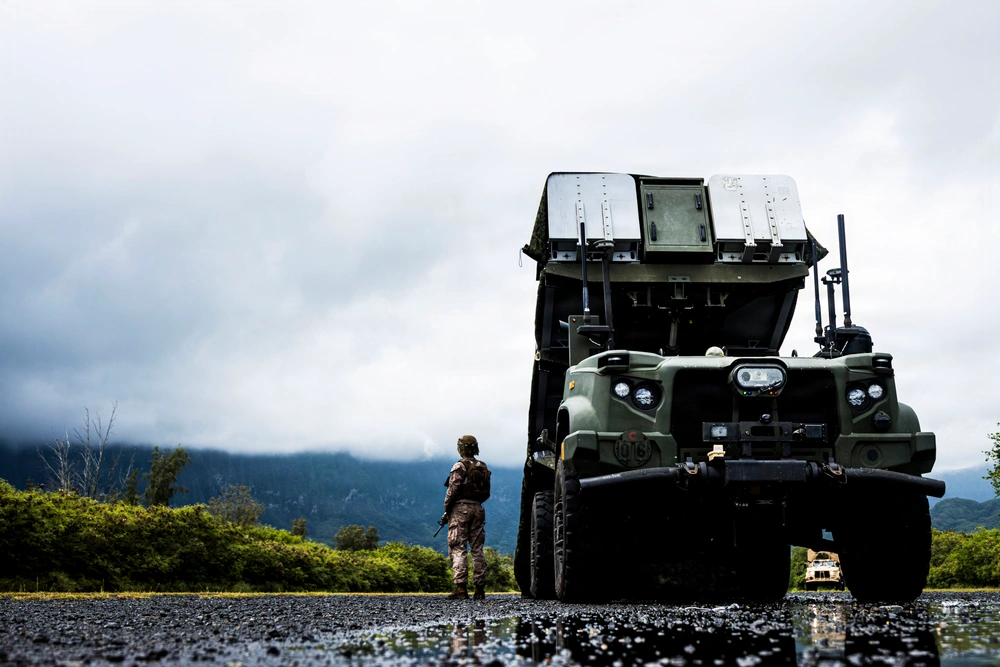
US Marines with the Medium-Range Missile Battery of 3rd Littoral Combat Team (LCT), 3rd Marine Littoral Regiment (MLR), completed a five-day training evolution at Marine Corps Training Area Bellows on Oahu, Hawaii, from September 28 to October 2, 2026, rehearsing fire mission processing, distributed command and control, and rapid displacement with the Navy-Marine Expeditionary Ship Interdiction System (NMESIS), the Marine Corps said in an October 6 release.
The training lands two weeks before Keen Sword 27, the biennial US-Japan field exercise scheduled for October 19 to 29, 2026, whose announced events include bilateral joint offensive anti-ship operations, according to Japan’s Joint Staff. On October 2, officials on Yonaguni, Japan’s westernmost inhabited island roughly 110 kilometers east of Taiwan, disclosed that Marine anti-ship and air defense systems will deploy there for the exercise, marking the first NMESIS deployment to Yonaguni. The 3rd MLR became the first unit to field NMESIS in November 2024; the Okinawa-based 12th MLR received it in June 2026. Ground-based anti-ship fires anchor the Corps’ Force Design restructuring, which divested tanks and most cannon artillery in favor of dispersed missile units.
How the Marine NMESIS Battery Rehearsed Distributed Fire Missions at Bellows
Platoons completed two courses of instruction. The first covered artillery tactics: reconnaissance, selection and occupation of firing positions, security, and rapid displacement, alongside NMESIS fire mission processing and procedures. The second drilled field skills, including patrolling, fire team attacks, tactical combat casualty care, and local security.
Command and control ran at both battery and platoon level. Marines stood up operations centers that functioned as distributed nodes, coordinating movement, processing targeting information, and directing simulated fire missions through each phase, according to the Marine Corps.
“The NMESIS is a critical component of the Marine Corps’ Force Design initiatives to meet the needs of the modern battlespace,” said Capt. Daniel Cook, the battery operations officer. “As a highly capable, mobile, and survivable system, it can effectively deny maritime threats access to critical waterways from distributed and austere sites.”
The weighting toward displacement and local security reflects the logic of Expeditionary Advanced Base Operations (EABO). A section firing from an island inside an adversary’s weapons engagement zone exposes its position at launch and must relocate before counter-battery fires arrive, often without a maneuver unit screening the site. Platoon-level operations centers also reduce dependence on a single battery headquarters that an adversary would target first.
The Bellows evolution builds on the regiment’s Marine Corps Combat Readiness Evaluation of February 6 to 11, 2026, when the same battery emplaced NMESIS at the Pacific Missile Range Facility on Kauai and executed simulated fire missions. Between the two events, the regiment deployed NMESIS to the Philippines for Balikatan 2026, held from April 20 to May 8.
NMESIS and the Naval Strike Missile: Range, Seeker, and Mobility
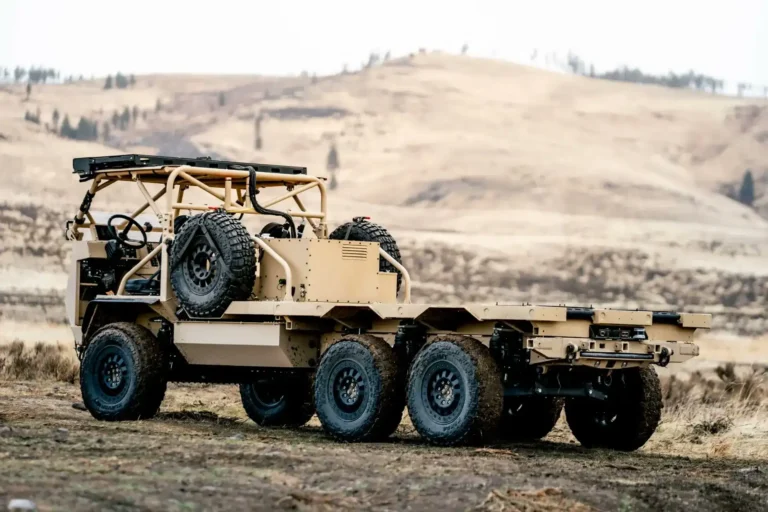
NMESIS pairs two Naval Strike Missiles (NSM) with an uncrewed launcher built on the Joint Light Tactical Vehicle (JLTV) chassis, known as the Remotely Operated Ground Unit for Expeditionary Fires (ROGUE-Fires). The launcher is driven remotely or follows a manned leader vehicle, and its weapon control system rides in a separate command vehicle, keeping Marines away from the launch signature.
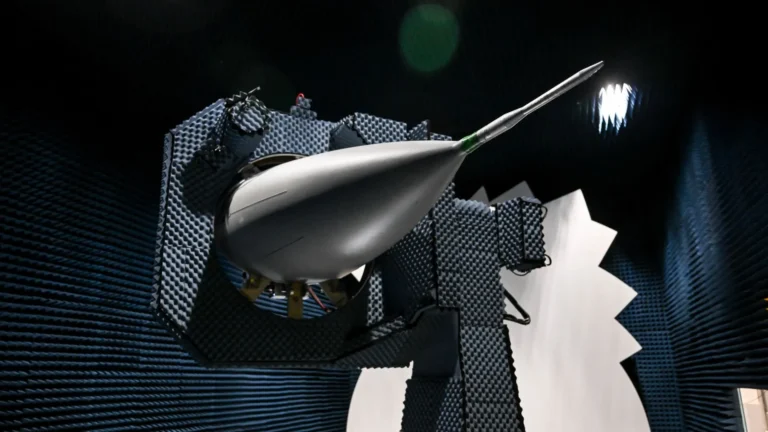
The NSM, developed by Norway’s Kongsberg and teamed with RTX in the United States, flies a high-subsonic, sea-skimming profile to ranges beyond 185 kilometers (100 nautical miles), with terminal homing by a passive imaging infrared seeker matched against an onboard target database.
The passive seeker matters operationally. Unlike radar-homing missiles such as the Harpoon, the NSM emits no radar energy in its terminal phase, denying shipboard electronic support measures an early cue and complicating jamming. The Corps proved the system on August 15, 2021, when Marines from 1st Battalion, 12th Marines struck a target ship with two NSMs at 100 nautical miles off Kauai during Large Scale Exercise 2021. The US Navy fields the same missile on its Littoral Combat Ships, giving both services a common munition and supply chain. NMESIS has also been airlifted by C-17 Globemaster III transports, and the Corps plans to shuttle launchers between islands aboard the future McClung-class Landing Ship Medium.
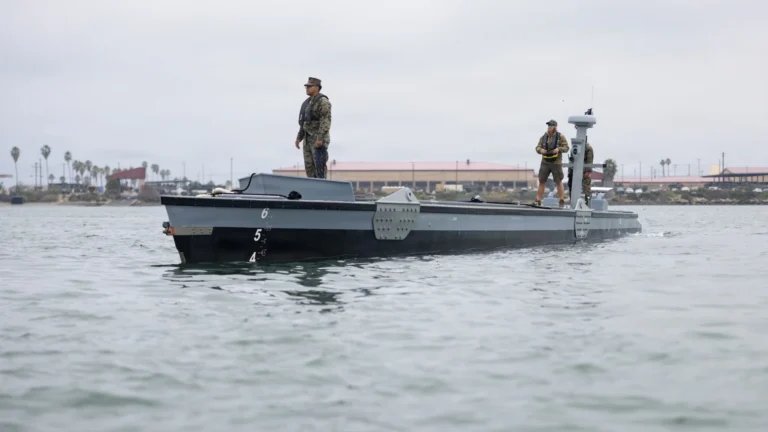
Analysis: The Bellows drills show where the Marine Littoral Regiment concept will succeed or fail: not in the missile, which is mature, but in the kill chain and the survival of the shooters. Each launcher carries only two rounds, so every engagement depends on off-board cueing, fast fire mission processing, and displacement before the battery is located. During KAMANDAG 9 in 2025, 3rd MLR networked NMESIS sections with a Navy P-8A Poseidon and littoral reconnaissance teams to prosecute simulated targets across the Luzon Strait. Reloads remain the constraint, despite uncrewed low-profile vessels the Corps has procured to ferry missiles forward. From Yonaguni, a missile with more than 185 kilometers of range covers waters off Taiwan’s east coast, which explains the criticism the planned deployment has drawn in China.
The Marine Corps has not disclosed how many launchers will move to Yonaguni for Keen Sword 27, whether any live fire is planned, or whether the systems will remain after the exercise; 3rd LCT’s launcher count is also undisclosed.