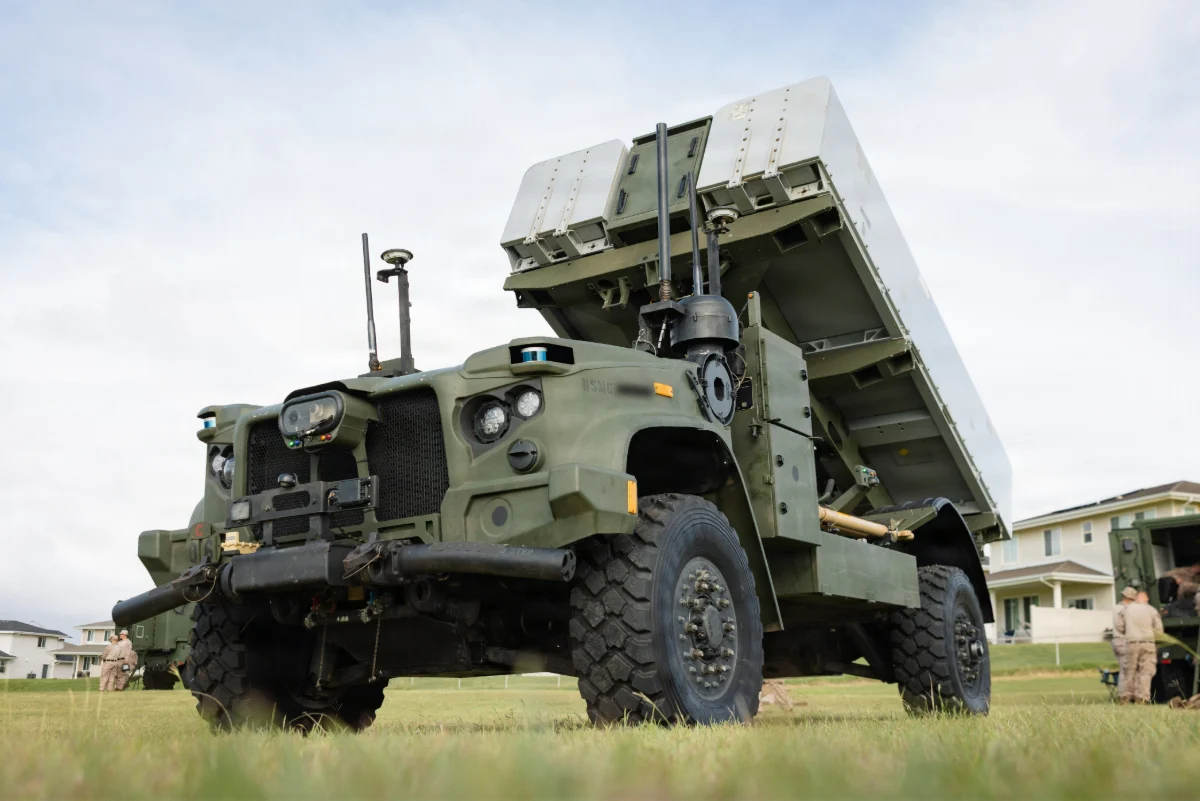
The U.S. Marine Corps will deploy its Navy-Marine Expeditionary Ship Interdiction System (NMESIS) to Yonaguni, Japan’s westernmost inhabited island, during the Keen Sword 27 exercise that opens October 19, 2026, Japanese media reported October 2, citing the Yonaguni town government. It will be the first time the ground-based anti-ship launcher operates from the island, which lies about 110 km (68 miles) east of Taiwan.
Keen Sword is the biennial field training phase of the Japan-U.S. bilateral joint exercise series, and this 18th iteration runs through October 29. Japan’s Joint Staff said on September 29 that the Japan Self-Defense Forces (JSDF) will commit approximately 45,000 personnel, 6,100 vehicles, 40 vessels and 260 aircraft, with Admiral Tateki Tawara, commander of the JSDF Joint Operations Command, and Admiral Stephen Koehler, commander of U.S. Pacific Fleet, serving as exercise controllers. Training events include integrated air and missile defense and bilateral joint offensive anti-ship operations. Australia, Canada, France, Germany, the Netherlands, New Zealand and the Philippines will also take part.
NMESIS Yonaguni Deployment: Launcher, Missile and Engagement Envelope
NMESIS mates the Remotely Operated Ground Unit for Expeditionary Fires (ROGUE-Fires), an uncrewed derivative of the Oshkosh Defense Joint Light Tactical Vehicle (JLTV), with a launcher holding two Naval Strike Missiles (NSM). The ROGUE-Fires chassis has no crew cab and runs in teleoperated or leader-follower mode, so Marines can emplace, fire and displace the launcher without exposing a crew at the firing point. That design targets the core problem of island-based fires inside an adversary’s weapons engagement zone: keeping launchers alive long enough to shoot more than once.
The NSM, designated RGM-184A in U.S. service, was developed by Norway’s Kongsberg Defence & Aerospace, teamed with Raytheon for U.S. programs. It is a sea-skimming missile launched by a jettisonable solid rocket booster and sustained at high subsonic speed by a Microturbo TRI-40 turbojet. Publicly available specifications indicate a range beyond 185 km (115 miles) and a titanium-cased blast-fragmentation warhead of roughly 120 to 125 kg with a programmable fuze. Navigation combines GPS-aided inertial guidance and terrain-reference navigation; terminal homing relies on an imaging infrared seeker matched against an onboard target database. The passive seeker emits no radar energy, denying a target’s electronic support measures an early cue.
From Yonaguni, that envelope covers the full channel to Taiwan’s east coast and the passage toward Iriomote. Japan’s Joint Staff reported in September 2024 that the People’s Liberation Army Navy (PLAN) carrier Liaoning transited between Yonaguni and Iriomote, the first Chinese carrier confirmed in those waters.
The launchers belong to the Okinawa-based 12th Marine Littoral Regiment (MLR), which formally received NMESIS and the Marine Air Defense Integrated System (MADIS) in June 2026. The Hawaii-based 3rd MLR fielded NMESIS first, in late 2024, and has since taken it to the Luzon Strait islands during Balikatan.
Keen Sword 27 Scope and Japan’s Expanding Surface-to-Ship Missile Force
The Japan Ground Self-Defense Force (JGSDF) will also bring surface-to-ship missiles with a range of several hundred kilometers to Yonaguni for the first time in an exercise, according to Japanese media reports. Officials have not named the variant. During Resolute Dragon in September 2025, Marines displayed an NMESIS launcher alongside the JGSDF’s Type 12 on Ishigaki, about 240 km from Taiwan, without firing; Yonaguni sits roughly 130 km closer.
On the main islands, the JGSDF plans to employ its upgraded Type 12 during Keen Sword activity at the Oyanohara training area in Kumamoto Prefecture, according to late-September press reports citing Defense Ministry officials. The weapon entered service at nearby Camp Kengun on March 31, 2026, under the new designation Type 25 Surface-to-Ship Guided Missile (25SSM). It extends the Type 12’s reach to about 1,000 km, placing parts of China within range from Kyushu. Keen Sword 27 would mark the first time Japan’s long-range stand-off missiles feature in an exercise.
Neither government has disclosed how many NMESIS launchers will go to Yonaguni, how long they will remain, or whether any missile will be fired on the island or in Kumamoto.
Yonaguni’s own garrison is growing. The JGSDF has operated a coastal observation unit there since March 2016, and an electronic warfare unit is slated to stand up in fiscal year 2026. Defense Minister Shinjiro Koizumi announced on February 24, 2026, that a Type 03 medium-range surface-to-air missile unit will deploy to the island in fiscal year 2030, which ends in March 2031. Japanese media reports anticipate local opposition to the continued missile presence.
Analysis: Keen Sword 27 rehearses two layers of one anti-ship architecture. NMESIS provides short-range, mobile, low-signature fires from the Japanese territory closest to Taiwan, while the 25SSM adds a 1,000 km outer layer from Kyushu. Exercising both under a training event Japan’s Joint Staff lists as bilateral joint offensive anti-ship operations shows the alliance now trains for combined sea denial across the Yonaguni-Taiwan gap and the Sakishima passages, not only for static island defense. The limiting factor is persistence: launchers that arrive for an 11-day exercise and leave impose a lighter planning burden on the PLAN than launchers based forward year-round.
Field training begins October 19. Indicators to watch include the number of NMESIS launchers landed on Yonaguni, whether MADIS or JGSDF air defenses cover the launch sites, whether the 25SSM conducts a live firing, and whether any NMESIS element stays in the Sakishima Islands after October 29. Beijing’s response, including PLAN activity near Yonaguni, is the other variable.