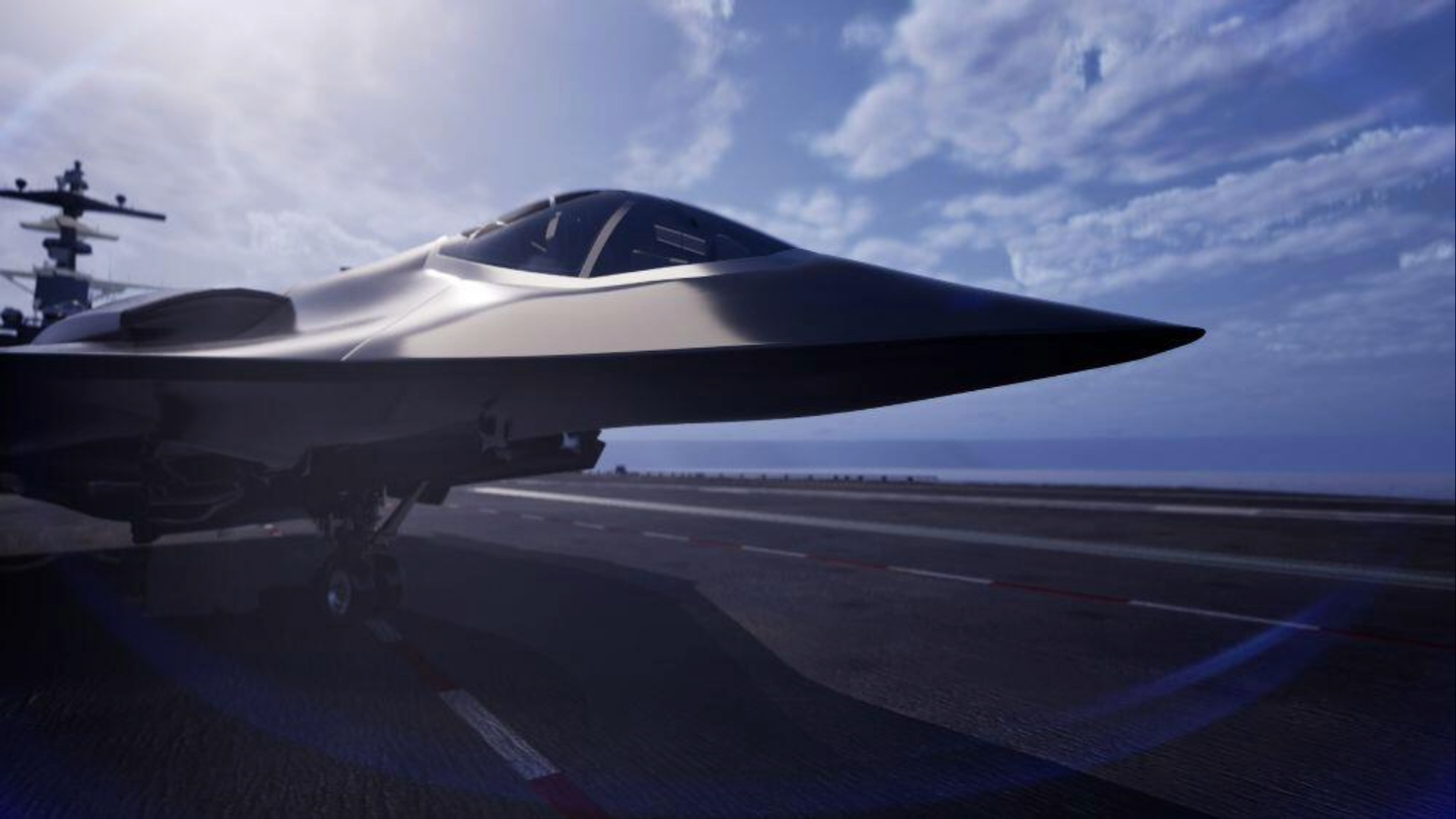
The US Navy is expected to name Boeing or Northrop Grumman as prime contractor for the F/A-XX this month, selecting the builder of its sixth-generation carrier fighter after roughly a year of delay. The f/a-xx program will move into engineering and manufacturing development and closes a two-way competition that narrowed in 2025 when Lockheed Martin was eliminated. Chief of Naval Operations Admiral Daryl Caudle said in April that the service had committed to an August 2026 downselect.
The decision follows a bruising fight over whether the program would survive in its current form. The White House sought to slow F/A-XX in favor of the Air Force’s F-47, and budget documents last year argued that proceeding was likely to delay that higher-priority effort. Congress rejected the reasoning and restored funding across several bills. The result is a program that Navy leaders and lawmakers treat as non-negotiable, advancing on a timeline Congress imposed rather than one the Pentagon sought.
What the F/A-XX Program Brings to the Carrier Air Wing
The F/A-XX is the crewed strike-fighter element of the Navy’s Next Generation Air Dominance family of systems. It is designed to replace the Boeing F/A-18E/F Super Hornet, in fleet service since 1999, and to absorb much of the electronic-attack mission now flown by the EA-18G Growler. It will operate alongside the Lockheed Martin F-35C rather than replace it.
The program’s defining requirement is reach. Publicly reported figures put its combat radius well beyond the Super Hornet’s, with open sources citing a target near 1,000 nautical miles against the roughly 390 nautical miles a Super Hornet covers unrefueled. The difference is doctrinal rather than incremental. Chinese anti-ship ballistic missiles such as the DF-21D and DF-26 are built to push carriers back beyond the reach of their own air wings, and a longer-legged fighter, tanked by the MQ-25A Stingray uncrewed refueler due to reach initial operational capability late in 2026, is the Navy’s method for keeping the carrier relevant in a contested Pacific.
The aircraft is also being built as the manned node of a manned-unmanned team, directing Collaborative Combat Aircraft that will push sensors, weapons, and jammers forward while the crewed jet stays back. Concept renderings from both competitors show a tailless planform with folding wings for carrier stowage, and the Navy has stressed an open, modular architecture to speed upgrades. Detailed performance data remain classified, and no in-service date beyond the 2030s has been set publicly.
Boeing Versus Northrop Grumman: Two Industrial Bets
The contest between the finalists is a choice between two industrial theories. Boeing already holds the Air Force’s F-47 sixth-generation contract, awarded in March 2025, and still builds the F-15EX and the last Super Hornets on a line set to close around 2027. A Boeing win would place two sixth-generation fighters under one roof, offering commonality in tooling, workforce, and stealth production, while loading a single prime with two clean-sheet fighter programs at once.
Caudle appeared to flag that risk. The Navy is “being very careful not to oversubscribe contractors who are already managing F-35 and other major programs,” he said, adding that “one of the contractors who would make this plane for us is in a place where they really can’t deliver in the timeframe we need it.” He described a “check twice, cut once” approach to the decision, remarks widely read as pointing to Boeing’s F-47 workload.
Northrop Grumman presents the opposite profile. It has not delivered a production fighter in more than five decades, but it builds the B-21 Raider and produced the carrier-capable X-47B demonstrator, both directly relevant to a stealthy naval aircraft. Chief Executive Kathy Warden has defended the company’s capacity, telling investors that Northrop and its suppliers are “prepared to bring the workforce and infrastructure that’s needed to execute the program” and citing the B-21 as proof it can deliver complex classified aircraft on schedule. A Northrop award would avoid any fighter-line conflict, at the cost of the scale a shared F-47 base might offer.
A Generational Contract on a Contracting Industrial Base
The award lands against a sharp gap between rhetoric and resources. Navy leaders call the F/A-XX one of their most important modernization efforts, yet the fiscal 2027 request seeks just $140 million for it, split between $68 million in discretionary funds and $72 million contingent on a future reconciliation package. The F-47, by contrast, is slated for roughly $5 billion in the same request, with a first flight targeted for 2028. In fiscal 2026 the F/A-XX eventually drew close to $1.7 billion, but Congress added the great majority after the administration requested a token sum near $74 million.
That pattern collides with the state of the industrial base meant to build the jet. By one widely cited count, the number of prime contractors able to design and integrate advanced combat aircraft has fallen from 51 to five, and roughly 17,045 defense firms have left the sector in the past five years. Those same five primes now underpin the F-47, the F-35, and the B-21 at the same time, a concentration that leaves little margin if any one program slips.
This is what the downselect actually tests. Deputy Secretary of Defense Steve Feinberg has taken part in deliberations weighing not only which design best meets Navy requirements but which company can add a sixth-generation fighter without destabilizing existing work. The White House’s stated preference for the F-47 sharpens the problem: if the department will not fund two sixth-generation fighters aggressively at once, the F/A-XX winner inherits a mandate without the money to match it.
Analysis: The identity of the winner matters less than what the award reveals about how the Navy intends to modernize. The service is committing to a generational carrier fighter on an industrial base that visibly cannot absorb every program at once, and it is doing so with a fiscal 2027 request funding the effort at a fraction of its stated priority. The downselect is therefore as much a bet on industrial capacity, and on Congress continuing to backfill, as it is a judgment about which airframe should fly.
The immediate milestone is the award itself, expected within weeks, which moves the winner into engineering and manufacturing development. The next test is the fiscal 2027 appropriations cycle, where the lawmakers who forced the program forward once will decide whether to do so again over the administration’s thinner request. The MQ-25A’s initial operational capability, due late in 2026, will show how quickly the uncrewed half of the future air wing matures. A firm in-service date, a stable funding line, and a settled production plan all remain open questions.