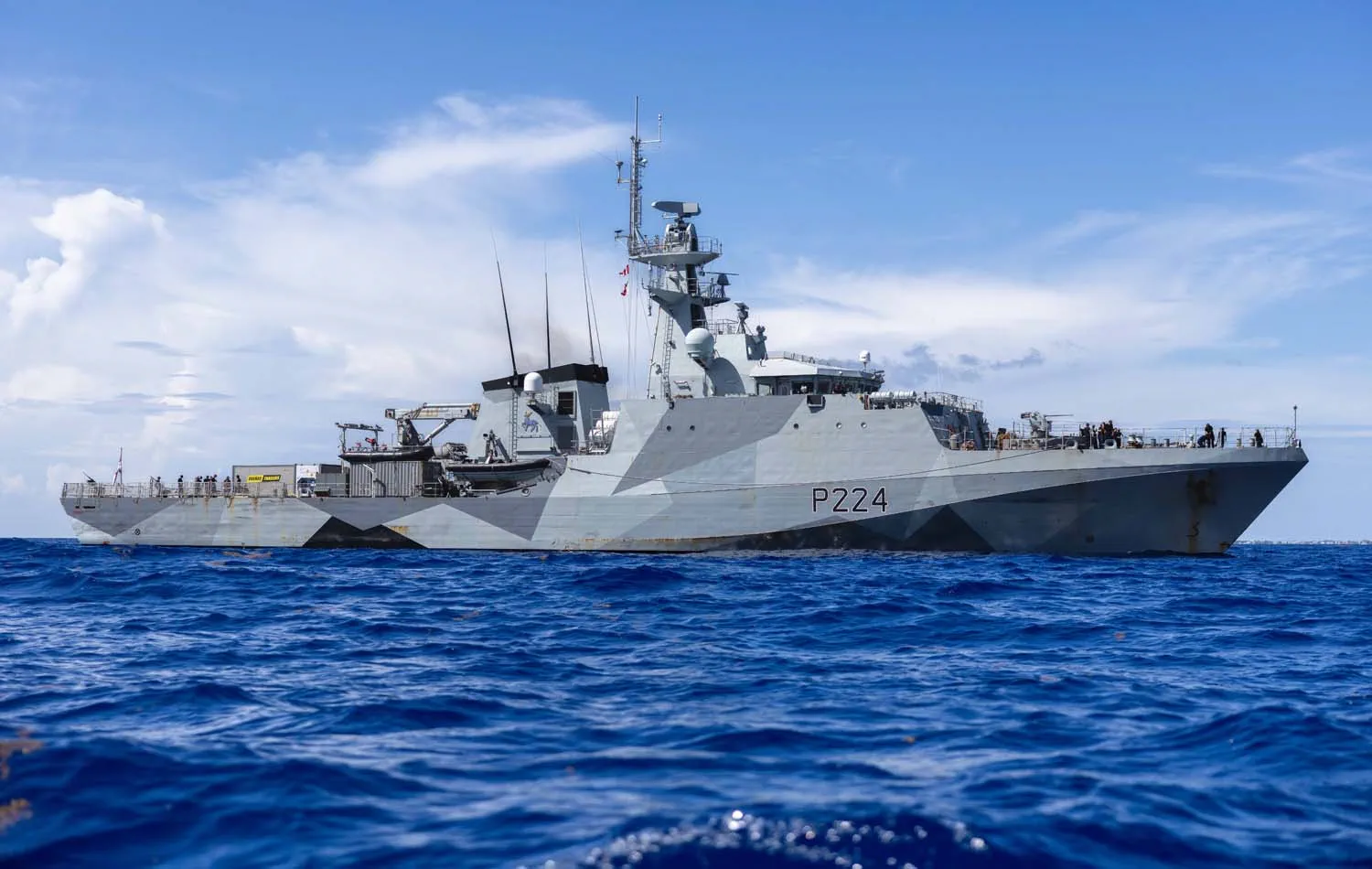
The Royal Navy offshore patrol vessel HMS Trent (P224) has wrapped up a two-day port call in George Town, Grand Cayman, where its embarked Crisis Response Troop from 24 Commando Royal Engineers trained with the Cayman Islands Regiment (CIR) and drone operators from 700X Naval Air Squadron worked with the Cayman Islands Coast Guard (CICG), the Royal Navy announced on October 7, 2026.
The Cayman stop follows earlier calls in the British Virgin Islands and the Turks and Caicos Islands as the Portsmouth-based River-class Batch 2 ship works through the 2026 hurricane season on Atlantic Patrol Task (North). Trent sailed from Plymouth in early May for counter-narcotics patrols and humanitarian assistance and disaster relief (HADR) readiness under Operation Ventus, the codename for the ship’s relief missions. The announcement comes as the region enters October, the second climatological peak of the Caribbean storm season.
How HMS Trent’s Commando Engineers Trained With the Cayman Islands Regiment
The engineering exchange ran in both directions. The CIR, which the Royal Navy credits as a regional leader in Urban Search and Rescue (USAR), ran practical and classroom sessions for the troop. The culminating scenario had personnel cut through concrete, enter a collapsed building, stabilise a casualty and recover them safely, the core sequence of post-storm structural collapse rescue.
The Royal Engineers reciprocated with instruction on diggers and other heavy plant, chainsaw work and vehicle recovery. Those skills govern the first days after landfall, when debris decides whether relief convoys can move at all.
Established in 2019, the CIR is a predominantly reservist unit under the Cayman Islands Ministry of Home Affairs, focused on disaster support to civil authorities. Its vehicle park of JCB backhoes, Unimog trucks and wheeled loaders mirrors the troop’s own equipment. In December 2025, CIR instructors delivered USAR training abroad for the first time, to Trinidad and Tobago forces during Exercise Soter. Its Commanding Officer, Lieutenant Colonel Graham Muir, said the regiment is “increasingly able to contribute capability back to the UK” and to regional partners.
Trent’s ship’s company also held joint briefings with Hazard Management Cayman Islands (HMCI), the CICG, the CIR and the Royal Cayman Islands Police Service (RCIPS) Air Operations Unit, and hosted Governor Jane Owen on board. The relationship predates this patrol: Trent arrived off Grand Cayman on July 5, 2024, after an official assistance request from the governor as Hurricane Beryl approached, and in November 2025 it landed a Royal Engineers troop at Falmouth, Jamaica, after Category 5 Hurricane Melissa.
Scout Flight Drones and the River-Class Batch 2 Aviation Gap
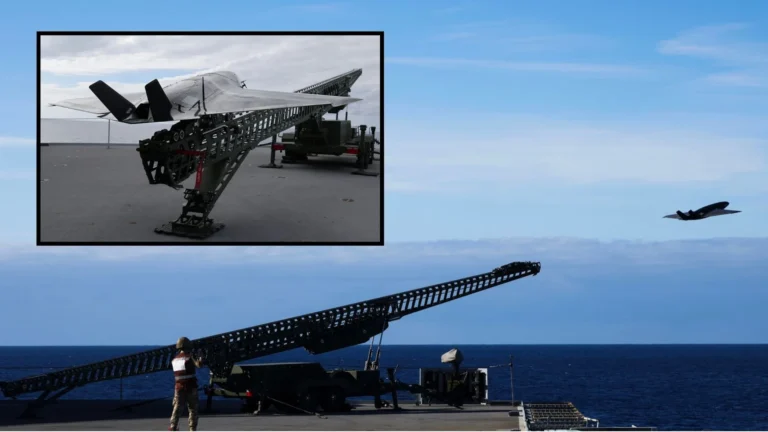
Scout Flight of 700X Naval Air Squadron showed the CICG how small drones could fly from its patrol boats for search and rescue, surveillance and situational awareness. Flight Commander Lieutenant Charles Harper praised the CICG’s professionalism and willingness to adopt new technology. The Royal Navy did not identify the systems flown in Grand Cayman; in Turks and Caicos, Scout Flight fielded the hand-launched AeroVironment Puma fixed-wing drone and the Parrot Anafi quadcopter.
The heavier asset aboard is the Malloy T-150B quadcopter, which the Royal Navy rates at a 68 kg payload, 40 minutes of endurance and a top speed of 60 mph. On August 21, 2026, the Navy announced that Trent had become the first River-class Batch 2 ship to launch and recover the system from a moving flight deck.
That capability matters because of what the hull lacks. Publicly available specifications indicate the BAE Systems-built Batch 2 design displaces about 2,000 tonnes on a 90.5 m hull, with two MAN 16V28/33D diesels delivering 24 knots and a range of 5,500 nautical miles. Armament comprises a 30 mm cannon, two miniguns and general-purpose machine guns. The flight deck accepts a Merlin-sized helicopter, but there is no hangar and no embarked aircraft. Accommodation for up to 50 additional troops is what lets Trent carry the Crisis Response Troop and its plant.
After a storm, that leaves boats and the troop’s vehicles as the main ship-to-shore links. A 68 kg drone cannot match a helicopter’s lift, but it can move medical kits, water or radios across a severed road or wrecked quay in minutes, while smaller drones give commanders imagery before anyone goes ashore.
Analysis: The Cayman visit shows how lean the UK’s Caribbean disaster posture is, and how the Royal Navy is working around it. A single helicopter-less offshore patrol vessel carries the maritime share of Operation Ventus; in December 2025 the Ministry of Defence told Parliament it had no plans to add another warship during hurricane season. With one hull covering territories across the Caribbean, outcomes after landfall depend on what local forces can do before Trent arrives. Training reservist regiments in heavy plant and coast guards in drone employment multiplies a modest platform’s effect, and the USAR expertise flowing from Cayman to British engineers shows the territories contributing capability, not only receiving it. The Malloy trial adds a second lever: routine heavy-lift drones would give patrol vessels a low-cost aviation layer they were never designed to carry.
The Atlantic season runs to November 30. The 2026 basin went past September 11 without a hurricane, a satellite-era record for the latest first hurricane, but late-season western Caribbean storms remain Trent’s core planning case. The Royal Navy has not released the ship’s remaining itinerary or the date of its Caribbean handover. The next marker is whether the Malloy earns a defined ship-to-shore role in Ventus planning.