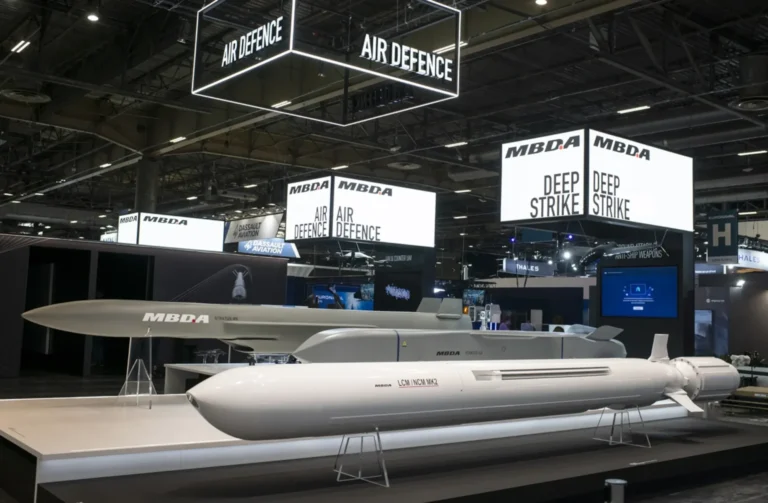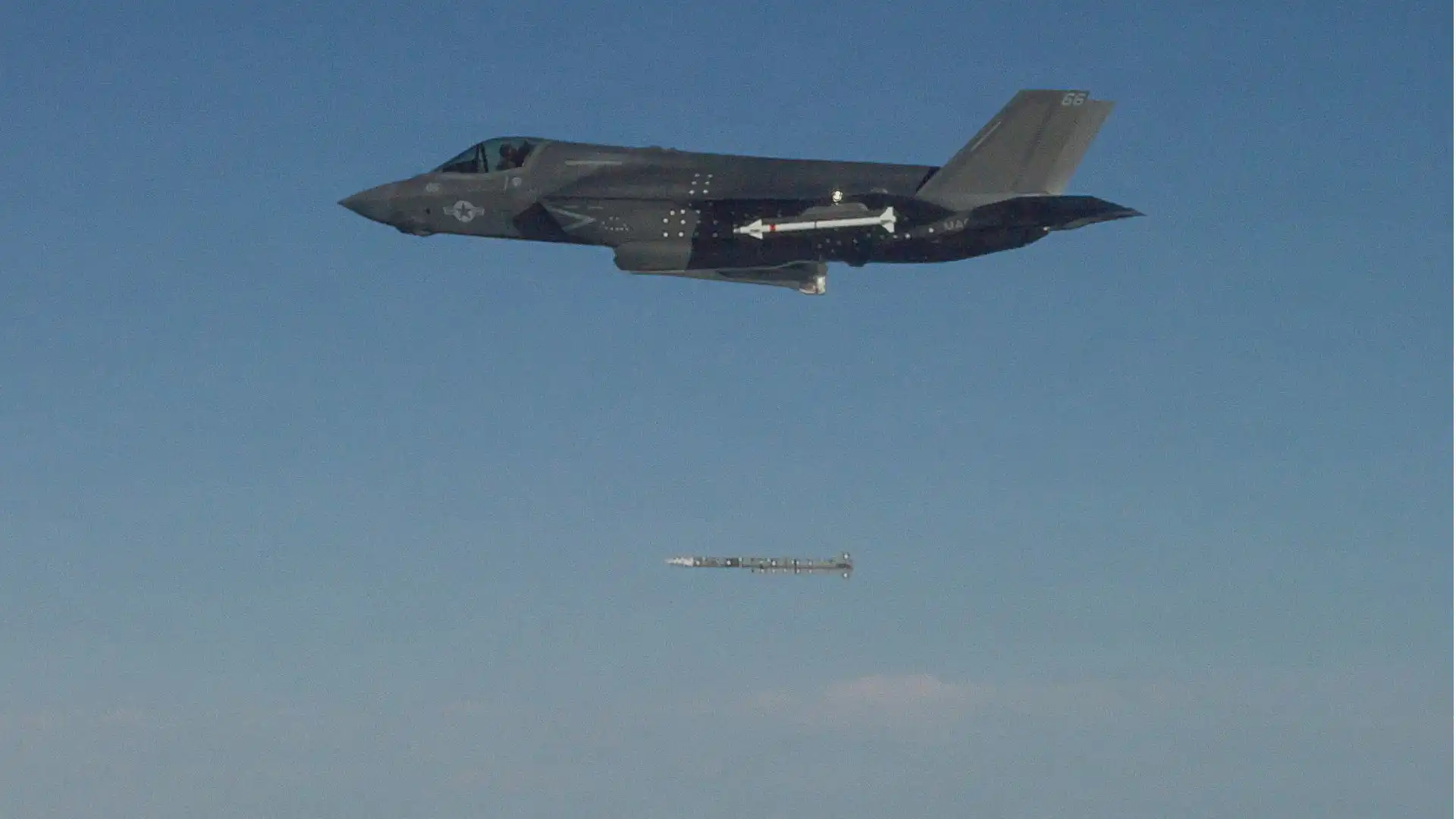
MBDA’s Meteor beyond-visual-range air-to-air missile (BVRAAM) separated from the internal weapons bay of an F-35B Lightning II for the first time on October 7, 2026, during a jettison flight trial at Naval Air Station (NAS) Patuxent River, Maryland. A Royal Navy test pilot flew the sortie, which released an inert test asset and opens a series of separation trials that will culminate in live firings, according to MBDA and the F-35 Joint Program Office (JPO).
The trial comes in a program defined more by schedule slippage than by technical risk. Integration work began in March 2019, when BAE Systems received initial funding from Lockheed Martin, and a September 2021 award funded completion of Meteor integration on the F-35A and F-35B for the United Kingdom and Italy. The UK leads the F-35B effort; Italy sponsors the F-35A. Early plans pointed to the middle of this decade, but the UK government now expects in-service capability in the early 2030s, tied to the F-35’s delayed Block 4 modernization.
Meteor F-35B Jettison Trial at Naval Air Station Patuxent River
Jettison testing confirms that a store separates cleanly from its host aircraft in normal or emergency release without striking the fuselage, damaging structure or upsetting the jet’s flight dynamics. Internal carriage makes the problem harder, because the missile must clear the bay through the unsteady airflow that forms once the doors open at speed.
According to the JPO, the missile cleared the F-35B safely in that environment with its rocket motor unlit and its control surfaces inactive. That configuration isolates the pure aerodynamic separation event. MBDA said the flight data will refine the predictive digital models used to assess weapon release characteristics, the same models that will clear later, more demanding release points.
A combined UK and US team within the F-35 Integrated Test Force (ITF), drawn from the Royal Navy, the Royal Air Force (RAF) and Lockheed Martin, prepared and loaded the test asset. The pilot is assigned to the UK’s Air and Space Warfare Centre (ASWC) and embedded in the ITF. The UK Ministry of Defence, the US Department of Defense, the Italian Ministry of Defence, BAE Systems and Northrop Grumman supported the effort alongside MBDA and Lockheed Martin.
The release builds on earlier milestones. The first Meteor carriage flight on an F-35 took place on November 20, 2024, when F-35B test aircraft BF-18 flew from Patuxent River with an inert round to gather environmental data. For the F-35A, ground vibration testing and weapons bay fit checks at Edwards Air Force Base, California, were announced in December 2025, and the 461st Flight Test Squadron loaded a Meteor test asset into an F-35A for pit testing at Edwards on January 16, 2026.
Ramjet Kinematics, Clipped Fins and the Internal Carriage Challenge
Meteor was developed for six partner nations, the UK, France, Germany, Italy, Spain and Sweden, and is operational on the Saab Gripen, Eurofighter Typhoon and Dassault Rafale. Manufacturer data lists a weight of 190 kg, a length of 3.7 m and a diameter of 178 mm, with both rail and ejection launch capability; ejection is the mode internal carriage requires.
Propulsion is a solid-fuel, variable-flow ducted rocket, a throttleable ramjet supplied by Germany’s Bayern-Chemie. Unlike the boost-and-coast AIM-120 AMRAAM that equips UK F-35Bs today, the motor sustains thrust up to intercept, which MBDA credits with a larger no-escape zone than any comparable system. Publicly available specifications indicate a speed in excess of Mach 4 and a range beyond 100 km, while Royal Navy material cites engagements out to 120 miles. Guidance pairs inertial mid-course navigation and a two-way datalink for target updates or retargeting with an active radar seeker for terminal homing. A blast-fragmentation warhead uses impact and proximity fuzing.
Internal carriage required airframe changes. The standard Meteor’s tail fins are too large for the F-35 bay, so MBDA developed a version with fins reduced in height and lengthened to preserve control surface area and kinematic performance. Earlier industry disclosures described one Meteor per internal bay on the F-35B, whose bays are shorter than those of the F-35A; the certified internal loadout for either variant has not been published. MBDA and Lockheed Martin present the pairing of Meteor’s datalink with the F-35’s sensor suite as the core rationale for the integration.
Analysis: The jettison trial retires the first separation risk, but the pacing item for Meteor on the F-35 remains software rather than the missile. Integration rides on Block 4, which depends on the troubled Technology Refresh 3 (TR-3) computing upgrade, and the US Government Accountability Office reported in September 2025 that even a reduced Block 4 capability set will not be complete before 2031. Until then, the UK’s carrier-based F-35B force keeps relying on AMRAAM while RAF Typhoons already field Meteor, an uneven long-range posture as China’s PL-15 extends the reach of opposing fighters. A cleared Meteor would also open a non-US long-range option to other European F-35 operators, including Germany, a Meteor partner nation now acquiring the F-35A.
MBDA said Meteor will fly a series of release profiles over the coming months to validate safe separation across the F-35’s operational envelope, ending in live firings that confirm both separation and fly-out performance. No date has been given for the first guided shot, and MBDA’s announcement did not address the F-35A flight-test schedule. The decisive milestone remains the Block 4 software release that will carry Meteor into UK and Italian service.