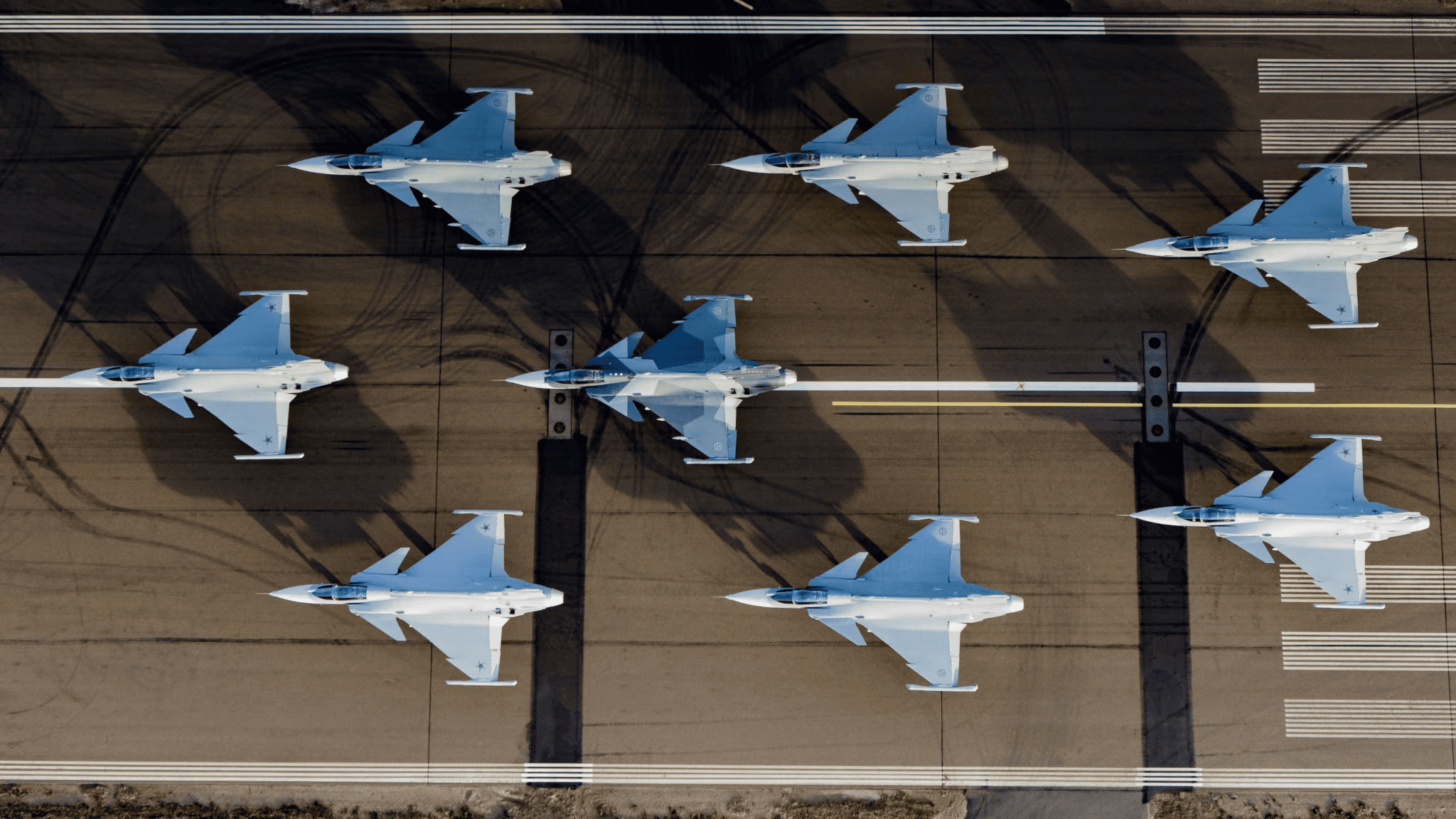
Saab and GKN Aerospace have signed a cooperation agreement on engine and propulsion systems for the Gripen E/F fighter, Saab announced on October 8, 2026. The deal lays the foundation for GKN Aerospace to become Saab’s partner on engine-related matters for the aircraft and follows a recent Swedish government decision to strengthen national capability and expertise on the Gripen E engine.
The government has tasked the two companies with jointly creating the conditions to meet that objective. The agreement extends to the new fighter a partnership already in place on the Gripen C/D, and it arrives as the Gripen E/F order book grows: Sweden has 60 aircraft on order, Brazil 36, Colombia 17 and Thailand four. On June 30, 2026, Saab also signed a contract worth approximately SEK 24.6 billion with the Swedish Defence Materiel Administration (FMV) for 16 Gripen E destined for Ukraine.
From RM12 to RM16: GKN’s Path to the Gripen E Engine
Johan Segertoft, head of Saab’s Gripen business unit, said the agreement “lays the foundation for establishing GKN Aerospace as Saab’s partner in engine-related matters for Gripen E/F.” According to Saab, GKN Aerospace will progressively assume a greater role on the engine and provide expertise, capacity and technical support to the program.
GKN’s Swedish subsidiary in Trollhättan, the former Volvo Aero acquired in 2012, is the original equipment manufacturer and military type certificate holder for the RM12, the General Electric F404 derivative that gives the Gripen C/D 80.5 kN (about 18,100 lbf) of afterburning thrust. The site has supported the engine since the Gripen entered Swedish service in 1997 and leads the RM12EP (Enhanced Performance) upgrade, launched in 2019 and funded through an order worth approximately SEK 400 million. The first upgraded engine reached the Swedish Armed Forces on March 24, 2026.
The Gripen E/F uses a different powerplant, the RM16, Sweden’s designation for the GE Aerospace F414G, a single-engine variant of the F414-GE-400 fitted to the Boeing F/A-18E/F Super Hornet. Publicly available specifications place it in the 22,000 lbf (98 kN) thrust class with afterburner and at about 13,000 lbf (57.8 kN) at military power, with full authority digital engine control (FADEC) and a thrust-to-weight ratio in the 9:1 class. That gain of roughly 20 to 25 percent over the RM12 underwrites the Gripen E’s heavier airframe, larger internal fuel load and 10 weapon hardpoints.
On the RM16, however, GKN’s role has been narrower. FMV selected the company in early 2020 as product support and maintenance, repair and overhaul (MRO) provider for the engine, including spare parts supply, and GKN completed its first RM16 test-cell run at Trollhättan in October 2022. Saab’s announcement does not say whether the expanded role will reach engineering authority, component manufacturing or certification duties comparable to those GKN holds on the RM12.
Engine Sovereignty, Gripen Exports and Sweden’s Future Fighter Studies
For a single-engine fighter, engine availability is aircraft availability. Swedish air doctrine relies on dispersed operations from short and improvised strips, including closed road sections, which puts a premium on rapid troubleshooting and module replacement close to the flight line. National engineering depth on the RM16 shortens that support chain in a crisis, when transatlantic logistics and engineering assistance could be delayed or disrupted.
The engine fleet is also expanding well beyond Swedish service. Firm Gripen E/F orders now total 133 aircraft across five customers, and Ukraine’s 16 jets, due for delivery to FMV in 2029 and 2030, will operate at combat tempo, placing sustained demand on spares and overhaul capacity. As a US-origin engine, the F414G remains subject to US export controls, and Saab did not address the position of GE Aerospace, the engine’s original equipment manufacturer. Other F414 users have secured deeper industrial roles: Hanwha Aerospace license-produces the F414-GE-400K for South Korea’s KF-21 Boramae, and Hindustan Aeronautics Limited signed a memorandum with GE in June 2023 on F414 co-production for India’s Tejas Mk2.
The agreement also connects to Sweden’s search for a Gripen successor. In September 2026, FMV awarded Saab a SEK 2.9 billion contract for flying and ground demonstrators and for crewed and uncrewed system concepts, and GKN Aerospace a SEK 390 million contract covering thermal management, onboard electrical power and propulsion-related technologies, both running through 2028. Stockholm is weighing a national program, international cooperation or a foreign purchase, with a decision expected around 2030. Propulsion engineering skills retained and expanded at Trollhättan through RM16 work would feed directly into either of the first two paths.
Analysis: The agreement targets an asymmetry built into the Gripen transition. On the RM12, Sweden holds OEM status and type certification in-country; on the RM16, its national role has been confined to support and overhaul. By directing Saab and GKN Aerospace to narrow that gap, the government is treating propulsion know-how as a component of operational sovereignty for a single-engine fleet expected to serve into the 2040s, while preserving the engine workforce Sweden would need for any domestic or collaborative successor program.
Key terms remain undisclosed, including the agreement’s value and duration, the specific responsibilities GKN Aerospace will assume, the timeline for that transfer and the role of GE Aerospace. The next markers are any FMV contract implementing the government’s decision, the pace of Gripen E deliveries following the Swedish Air Force’s first handover at F 7 Såtenäs on October 20, 2025, and the future fighter decision expected around 2030.