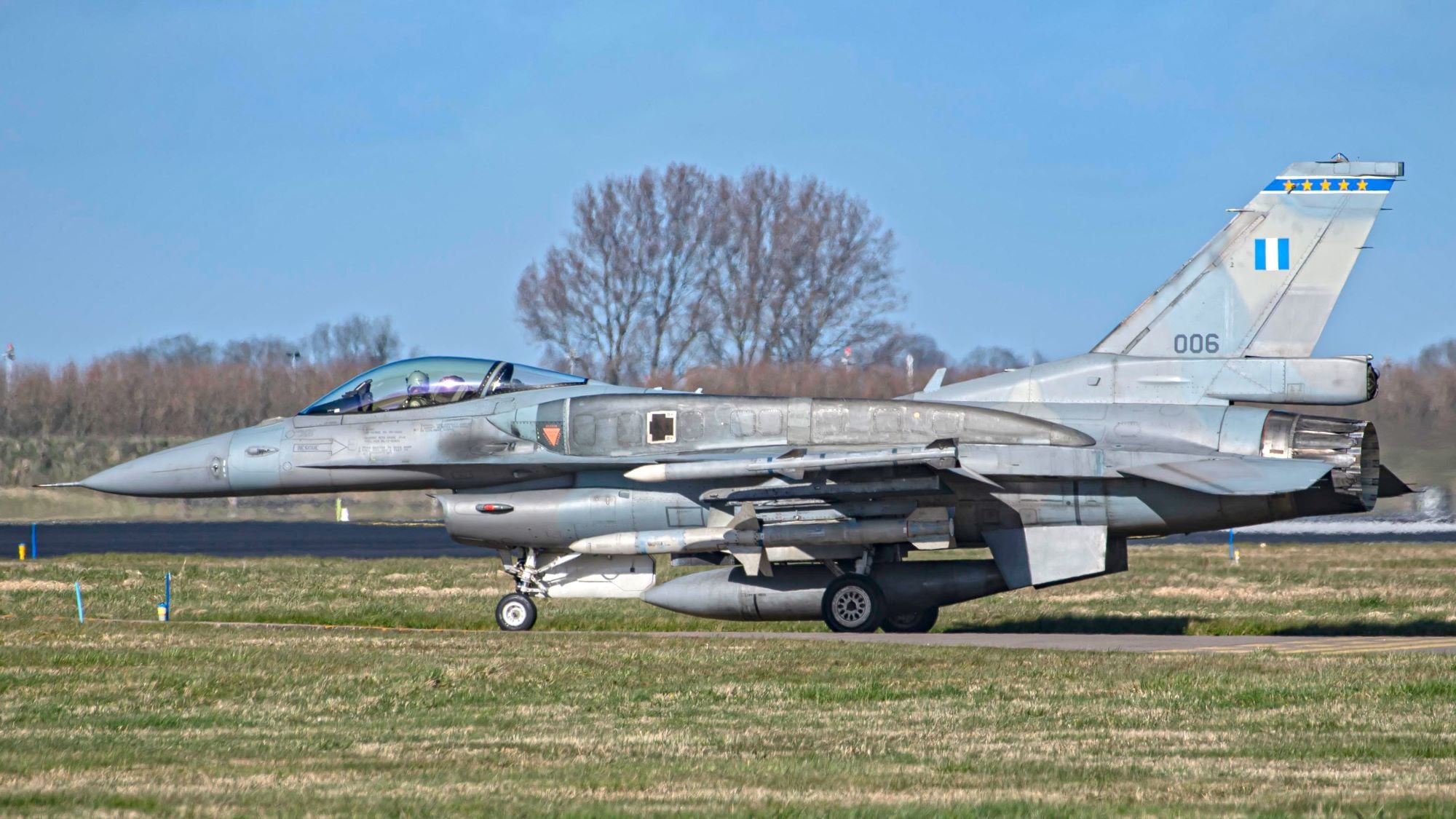
Greece has agreed to spend up to $4 billion upgrading more of its F-16 fighters and buying advanced US missiles and bombs, two senior Greek officials said on October 8, 2026, a day after Secretary of State Marco Rubio led the US delegation at the sixth US-Greece Strategic Dialogue in Athens. A senior defense ministry official said the package covers munitions for the Hellenic Air Force’s F-16 Viper and F-35 fleets and the Hellenic Army’s Black Hawk helicopters, plus Viper conversions for older F-16s.
The commitment sits on top of roughly €28 billion Athens already planned to spend through 2036 on F-35 fighters, helicopters and Achilles Shield, a multilayer air and missile defense network built around Israeli systems. Officials said most of the new items already fall within the multiyear defense plan, with costs spread over several years. Greece spends nearly 3.5% of gross domestic product on defense, above many NATO allies, driven by its long-running dispute with Türkiye. Rubio also announced a joint counterterrorism information-sharing plan on October 7.
What the Greece Arms Deal Adds to the F-16 Viper Fleet
The aircraft component extends an upgrade line already in production. Hellenic Aerospace Industry (HAI) and Lockheed Martin are converting 83 F-16 Block 52+ and Block 52+ Advanced jets to the F-16V configuration at HAI’s Tanagra facility. The Hellenic Air Force accepted its 60th upgraded aircraft on September 16, 2026, taking the program past two-thirds completion, and deliveries are scheduled to continue through 2027.
The modification brings the jets close to the new-build Block 70/72 baseline. Its core is the Northrop Grumman AN/APG-83 Scalable Agile Beam Radar (SABR), an active electronically scanned array that, according to publicly available specifications, offers longer detection range, interleaved air-to-air and air-to-ground modes and stronger jamming resistance than the mechanically scanned APG-68 it replaces. A new mission computer, modern cockpit displays and Link 16 integration complete the package. To contain cost, Athens retained weapons already integrated on its F-16s, including the IRIS-T short-range missile and LANTIRN targeting pods, leaving modern US munitions as a separate purchase. The radar matters here: a longer-range missile adds little without a sensor able to cue it at matching distances.
The second tranche targets older airframes. Athens plans to bring 38 F-16C/D Block 50 aircraft, delivered in the late 1990s and based at Nea Anchialos, to the same standard for about $1 billion, with HAI starting work once the Block 52+ line clears in 2027. Completion would leave Greece with 121 F-16 Vipers by 2037 under current planning, a single standard that simplifies training, spares and software management as the F-35 enters service.
Munitions Athens Has Requested for Its F-35A and Viper Fleets
Neither official named the specific weapons. Greek press reports before the dialogue said Athens had already submitted a Letter of Request for price and availability covering the AIM-120D Advanced Medium-Range Air-to-Air Missile (AMRAAM), AIM-9X Sidewinder Block II/II+, AIM-260 Joint Advanced Tactical Missile (JATM), AGM-158B Joint Air-to-Surface Standoff Missile-Extended Range (JASSM-ER), GBU-53/B StormBreaker glide bomb and air-launched AGM-84 Harpoon. Which of these fall inside the $4 billion ceiling remains unconfirmed.
Athens renewed its AIM-120D request in November 2025 for its incoming F-35As, citing Türkiye’s acquisition of MBDA’s Meteor for its Eurofighter Typhoons. Publicly available specifications indicate the AIM-120D adds a two-way datalink, GPS-aided navigation and longer range than the AIM-120C variants Greece already flies. The AIM-260, designed for internal carriage in stealth fighters, remains classified, and Washington has not publicly announced any export release.
On the strike side, publicly available figures put JASSM-ER range above 900 km with a 450 kg-class penetrating warhead, while StormBreaker’s tri-mode seeker, combining millimeter-wave radar, imaging infrared and semi-active laser, lets it hit moving targets in poor weather. Air-launched Harpoon would give the Vipers an anti-ship option over the Aegean. The same reports flagged supply risk as US demand for JASSM-ER climbs.
The weapons will arm aircraft already on order. Greece signed for 20 F-35As in July 2024 at about $3.5 billion, with an option for 20 more and deliveries from 2028; the jets will base at Andravida once US-based training ends around 2030. The Hellenic Army’s 35 UH-60M Black Hawks, approved in December 2023 at an estimated $1.95 billion, are due from 2027 to replace UH-1H Hueys.
Analysis: The package shows Athens anchoring its combat aircraft and munitions to US systems even as it diversifies elsewhere, flying Meteor-armed Rafales and signing a €3.035 billion Achilles Shield contract with Israel on August 31, 2026. The air-to-air requests answer Türkiye directly: excluded from the F-35 program since 2019 over its S-400 purchase, Ankara is fielding Meteor-armed Eurofighter Typhoons while pursuing 40 F-16 Block 70s. For Washington, the deal feeds Lockheed Martin, RTX and Boeing production lines and reinforces a partner hosting US forces at Souda Bay. Release authority is the decisive variable: clearing the AIM-120D and AIM-260 would lock in an air-to-air edge Ankara is likely to contest in its own talks with Washington.
The package now moves through the Foreign Military Sales process: State Department approval and congressional notification for major cases, then Letters of Offer and Acceptance fixing quantities, prices and schedules. Athens also awaits the Block 50 acceptance letter, the end of Block 52+ deliveries in 2027 and its first F-35s in 2028. The open questions are whether Washington clears the AIM-120D and AIM-260, and how the $4 billion divides between upgrades and munitions.