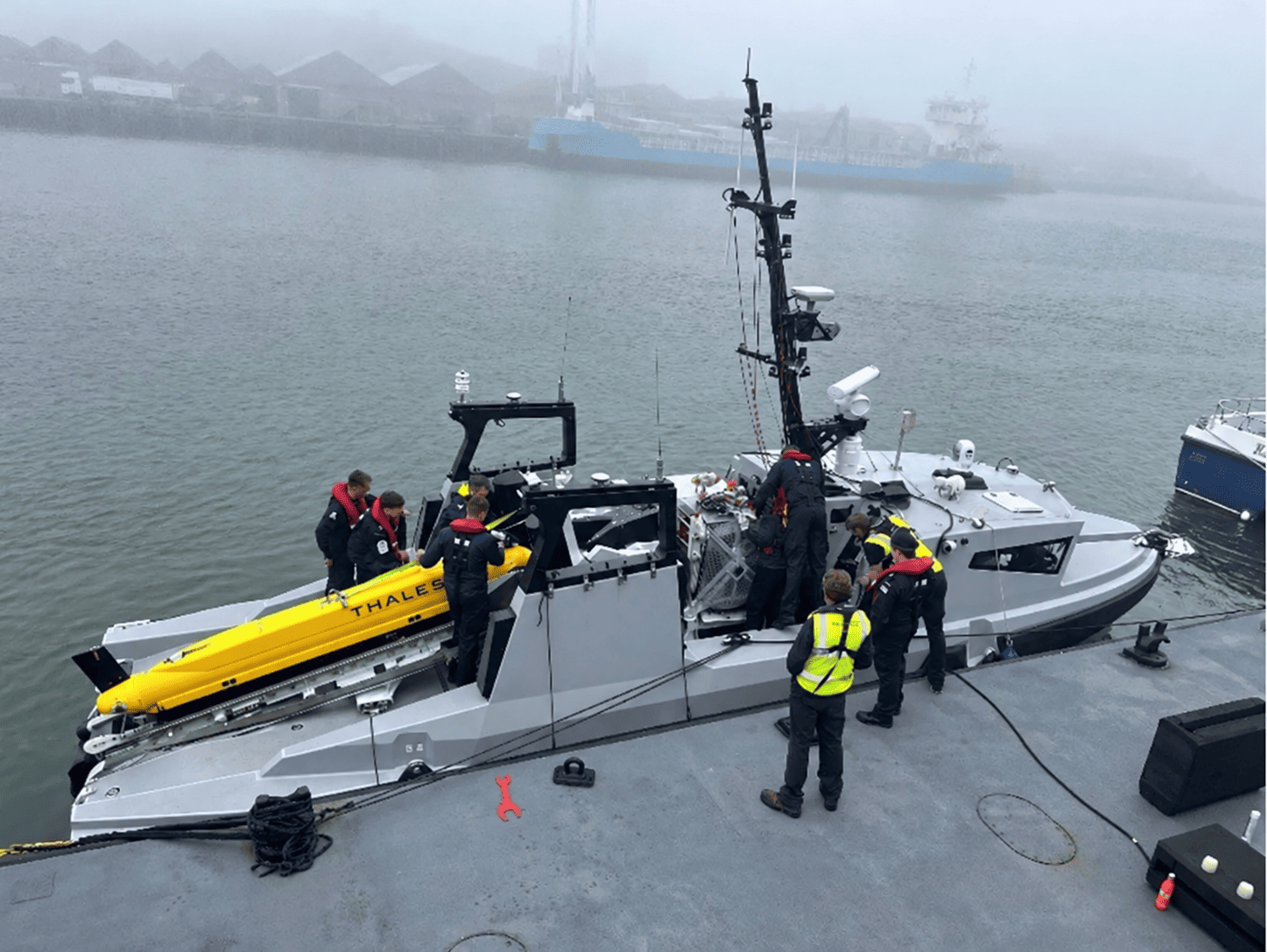
Royal Navy mine warfare specialists in Zulu Squadron have completed training on three new autonomous mine countermeasures systems and moved into sea trials, the service said on October 8, 2026. By year’s end, the squadron, part of the Mine and Threat Exploitation Group (MTXG), will have taken delivery of the Thales Maritime Mine Counter Measures (MMCM) system, the TKMS SeaCat medium uncrewed underwater vehicle (UUV) and the TKMS Sweep Portable System.
The milestone comes as the service’s autonomous mine countermeasures force moves from trials into operations. Since the US-Israeli air campaign against Iran began on February 28, 2026, MTXG teams have deployed aboard RFA Lyme Bay to stage for a UK-France-led mission to reopen the Strait of Hormuz. At home, Defence Equipment and Support is replacing crewed minehunters with uncrewed systems, a core plank of the 2025 Strategic Defence Review’s hybrid navy model.
Royal Navy Mine Warfare Squadron Restructures Around Three New Systems
MTXG is headquartered at HM Naval Base Clyde and numbers about 250 personnel in four squadrons: Whiskey, X-Ray and Yankee in Portsmouth, and Zulu at Clyde. Zulu has split into two units. Unit 1 spent most of 2026 in Plymouth training operators and maintainers on the Thales system, while Unit 2 trained on the TKMS equipment in Weymouth. The Navy frames the shift as a move from commercial off-the-shelf kit to purpose-built military technology; sea trials will validate procedures in representative conditions.
MMCM is an Anglo-French program managed by the Organisation for Joint Armament Co-operation (OCCAR), with Thales as prime contractor. Each UK primary system pairs a 12-meter uncrewed surface vessel (USV) with a towed synthetic aperture multiview sonar, a remotely operated vehicle (ROV) for investigating contacts and a portable operations center. Publicly available specifications indicate operation up to Sea State 4, or waves of about 2.5 meters. The Navy accepted RNMB Ariadne in March 2025 and RNMB Adventure at Turnchapel, Plymouth, on March 27, 2026; two further primary systems are planned, with no published delivery dates.
Thales also holds a remote command center contract worth £10 million initially and up to £100 million, built on its M-Cube mission management system, letting operators run mixed uncrewed fleets from portable command posts.
SeaCat UUV and Sweep Portable System: What TKMS Delivers
SeaCat is a medium-class UUV from Atlas Elektronik, now part of TKMS. The Royal Navy ordered three systems totaling nine vehicles under a £32 million contract in 2022, each carrying a Vision synthetic aperture sonar and SeeByte Neptune mission software. Publicly available specifications indicate a 325-millimeter hull diameter, a mass of about 400 kilograms, a 300-meter depth rating and speeds up to 6 knots, with a modular SwapHead nose for payload changes. A dedicated launch and recovery system lets SeaCat deploy from the Navy’s 11-meter ARCIMS USVs, keeping crewed hulls clear of suspected minefields.
The Sweep Portable System is the least documented of the three. The Navy describes it as an autonomous towed acoustic system that replicates target signatures, deployable from a vessel or shore to reduce risk before personnel and conventional minehunting assets move in. No dimensions, acoustic output or host platform have been published, and the service has not said how it relates to SWEEP, the TKMS Atlas UK combined influence system the Navy accepted in July 2025: three sets, each an 11-meter USV towing magnetic, acoustic and electric influence sources, reviving a capability last exercised from Hunt-class ships in 2005. Sweeping complements hunting: a towed source mimicking a ship’s signature can trigger buried or low-signature mines that sonar struggles to find.
How Sea Breeze 2026 and RFA Lyme Bay Tested MTXG Autonomy
X-Ray Squadron Unit 2 joined the UK contingent for Sea Breeze 26-2, the mine countermeasures phase of the US- and Ukraine-co-hosted exercise, held off Portland from July 13 to 24, 2026. Alongside US Navy expeditionary mine countermeasures teams, the unit independently closed the detect, classify and identify sequence, known as the MCM kill chain, on multiple contacts, two of them assessed as legacy ordnance. Lieutenant Scott White of MTXG said autonomous mine warfare is “rapidly becoming a cornerstone of maritime security.”
Further afield, X-Ray Squadron Units 1 and 3, Yankee Squadron Units 1 and 2 and Delta Unit of the Diving and Threat Exploitation Group deployed aboard RFA Lyme Bay. The Bay-class auxiliary embarked RNMB Ariadne at Gibraltar, sailed on May 26, 2026, and reached the Middle East in late June with more than 270 personnel aboard, escorted by the Type 45 destroyer HMS Dragon. After the Suez transit, the teams completed Combined Effect Tactical Force Integration Training and Mission Rehearsal Exercises.
The Navy’s update gives no sign that the Hormuz clearance mission has begun. With the conflict continuing, Lyme Bay sailed south to Mombasa, Kenya, where 27 X-Ray Squadron personnel crossed the equator for the first time. Yankee Squadron has moved in 12 months from trials to its first Basic Operational Sea Training, allied integration, homeland defense tasking and an operational deployment.
Analysis: The update exposes a sequencing reality. The Royal Navy sent an autonomous mine countermeasures package into a live crisis in May, while the squadron covering home waters is only now validating MMCM, SeaCat and an unpublished sweep system at sea. That buys presence and operational learning but shifts risk from hulls to integration, maintenance and doctrine. The Sea Breeze result carries more weight than its scale suggests: closing the full kill chain without a crewed minehunter is the central claim of the hybrid model, demonstrated so far in exercise conditions rather than against a live minefield.
Zulu Squadron’s sea trials run through the end of 2026, when it is due to hold all three systems. Remaining MMCM deliveries and the Thales command center contract will set the pace for homeland coverage. In the Gulf, the trigger remains political: a limited first phase agreed with Oman in July 2026 would be confined to Omani waters. Whether Lyme Bay returns north toward Hormuz is the key unknown.