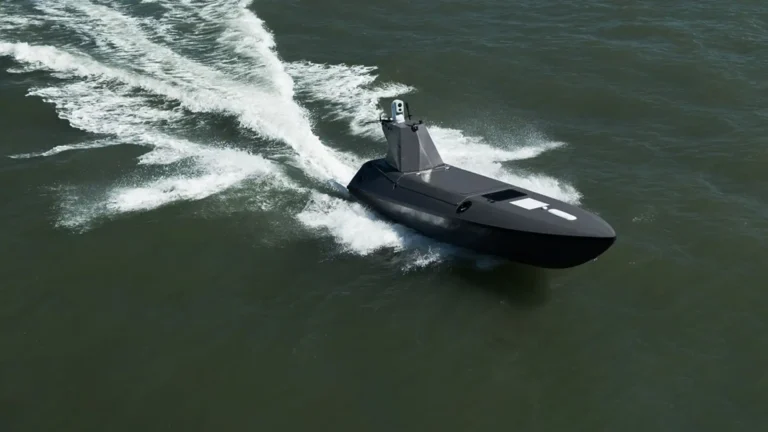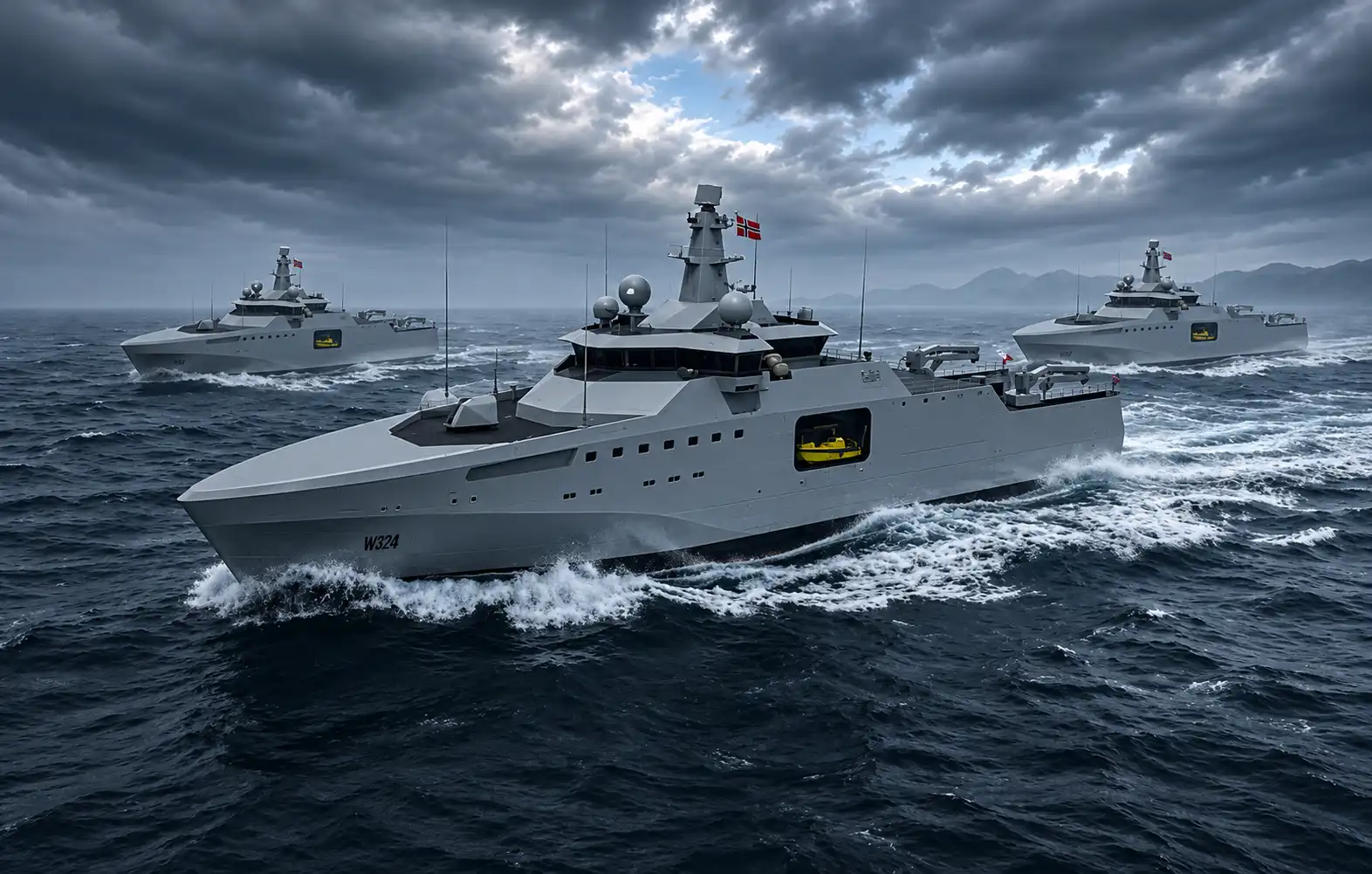
The United Kingdom will buy three Norwegian-designed Offshore Support Vessels (OSVs) to act as motherships for the Royal Navy’s uncrewed mine-hunting systems, Defence Secretary Wes Streeting and Norwegian Defence Minister Tore O. Sandvik confirmed at the Atlantic Future Forum in Oslo on November 12, 2026, the Royal Navy announced. The first ship is due in 2031, the agreement carries an option for three more, and the Ministry of Defence (MoD) has set aside an additional £90 million in the Defence Investment Plan for the acquisition.
The deal brings Britain into Norway’s P1118 Standardised Vessel Programme and sits alongside Oslo’s £10 billion Type 26 frigate procurement, the UK’s largest warship export by value, which supports 4,000 UK jobs. The timing is driven by a capability cliff. The Royal Navy has been retiring its Hunt-class and Sandown-class minehunters, and the MoD has told Parliament the last Hunt-class ship will leave service in 2031, the year the first mothership is due. London also points to Iran’s mining of the Strait of Hormuz, which the UK government describes as illegal and says has caused major disruption to the global energy trade.
Inside the P1118 Standardised Vessel Programme and Its UK Variant
The Norwegian Defence Materiel Agency (NDMA) selected Kongsberg Defence & Aerospace and Salt Ship Design on March 30, 2026, to design a family of up to 28 standardised vessels in two sizes, intended to replace a range of ageing Royal Norwegian Navy and Coast Guard classes with a common platform. On October 20, 2026, the agency signalled that procurement would begin with the larger, ocean-going variant: up to 20 hulls shared among Norway, the UK and Lithuania, with Norway taking up to six for the Coast Guard and up to four for the Navy, and the UK up to six. The Royal Navy has baselined that ocean-going design for its mothership requirement.
The British ships will be delivered through the government-to-government Maritime Capability Partnership Framework (MCPF), meaning the UK is buying into a Norwegian-managed procurement rather than running its own competition. A Defence Science and Technology Laboratory (Dstl) assessment earlier this year identified at least one key design change needed to adapt the Norwegian design for UK service.
Core specifications remain undisclosed. The MoD has released no figures for displacement, length, propulsion, crew size, endurance or mission bay configuration, and the shipbuilder has yet to be chosen. The role itself sets the requirements: large open working decks, launch and recovery systems for uncrewed surface vessels (USVs) and unmanned underwater vehicles (UUVs), workshops, space for containerised mission modules and accommodation for embarked specialist teams. The MoD describes the ships as globally deployable and says they will also support anti-submarine warfare (ASW) on NATO’s northern flank, which points to a multi-mission deck rather than a single-role minehunter.
How Royal Navy Mine Hunting Shifts to Uncrewed Systems
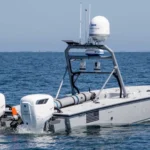
The motherships form the hull layer of the Royal Navy’s Hybrid Navy approach to mine countermeasures (MCM). Under the Mine Hunting Capability (MHC) programme run with France, crewed minehunters that operated inside minefields are giving way to uncrewed boats towing sonars, autonomous underwater vehicles and remotely operated disposal systems, keeping sailors at stand-off distance. The Defence Investment Plan allocates roughly £1.3 billion to MHC over four years, with about £1.1 billion directed to the next phase of the autonomous system procured with France.
HMS Stirling Castle is the pathfinder. The former offshore supply vessel MV Island Crown, bought in 2023 for around £40 million and converted at Devonport, transferred from the Royal Fleet Auxiliary to the Royal Navy in 2025 and is developing tactics for the uncrewed toolset. The three OSVs will give the service a dedicated class rather than a single converted commercial ship.
Streeting framed the deal around sea lane security. “This deal strengthens our ability to protect freedom of navigation, which is critical to our security and our economy,” he said. Sandvik tied it to the bilateral Lunna House agreement, stating that “operating similar platforms will enhance our navy-to-navy cooperation.”
A parallel announcement in Oslo reinforced the underwater focus: Ocean Infinity holds a £90 million MoD contract for Atlantic Net, which pairs uncrewed systems with advanced sensors to monitor underwater threats across the North Atlantic.
Analysis: The decision trades sovereign design control for schedule and commonality. By adopting a Norwegian standard and letting the NDMA run the competition, the MoD avoids a bespoke design cycle and gains a hull that will also equip a close ally operating in the same northern waters, which simplifies training, logistics and combined MCM tasking. The risk sits in the margin: with the last Hunt-class ship leaving in 2031 and the first OSV arriving that same year, any slip in Norway’s shipbuilding competition would leave Stirling Castle carrying the deployable mothership role alone. The £90 million allocation is also modest for three ocean-going ships, and the MoD has not disclosed a total programme value.
The next milestone is the NDMA shipbuilding competition, expected to run from late 2026 into 2027, followed by yard selection and a firm contract covering the UK hulls. Still unknown are the builder, unit cost, self-defence fit, crew model, home port and whether London exercises its option for three additional ships. The Royal Navy has indicated it does not plan to use the type to replace its three Batch 1 River-class offshore patrol vessels, leaving the role of any further hulls undefined.