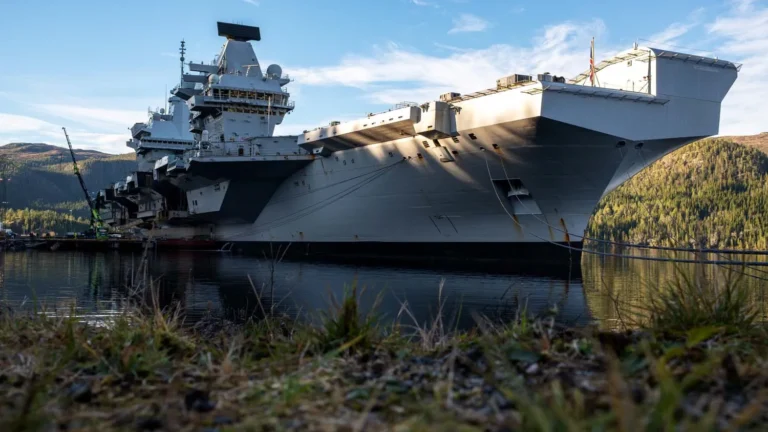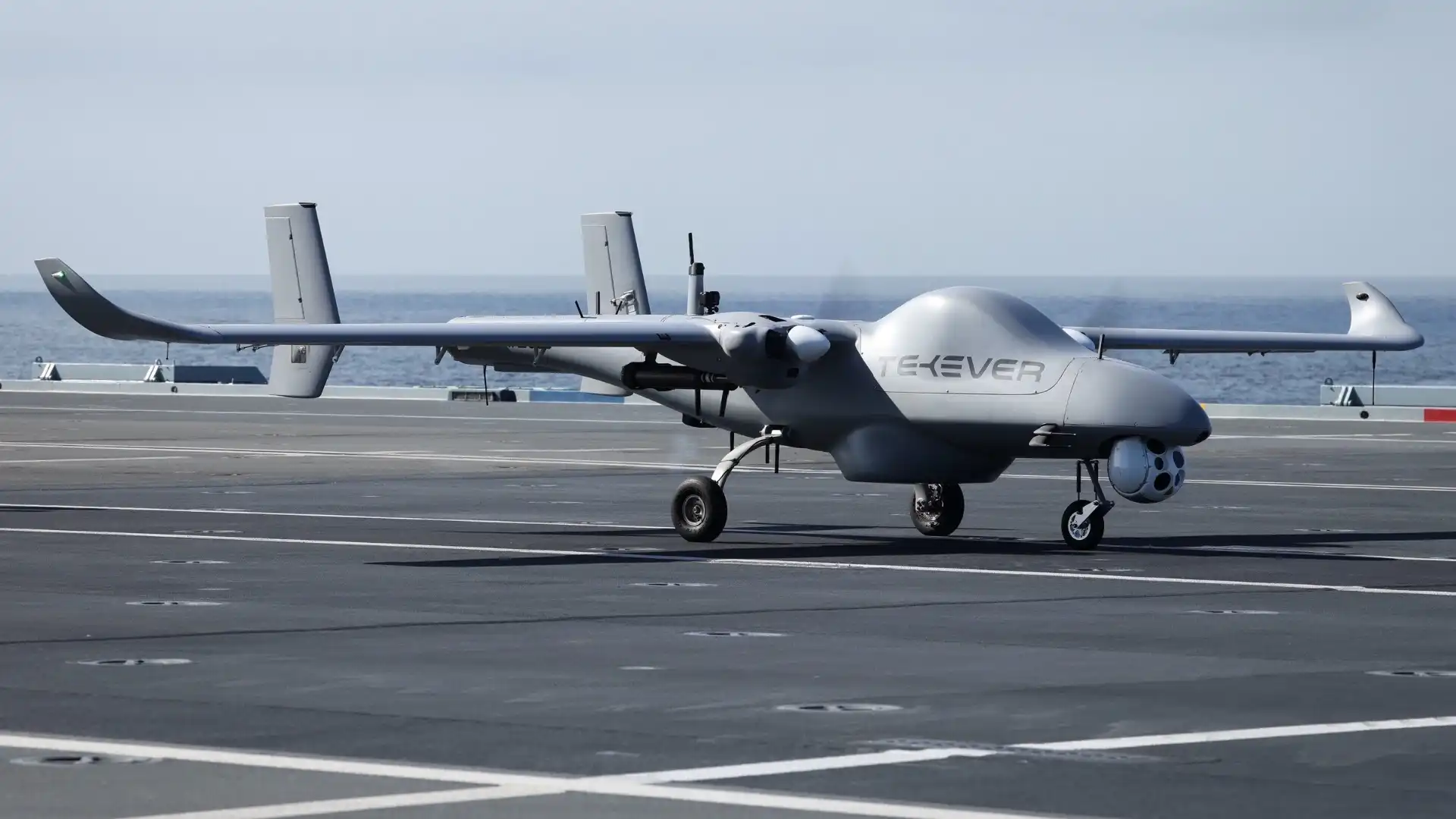
The Tekever AR5 long-endurance drone has taken off from and landed on HMS Queen Elizabeth during trials in October 2026, the first time the type has operated from a Royal Navy aircraft carrier, the UK National Armaments Director (NAD) Group confirmed on November 15, 2026. The flights were part of Heavy Lift Challenge 3, a strand of the Royal Navy’s Rapid Eagle trials. The AR5 launched from Tekever’s Flight Operations and Training Centre at Atouguia da Baleia, Portugal, flew for around 90 minutes to reach the carrier, then returned on a flight of about 120 minutes.
The Ministry of Defence (MoD) selected the AR5 in July 2026 under Project Corvus to replace the British Army’s Thales Watchkeeper WK450, in service since 2014, and signed a contract worth up to £400 million over ten years with Tekever in September 2026. According to the NAD Group, the deal “starts with six drones, rising to up to 24 by 2029.” The Royal Navy, which is building toward a hybrid fleet of crewed and uncrewed platforms, is now testing whether the same airframe can support carrier logistics, sustainment and maritime intelligence, surveillance, target acquisition and reconnaissance (ISTAR) tasks.
Tekever AR5 Specifications and Carrier Deck Compatibility
Publicly available specifications describe the AR5 as a twin-engine, medium-altitude, medium-endurance fixed-wing aircraft with a 7.3 m wingspan, a 4.0 m length and a maximum take-off weight (MTOW) of 180 kg. Tekever rates endurance at 16 to 20 hours depending on payload, cruise speed at 100 km/h and service ceiling at 3,600 m. The aircraft uses automatic take-off and landing (ATOL) and is designed to operate from unprepared strips of 200 to 300 m.
That last figure is what makes the carrier trial feasible. The Queen Elizabeth class was designed for short take-off and vertical landing (STOVL) operations and has neither catapults nor arrestor wires, so a fixed-wing drone recovering aboard relies on its own low-speed handling. The carrier’s flight deck, roughly 280 m long, sits within the strip length Tekever quotes for the AR5. Neither the NAD Group nor the Royal Navy has disclosed the wind-over-deck conditions, approach profile or any recovery aids used during the trial.
The NAD Group put payload capacity at 50 kg of cameras and sensors. Tekever’s catalogue for the AR5 lists electro-optical/infrared (EO/IR) sensors with 30x optical zoom, an Automatic Identification System (AIS) receiver, maritime radar, synthetic aperture radar (SAR), signals intelligence packages and a life-raft drop option. Command links combine radio line-of-sight out to 230 km with satellite communications for beyond line-of-sight control. Against Watchkeeper, with its 10.9 m span, 6.5 m length and 450 kg class MTOW, the AR5 is smaller and roughly 60% lighter, yet quotes a longer endurance than Watchkeeper’s typical 14 hours.
Heavy Lift Challenge 3 and Royal Navy Hybrid Fleet Ambitions
The Heavy Lift Challenge is the Royal Navy’s vehicle for testing autonomous airborne resupply. Earlier rounds in 2021 and 2022 tested the Windracers Ultra and Malloy Aeronautics heavy-lift drones from RNAS Culdrose, and Malloy T-150 drones have since operated aboard HMS Prince of Wales. The third round widens the scope to mixed logistics and ISTAR tasking. During the same trials period, HMS Queen Elizabeth also launched Callen-Lenz Nyan one-way effectors under Project VANTAGE, the first strike drone launches from a British carrier.
Lieutenant Commander David Burton, trials sponsor for Navy Capability, said the operation “has provided valuable insight into how uncrewed systems might support logistics, sustainment and wider operational tasking in demanding maritime environments.” He added that working with Project Corvus and Pantheon teams highlighted “the benefits of connecting future ISTAR, logistics and operational capabilities into a more coherent system.”
The Corvus aircraft will be built at Tekever’s Swindon facility, and the company is investing £400 million in the UK over five years through its OVERMATCH programme.
Analysis: The value of this trial lies in commonality rather than lift. A 50 kg payload is a fraction of what a medium helicopter moves in a single vertical replenishment sortie, so the NAD Group’s reference to logistic missions should be read narrowly. The more relevant result is operational: the ISTAR drone selected for the British Army transited from a land base, worked with a carrier and recovered on a STOVL deck without dedicated launch or recovery gear. That points to a shore-launched, ship-supported concept in which the Royal Navy could extend persistent surveillance around a task group by drawing on a common UK fleet, rather than funding a separate shipborne uncrewed system.
No naval procurement decision has been announced; the Royal Navy frames the trial as experimentation. The next markers are the AR5’s entry into British Army service, the growth of the Corvus fleet toward 24 aircraft by 2029, and the Navy’s assessment of Rapid Eagle data. Open questions include whether the Navy seeks its own AR5 buy or a share of the Army fleet, and how recoveries would be deconflicted from F-35B flight operations.