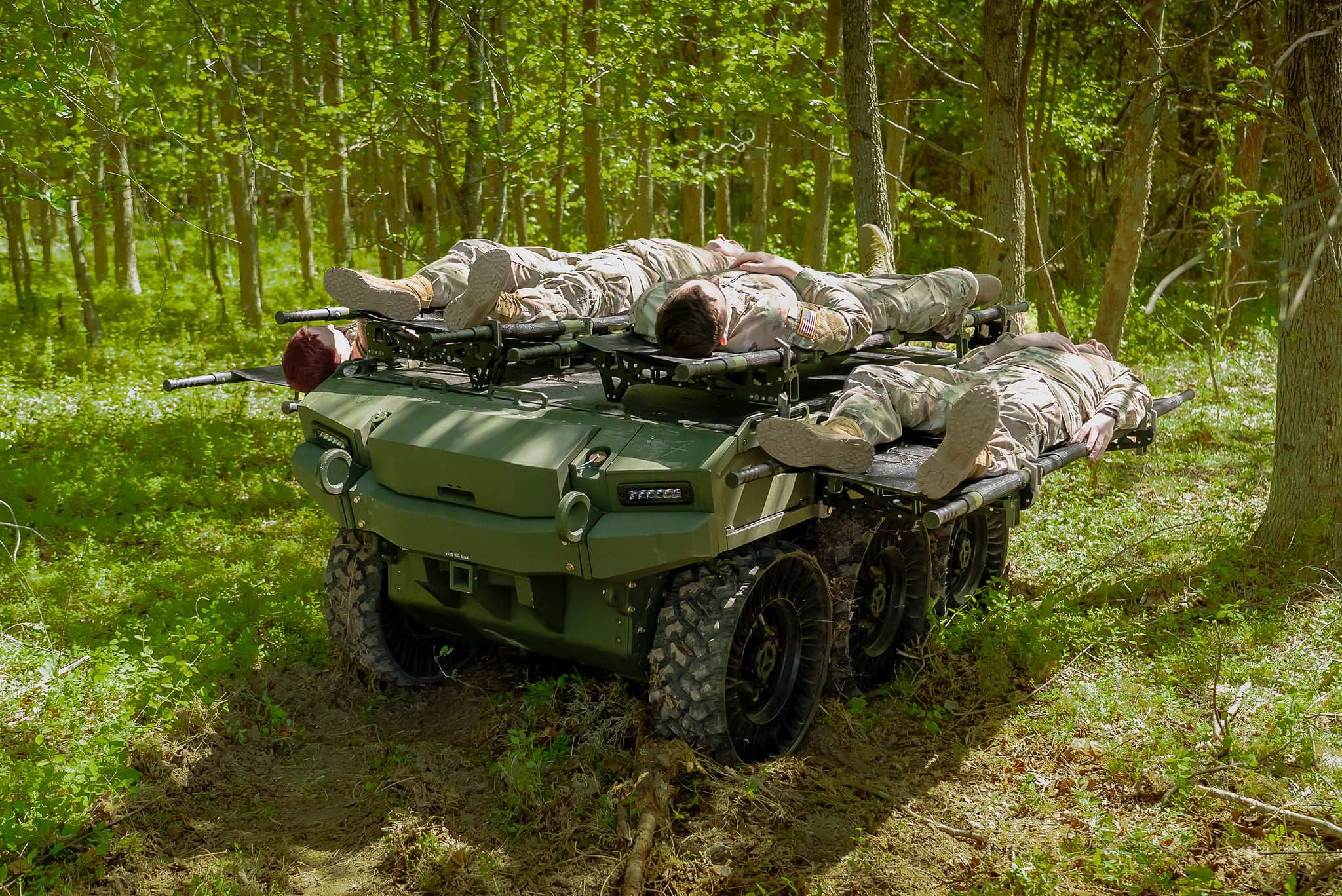
The Department of War has advanced BLADE’s Hunter WOLF unmanned ground vehicle (UGV) to Phase II of GroundBreaker 1, a joint demonstration in which service members will operate industry-built ground robots at Camp Grafton, North Dakota, from October 19 to 23, 2026. HDT Robotics, which does business as BLADE, announced the selection on October 8, 2026, after government evaluators reviewed the solution brief it submitted in Phase I.
GroundBreaker 1 targets a domain where the Pentagon has fielded autonomy more slowly than in the air or at sea, because ground robots must negotiate terrain and obstacles that drones never meet. Army Contracting Command issued solicitation RFW-DOTAC-ARMY-2026-002 on August 21, 2026, through the Department of War Drone Other Transaction Authority (OTA) Consortium, restricting eligibility to consortium members. The event feeds the department’s push to add UGVs to its online Drone Marketplace.
How GroundBreaker 1 Phase II Will Evaluate the Hunter WOLF UGV
Phase II evaluators will score each candidate on technology maturity, operational readiness and cross-domain interoperability. The solicitation sought complete systems for at least one core mission: reconnaissance, surveillance and target acquisition (RSTA); tactical logistics; explosive ordnance disposal (EOD) and route clearance; search and rescue; perimeter security; and casualty evacuation (CASEVAC). Entry requirements included obstacle avoidance, all-terrain mobility, and an open, hardware-agnostic software architecture compatible with Robot Operating System-Military (ROS-M) and existing command and control (C2) networks.
That last requirement matters as much as mobility: the government wants a chassis that can host autonomy software from multiple vendors, not a closed robot. Companies whose demonstrations pass will be invited to Phase III to submit full technical and cost proposals for a prototype OTA award.
“Hunter WOLF was built for exactly this kind of challenge,” said Tom Van Doren, president of BLADE’s Robotics Sector. “This is a mature, mission-ready platform that has been tested alongside warfighters in demanding environments.”
BLADE has not said how many vehicles it will bring or which configuration it will demonstrate, and the department has not published the number of Phase II participants. At least one rival is known: startup Liminal Industries says its four-wheeled Dynamic Unmanned Expendable Light Vehicle (DUEL-V) also advanced.
Payload, Power and Range: Hunter WOLF Technical Specifications
Hunter WOLF, short for Wheeled Offload Logistics Follower, is a 6×6 load carrier HDT began developing in 2012 for the Army’s Small Multipurpose Equipment Transport (S-MET) requirement. Its diesel-electric hybrid drivetrain lets a JP-8 or diesel engine charge onboard batteries for short silent-movement periods; earlier company literature listed a 12 km (7.5-mile) silent-run range, and BLADE has not published an updated figure.
BLADE rates payload at 2,800 pounds (1,270 kg) on a 29-square-foot (2.7-square-meter) deck, up from 2,200 pounds (1,000 kg) on earlier builds and above the Army’s 2,000-pound S-MET Increment II threshold. Range exceeds 200 miles (321 km) on internal fuel and 600 miles (965 km) with an extended-range tank. A mission kit exports up to 15 kilowatts (kW), with NATO-standard 28-volt DC connectors front and rear.
Six Michelin Tweel airless tires eliminate flats, and skid steering lets the vehicle pivot in place. The modular open systems approach (MOSA) design accepts third-party autonomy kits and armor. Publicly available specifications indicate it can be carried inside or slung under a UH-60 Black Hawk and loaded into CH-47, V-22 and C-130 aircraft. Curb weight and top speed for the current build are undisclosed.
Each figure maps to a battlefield problem. The 15 kW export lets one vehicle recharge radios, batteries and small drones for an electronics-heavy platoon, while helicopter transportability suits airborne and air assault units. During training with the 10th Mountain Division at Fort Polk, Louisiana, this year, it carried AN/VRC-158 radios, battery chargers, a 60-gallon (227-liter) water purification unit and CASEVAC kits.
Hunter WOLF in S-MET Increment II and Infantry Last Tactical Mile
GroundBreaker 1 is the third government pathway the Hunter WOLF now occupies. On September 24, 2024, the Army awarded HDT Expeditionary Systems and American Rheinmetall Vehicles OTA agreements worth a combined $22 million for eight S-MET Increment II prototypes each; HDT valued its share at $11.55 million. Increment II doubles the 1,000-pound payload requirement of Increment I, won in 2020 by General Dynamics Land Systems’ 8×8 Multi-Utility Tactical Transport (MUTT). A production decision is planned for late fiscal 2027, against an objective of up to 2,195 systems.
On August 11, 2026, the Army named HDT among six vendors for its Infantry Last Tactical Mile (ILTM) initiative, alongside Maren-Go, Overland AI, Forterra, Hendrick Motorsports and American Rheinmetall. ILTM targets beyond-line-of-sight autonomous resupply and CASEVAC up to the forward line of own troops (FLOT), with four prototypes per vendor ahead of an Operational Assessment in early 2027. The vehicle also trained with the 101st Airborne Division at the Joint Readiness Training Center in April and with the 82nd Airborne Division at Fort Polk on August 20. BLADE says it has seen operational use in Ukraine, without detailing its scope.
Analysis: The Hunter WOLF’s presence across S-MET Increment II, ILTM and GroundBreaker 1 shows how the Pentagon now buys ground robotics: parallel OTA pathways, each testing a different slice of the problem, instead of one sequential program of record. That rewards mature hardware already in soldiers’ hands, BLADE’s strongest card. But GroundBreaker 1’s emphasis on ROS-M and C2 integration shifts weight from the chassis to the software layer, and expendable entrants such as DUEL-V signal that unit cost will count as much as payload. A 2,800-pound hybrid 6×6 wins on capacity and endurance; it must still make the case on cost against attritable designs.
The live demonstration runs October 19 to 23. The department has not dated Phase III invitations or disclosed the value or quantity of any prototype OTA. Beyond Camp Grafton, the ILTM Operational Assessment in early 2027 and the S-MET Increment II production decision in late fiscal 2027 will frame the Hunter WOLF’s prospects.