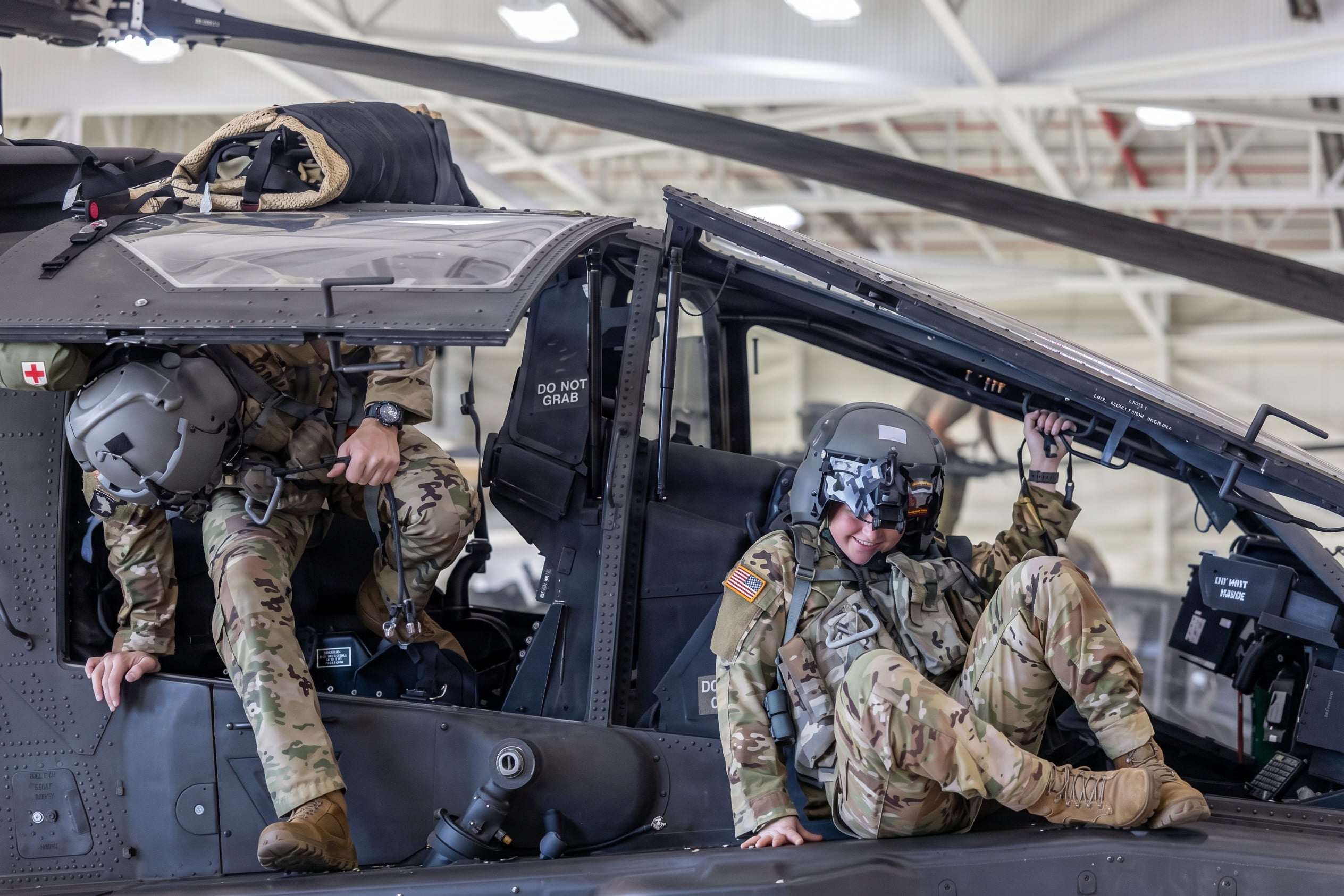
US Army aviators from the 101st Combat Aviation Brigade (CAB) completed the first helicopter tests of the Advanced Inflight Relief Universal System (AIRUS) at Fort Campbell, Kentucky, between October 5 and October 7, 2026, assessing whether the wearable bladder relief device can be cleared for the AH-64 Apache, UH-60 Black Hawk and CH-47 Chinook.
The trials marked the system’s first Army evaluation and its first in rotary-wing aircraft, according to Airion, the company that developed AIRUS for the Air Force. The brigade’s Holistic Health and Fitness (H2F) team brought Airion in after pilots reported limiting fluid intake before missions to avoid needing relief in flight, a practice aviators call tactical dehydration. The 101st Airborne Division (Air Assault) is building its doctrine around longer flights, and its aviation brigade is slated to be the first unit to receive the MV-75 Cheyenne II tiltrotor.
Inside the AIRUS Inflight Relief System and Its Helicopter Trials
Aircrews from the 1-101 Attack Battalion, the 6-101 Assault Helicopter Battalion and the 7-101 Heavy Lift Battalion were measured and fitted, completed human factors surveys and used the system in flight. Personnel from the Aviation Flight Test Directorate at Redstone Arsenal, Alabama, observed the trials and will issue recommendations on the system’s flight suitability. Testing began with egress. Elizabeth Rhonenus, a human factors engineer with the directorate, said evaluators selected participants at roughly the 5th and 95th percentiles of body size and checked whether each could enter and exit the aircraft safely while wearing the device. Tubing and a collection bag under the flight suit add snag points during an emergency exit, and cockpit geometry differs sharply between the tandem-seat Apache and the side-by-side Black Hawk and Chinook.
Chief Warrant Officer 2 Collin McAllister, an Apache pilot who flew with AIRUS, contrasted it with legacy relief bags that rely on a gelling agent. Airion founder and chief executive Colt Seman said pilots found it comfortable and functional. The Army has not released quantitative results, sortie counts or flight hours from the three-day evaluation.
AIRUS pairs a form-fitting, self-cleaning undergarment with soft tubing and a small pump that moves urine into a sealed collection bag, all operated with a handheld remote controller. Airion offers five cup sizes for female anatomy and two for male anatomy, and the company says the bag holds up to 1,800 milliliters, equivalent to four to seven voids.
The design emerged from the AFWERX Sky High Relief Challenge, launched in 2020 to serve female aircrew on missions of up to 16 hours. The Air Force awarded Airion an initial $2.5 million contract in March 2022, flight tested the system with F-15E Strike Eagle crews at Seymour Johnson Air Force Base, North Carolina, in 2024 and finalized the design in January 2025. Squadrons order kits through the General Services Administration at a base price of about $4,000 each, per 2025 Air Force figures. NASA flew AIRUS to the International Space Station on the SpaceX Crew-12 mission on February 13, 2026.
Why L2A2 and the MV-75 Cheyenne II Raise Endurance Demands
The division’s Long Range, Large Scale Air Assault (L2A2) concept aims to move a brigade combat team more than 500 miles in a single period of darkness. In January 2024, the division flew 76 CH-47, UH-60 and AH-64 aircraft carrying more than 1,000 soldiers into the Joint Readiness Training Center in Louisiana, covering more than 500 nautical miles over two periods of darkness.
The MV-75 Cheyenne II is meant to make that profile routine. Built by Bell Textron, the Army’s first conventional tiltrotor is designed to exceed 300 mph, carry 14 soldiers and lift external loads of up to 10,000 pounds, according to the Army, which says the aircraft will double the range and speed of today’s air assault fleet. The 101st CAB expects its first aircraft in 2027.
Physiology sets the ceiling on those profiles. Air Force research links dehydration to reduced G tolerance, degraded situational awareness, blurred vision, memory lapses and headaches. For crews flying low-level routes at night under night vision devices, that degradation carries direct safety consequences. McAllister said the system could help crews who must stay on station longer to support ground forces in contested environments.
Capt. Gena Baisa, lead dietitian for the 101st CAB H2F team, tied AIRUS directly to L2A2 and to the MV-75’s longer time aloft, noting that pilots who are not preoccupied with needing relief think more clearly. Seman argued that in a conflict with a near-peer adversary, “short flights are not going to be realistic,” and that soldiers should train with the system before they need it.
Analysis: The AIRUS trials expose a constraint the Army’s aviation modernization debate rarely addresses. As the MV-75 doubles the speed and reach of the air assault fleet, aircrew endurance, rather than airframe range, increasingly sets the length of a mission. The division’s January 2024 L2A2 rehearsal needed two nights to cover a distance the concept intends to cover in one. Equipment that lets crews hydrate normally is a prerequisite for flying those profiles safely, and building on a fielded Air Force program compresses the cost and timeline of acquiring it.
The Aviation Flight Test Directorate’s recommendations will determine whether AIRUS is cleared for Army aircraft. The Army has not announced a procurement decision, quantities, a funding line or a fielding schedule. The next marker is the MV-75’s arrival at Fort Campbell, expected in 2027.