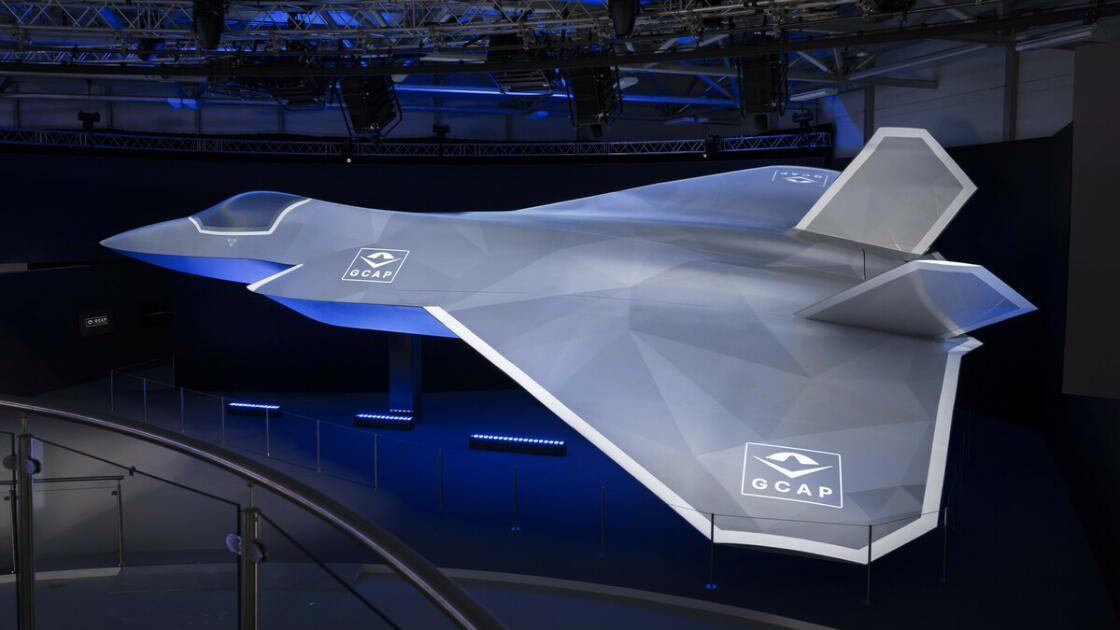
The collapse of the Franco-German-Spanish Future Combat Air System (FCAS) on June 8, 2026, set against the £4.6 billion ($6.1 billion) contract that funded the rival Global Combat Air Programme (GCAP) three weeks later, has fractured the West’s sixth-generation fighter enterprise into competing national and multinational tracks at the same moment China moved its own next-generation combat aircraft into open flight testing.
FCAS was launched politically by Emmanuel Macron and Angela Merkel in July 2017 and unveiled as a Dassault-Airbus partnership at the 2018 Berlin Air Show. Nine years and roughly €100 billion in projected cost later, it ended without a single prototype built or demonstrator flown. GCAP, by contrast, began only in 2022 yet has moved steadily toward hardware. The divergence lands during a compressed procurement window in which the United States and China are both racing sixth-generation designs toward first flight, sharpening the strategic cost of European fragmentation.
How the Dassault-Airbus Dispute Killed the Sixth-Generation Fighter
The proximate cause of the FCAS collapse was an irreconcilable industrial dispute between Dassault Aviation and Airbus Defence and Space over leadership, workshare, and intellectual property on the New Generation Fighter (NGF), the crewed aircraft at the center of the program. Dassault, citing its record as a combat aircraft prime, insisted on design authority and a dominant build share; Airbus argued that a program of that scale required a balanced partnership. Beneath the corporate fight sat divergent operational requirements: France needs a nuclear-capable, carrier-compatible fighter to succeed the Rafale, while Germany, replacing the Eurofighter Typhoon, needs neither.
A mediation launched after a Macron-Merz dinner in Brussels on March 18, 2026, failed within weeks. The German-appointed mediator concluded on April 18 that a jointly built crewed fighter was no longer feasible. Chancellor Friedrich Merz conveyed the final decision to President Macron on June 6 on the sidelines of the EU-Western Balkans summit in Montenegro, and German Defense Minister Boris Pistorius confirmed it publicly on June 9.
The termination applies only to the manned NGF. The combat cloud, the networked system-of-systems linking aircraft, drones, sensors, and satellites, continues under Airbus lead with Thales and Indra, as does the Airbus-led Remote Carrier drone effort; neither is contingent on the fighter. Dassault will now develop France’s sixth-generation fighter alone, financed in part through the more than €4 billion committed to the Rafale. Germany’s national aviation strategy, adopted June 10, demands that Airbus co-lead any successor. Spain has hedged with an Airbus-Indra national study, and Belgium, an observer since May 2024, declared the program dead and moved to order 11 additional F-35As.
Why GCAP Holds Together While the Franco-German Effort Broke
The Global Combat Air Programme, launched by the United Kingdom, Italy, and Japan in 2022 and codified by treaty in December 2023, is structured to avoid the governance trap that sank FCAS. A single industrial prime, Edgewing, holds design authority; it was created by BAE Systems, Leonardo, and Japan Aircraft Industrial Enhancement Co. (JAIEC), the last incorporating Mitsubishi Heavy Industries. The national integrators hold equal stakes, and a single trinational agency acts as the empowered customer, collapsing the multi-headed decision structure that left FCAS deadlocked.
Funding has followed. Edgewing received a £686 million bridging contract in April 2026, then a £4.6 billion ($6.1 billion) development contract signed July 1 and announced July 3, covering an 18-month phase to complete concept and assessment work and begin detailed design. The award came days after the United Kingdom’s Defence Investment Plan committed £8.6 billion to GCAP over four years, resolving the funding uncertainty that had shadowed the British contribution. The partners are targeting an in-service date of 2035, five years ahead of the 2040s timeline FCAS had set.
The contrast has drawn suitors. Saudi Arabia and Canada have expressed interest, and German industry, led by Airbus, has signaled openness to joining, though partners have made clear it is too late for Germany to enter as an equal design-authority partner. With FCAS gone, GCAP is now the only multinational sixth-generation fighter program advancing toward full-scale development.
China’s J-36 and America’s F-47: The Competitors Who Fly
While Europe argued over workshare, its competitors flew hardware. China’s large tailless, trijet combat aircraft, unofficially designated J-36 and attributed to Chengdu Aircraft Corporation, was first observed over Chengdu on December 26, 2024. The People’s Liberation Army released official footage on June 28, 2026, and open-source imagery has since tracked multiple distinct airframes testing competing intake, exhaust, and undercarriage configurations in parallel. A December 2025 Pentagon report confirmed that two Chinese sixth-generation prototypes, the J-36 and the Shenyang J-50, had completed first flights. Performance parameters remain classified; publicly available assessments characterize the J-36 as a heavier, longer-range platform optimized for networked operations across the Pacific.
The United States is moving on a similar timeline. Boeing’s F-47, selected in March 2025 over Lockheed Martin as the crewed core of the Air Force’s Next Generation Air Dominance family, has entered engineering and manufacturing development, with the fiscal 2027 budget requesting more than $5 billion, a 65 percent increase, to hold a first flight in 2028. Budget documents cite performance targets above Mach 2 and a combat radius exceeding 1,200 nautical miles, roughly double current F-35 variants. The Navy’s parallel F/A-XX, with Boeing and Northrop Grumman as finalists, has lagged, receiving only $140 million in the same request after Congress steered nearly $1.7 billion to it a year earlier.
Analysis: Sixth-generation air power is proving to be a test of industrial governance as much as of technology, and Europe has failed the test where the GCAP bloc has passed it. The strategic penalty is not the loss of one airframe but the fragmentation that follows: two competing European fighter programs plus continued F-35 dependence dilute both sovereignty and fleet mass at the precise moment Washington and Beijing are concentrating resources on single, funded platforms. The decisive advantage in this generation is the capacity to cooperate and execute, not the aircraft itself.
The near-term question is Germany’s path. Berlin can seek a subordinate role in GCAP, anchor a new European program with Sweden or Spain, or expand its F-35 fleet and pair it with domestic drones. A Franco-German ministerial council on July 17 was tasked with drafting a roadmap for the surviving combat cloud, though momentum has shifted toward national efforts. The next hard Western milestone is the F-47’s 2028 first flight; GCAP’s 2035 service target now sets the pace for allied sixth-generation airpower.