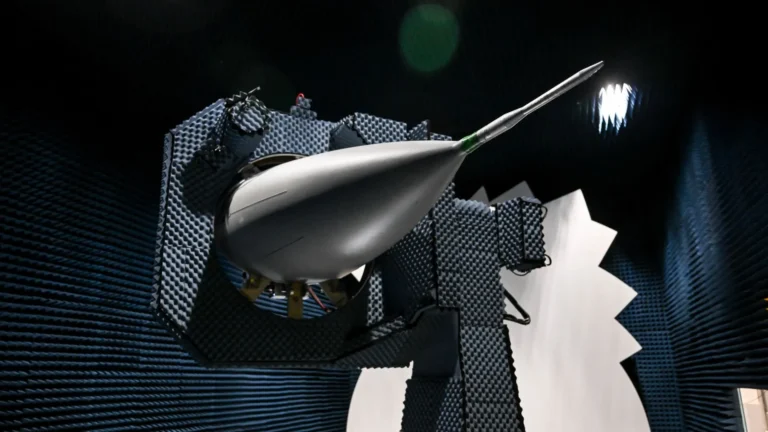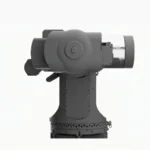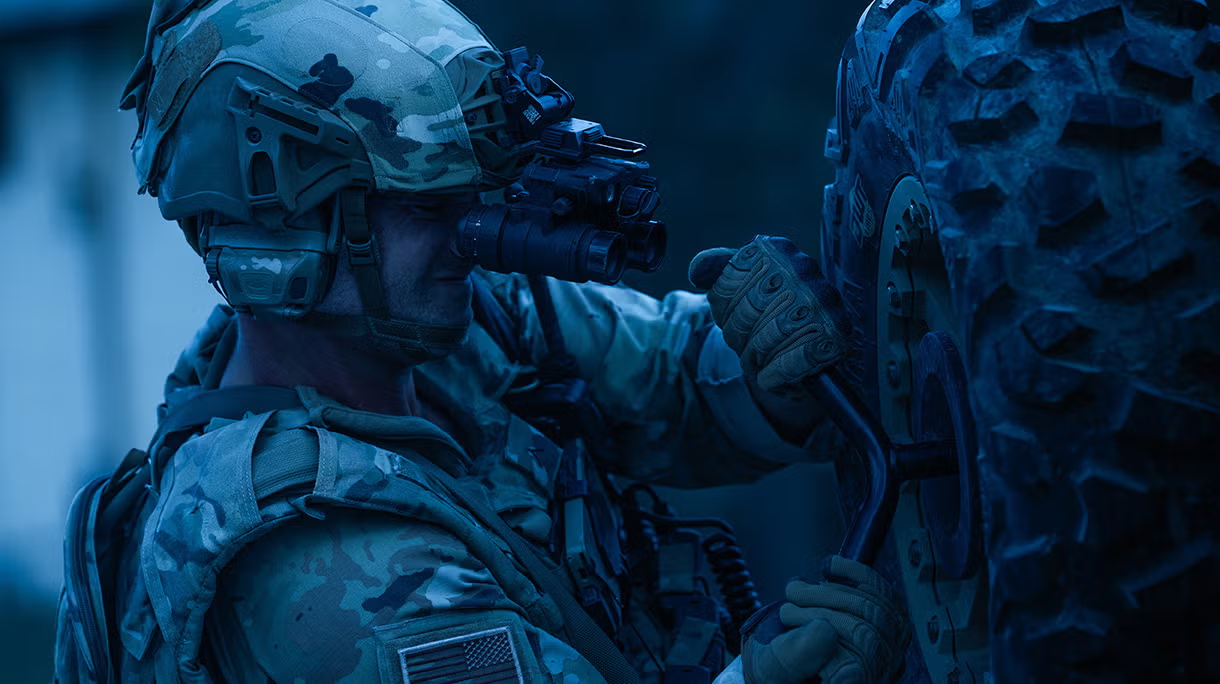
L3Harris Technologies has received a $55 million award from the U.S. Army to supply its NOVA helmet-mounted binocular night vision goggle under the Binocular Night Observation Device (BiNOD) program, the company announced on October 12, 2026. L3Harris said it will move directly into full-rate production of the system, which is meant to succeed the AN/PVS-14 monocular that has equipped soldiers for more than two decades.
BiNOD, formerly known as Night Vision Device-Next, is the Army’s effort to put a low-cost, standardized binocular goggle on soldiers who will not receive the far more expensive Enhanced Night Vision Goggle-Binocular (ENVG-B). On February 27, 2026, Army Contracting Command at Aberdeen Proving Ground, Maryland, awarded three firm-fixed-price contracts worth about $1.27 billion combined for BiNOD development, production and testing after receiving six bids. L3 Technologies of Londonderry, New Hampshire, received $465,993,977; Elbit Systems of America’s night vision unit in Roanoke, Virginia, $450,602,778; and Photonis Defense of Lancaster, Pennsylvania, $352,606,722. All three run through February 27, 2033. The new order equals roughly 12 percent of the L3Harris ceiling and is the first BiNOD production award the company has announced.
BiNOD Night Vision Goggle Requirements and the NOVA Design
L3Harris began developing NOVA in 2021 against what it describes as the Army’s core requirements for a PVS-14 successor: a binocular goggle cheap enough to buy at scale and fielded in one common configuration. The device mounts two image intensifier monoculars on a central bridge, and each side flips up independently so a soldier can keep one eye unaided and dark-adapted. L3Harris builds the system around its unfilmed Generation III image intensifier tubes, which omit the ion barrier film on the microchannel plate to improve sensitivity.
Company executives have described NOVA as weighing a little more than one pound and running up to 30 hours on a single AA battery. The goggle uses USB-C interfaces, and L3Harris says a damaged intensifier tube can be replaced by removing four screws, a design choice aimed at cutting downtime and lifecycle cost. The company says NOVA is built to stay in service for at least two decades.
The trade against the legacy monocular is clear. Publicly available specifications indicate the AN/PVS-14 weighs about 12.4 ounces (350 grams), offers a 40-degree field of view and runs roughly 50 hours on one AA cell. NOVA adds weight to the helmet and gives up battery endurance in exchange for stereoscopic depth perception, which matters most when driving under goggles, moving across broken terrain or handling equipment at arm’s length. L3Harris has not published NOVA’s field of view, resolution, figure of merit or phosphor type, and neither the company nor the Army has disclosed the unit price or the number of goggles covered by the $55 million award.
How NOVA Fits Below ENVG-B and Special Operations Goggles
NOVA is not intended to displace L3Harris’ premium systems. ENVG-B, a dual-waveband goggle that fuses white phosphor image intensification with thermal imagery, remains the night vision device for close-combat formations. L3Harris reported more than 20,000 ENVG-B deliveries as of April 2026, backed by full-scale production orders of $256 million in April 2024 and $263 million in January 2025. Special operations forces continue to field the AN/PVS-31A Binocular Night Vision Device and the Fused Panoramic Night Vision Goggle.
Cost is the dividing line. L3Harris executives have said the company’s BiNOD offering costs about one-third as much as an ENVG-B, and have framed the target population as tens of thousands of soldiers in logistics, transportation and other support roles, a segment that has largely relied on monoculars or lacked high-quality night vision. NOVA will also be offered to allied land forces, and L3Harris has outlined an enhanced variant with a partial heads-up display, an attached battery and deeper immersion protection. Brenna Baker, president of Integrated Vision Solutions at L3Harris, said the company is “prepared to deliver this capability at speed and scale for soldiers.”
Three Vendors Compete for BiNOD Production Orders Through 2033
BiNOD is structured as a multiple-award indefinite-delivery/indefinite-quantity vehicle, so the three holders compete for individual orders rather than splitting a fixed buy. Photonis Defense, the U.S. subsidiary of France’s Exosens, disclosed a first delivery order for 1,600 complete systems in late August 2026, using image intensifier tubes supplied by its French parent; that order was reported as a low-rate initial production lot. Elbit Systems of America has described its award, built around its F5035 goggle, as a vehicle to compete for future production orders.
The program’s statement of work sets out contractor and government engineering development tests, a limited user test, production qualification and first article testing, a logistics demonstration and initial operational test and evaluation. It also allows accelerated production, letting the Army field production-ready goggles while compliance testing continues, provided non-waivable performance criteria are met. Neither L3Harris nor the Army has said which test events NOVA has completed or whether the full-rate decision relies on that provision.
Analysis: BiNOD shifts Army night vision procurement from capability at the top of the force to coverage across it. ENVG-B addressed overmatch for infantry and cavalry; BiNOD targets a larger and less visible gap in support units that now operate within reach of drones, loitering munitions and long-range fires, where darkness no longer shields rear-area formations. A binocular goggle at roughly one-third of ENVG-B cost, bought competitively from three suppliers on firm-fixed-price terms, gives the Army price leverage and supply redundancy its single-tier programs lacked. The risk is that cost pressure pulls tube performance toward the floor of the requirement, a question operational test data will settle.
Key details remain undisclosed: the number of NOVA goggles in this order, the delivery schedule, the first units to be equipped and the per-unit price. The next indicators are an Army fielding announcement, follow-on orders against the L3Harris and Photonis ceilings, any production order for Elbit, and the first allied NOVA sale. Initial operational test results will show whether affordable binocular vision holds up across the force.