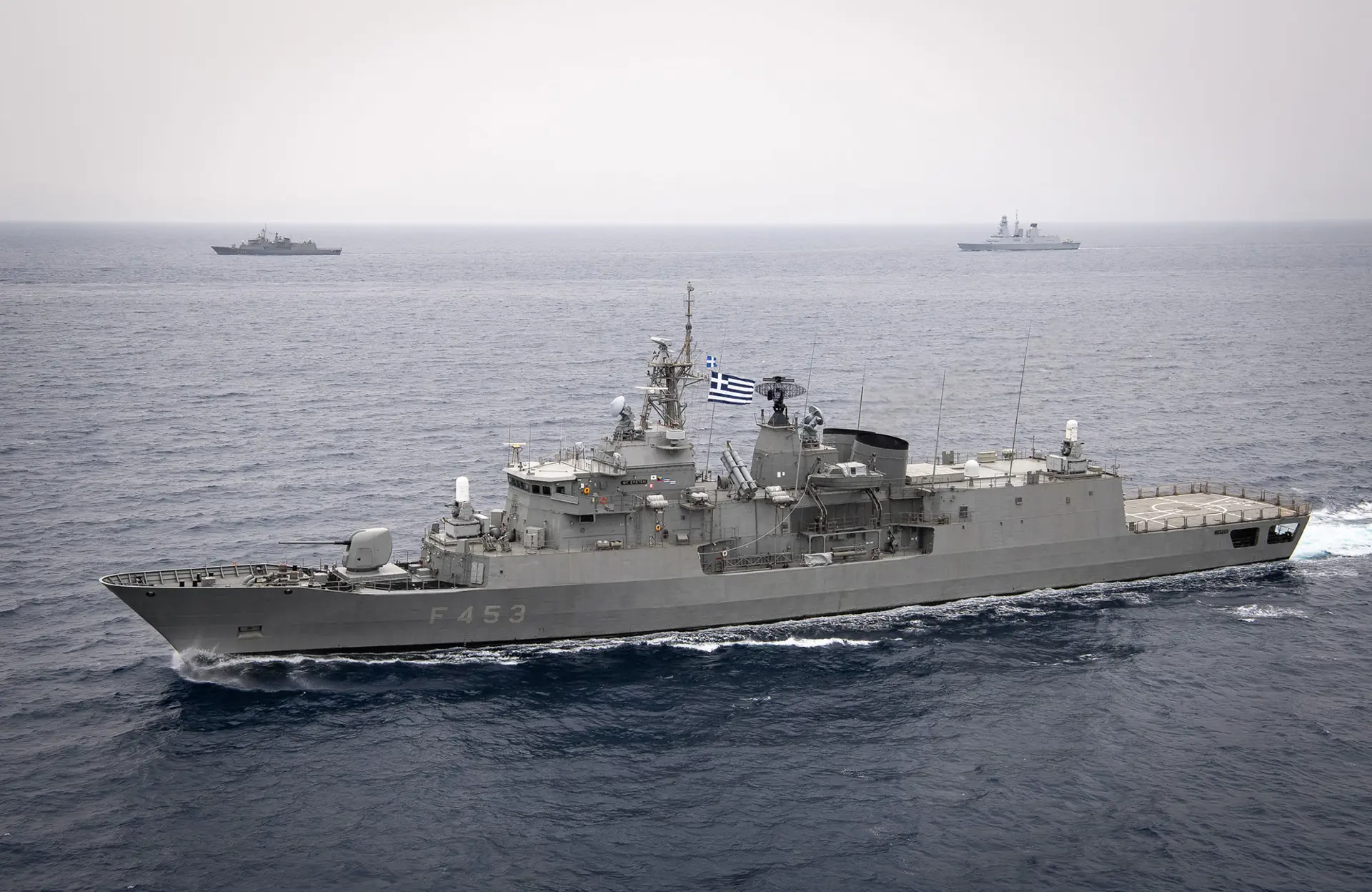
The Hellenic Navy and Hellenic Aerospace Industry (HAI) have selected Terma’s SCANTER 6002 X-band surveillance radar for the Hellenic Navy’s four Hydra-class (MEKO 200HN) frigates, the companies announced this week. The radar will feed HAI’s Centaur counter-unmanned aircraft system (C-UAS) and interface with the Thales TACTICOS combat management system now being installed as part of the frigates’ broader modernization.
The award lands partway through a long-delayed modernization of Greece’s four 30-year-old Hydra-class frigates, HS Hydra (F452), HS Spetsai (F453), HS Psara (F454), and HS Salamis (F455), endorsed in 2019 and ratified by the Hellenic Parliament in April 2023. Greece’s General Directorate for Defense Investments and Armaments (GDDIA) signed the core mission-system contract with Thales on May 25, 2026, covering a new TACTICOS build, the NS100 radar, and STIR 1.2 EO Mk2 fire-control sensors. SCANTER 6002 fills the navigation and surveillance layer of that architecture and formalizes the sensor pairing behind Centaur, already used operationally against Houthi drones over the Red Sea.
SCANTER 6002 Radar Specifications and Drone-Detection Role
The SCANTER 6002 is an X-band naval surveillance radar built by Terma, a Denmark-based defense electronics manufacturer headquartered in Aarhus with more than 3,000 radar systems fielded worldwide. Terma’s published specifications state the radar tracks surface targets to a maximum radius of 96 nautical miles and holds aircraft, including hovering helicopters, in the near airspace beyond 15 nautical miles. Its embedded ET2 tracker combines automatic clutter estimation, a patented Terma technique, with Interacting Multiple Models and Multi-Hypothesis Tracking to hold small, low-radar-cross-section targets in clutter without operator intervention.
The system’s relevance to the Hydra-class upgrade rests on an optional artificial intelligence classifier that separates small drones, single contacts and swarms alike, from birds at range; Terma states the radar can detect small drones out to roughly 5 kilometers in this mode. SCANTER 6002 also carries a Low Probability of Intercept mode adjustable from 0.2 to 350 watts and 16 independently selectable sectors for restrictive emissions control, features suited to the drone and jamming threat Hellenic Navy ships have faced in the Red Sea. Terma builds the radar on gallium nitride solid-state transmitters, which it says triples mean time between failure versus competing designs.
In the Hellenic Navy configuration, SCANTER 6002 will not operate as a standalone sensor. HAI will integrate its track output directly into Centaur, and the radar will separately interface with TACTICOS, giving crews one surface, air, and drone picture instead of three disconnected displays.
Hydra-Class Sensor Refit Builds on Centaur’s Combat Record
The radar buy is the latest piece of an effort that has moved in stages since Greece’s 2019 decision to extend the Hydra-class beyond its original design life. Under the May 2026 contract, Thales will replace the frigates’ MW-08 and DA-08 search radars with the NS100 radar and swap the STACOS combat system for the newest TACTICOS build. SCANTER 6002 replaces the aging Bridgemaster navigation radar, while the Wärtsilä NAVI 4000 set remains in place, per program details the Hellenic Navy disclosed at the 2024 Combined Naval Event. Publicly available specifications indicate the 117.5-meter, 3,360-ton frigates keep their 127mm Mk 45 gun, Mk 48 launcher for 16 RIM-162 Evolved Sea Sparrow Missiles (ESSM), and Mk141 Harpoon canisters unchanged under this contract.
Centaur is what gives the radar selection its operational weight. Developed by HAI without a foreign design partner, the electronic-warfare-based C-UAS system detects and jams small unmanned aircraft rather than relying solely on kinetic intercept. Hellenic Navy officials have credited it with defeating Houthi drones targeting the frigate Psara during Operation Aspides patrols in the Red Sea and Gulf of Aden in 2024, with the ship’s 127mm gun engaging targets that closed within direct-fire range. HAI has since fitted a naval variant of Centaur to the frigates Hydra and Spetsai for the same mission. Pairing SCANTER 6002’s small-target tracks with Centaur’s jamming envelope is meant to extend the detection-to-engagement timeline before a drone reaches gun range.
Analysis: The SCANTER 6002 award shows how Red Sea drone combat is reshaping mid-life frigate upgrades, not only new-construction programs. Rather than treating counter-UAS as an afterthought, Greece is embedding a radar-and-jammer pairing already tested in action into a hull built in the 1990s, a template other NATO navies with aging surface combatants may find hard to ignore. SCANTER 6002 already equips Belgian and Dutch anti-submarine frigates and Royal Australian Navy Arafura-class patrol vessels, giving Terma an established base to argue for similar integration elsewhere. Tying an indigenous Greek system to a Western radar and to Thales’ TACTICOS architecture also lowers the risk of fielding an unproven domestic system alone.
Neither company has disclosed contract value or delivery dates for the SCANTER 6002 order, and the Hellenic Navy has not said which hull will receive it first. Athens still must finalize the wider Hydra-class capability upgrade, which officials have said should take up to four years from signature to first sea trials. How the SCANTER 6002 to Centaur handoff performs against future drone activity in the Eastern Mediterranean will likely shape whether Greece extends the pairing to other surface combatants.