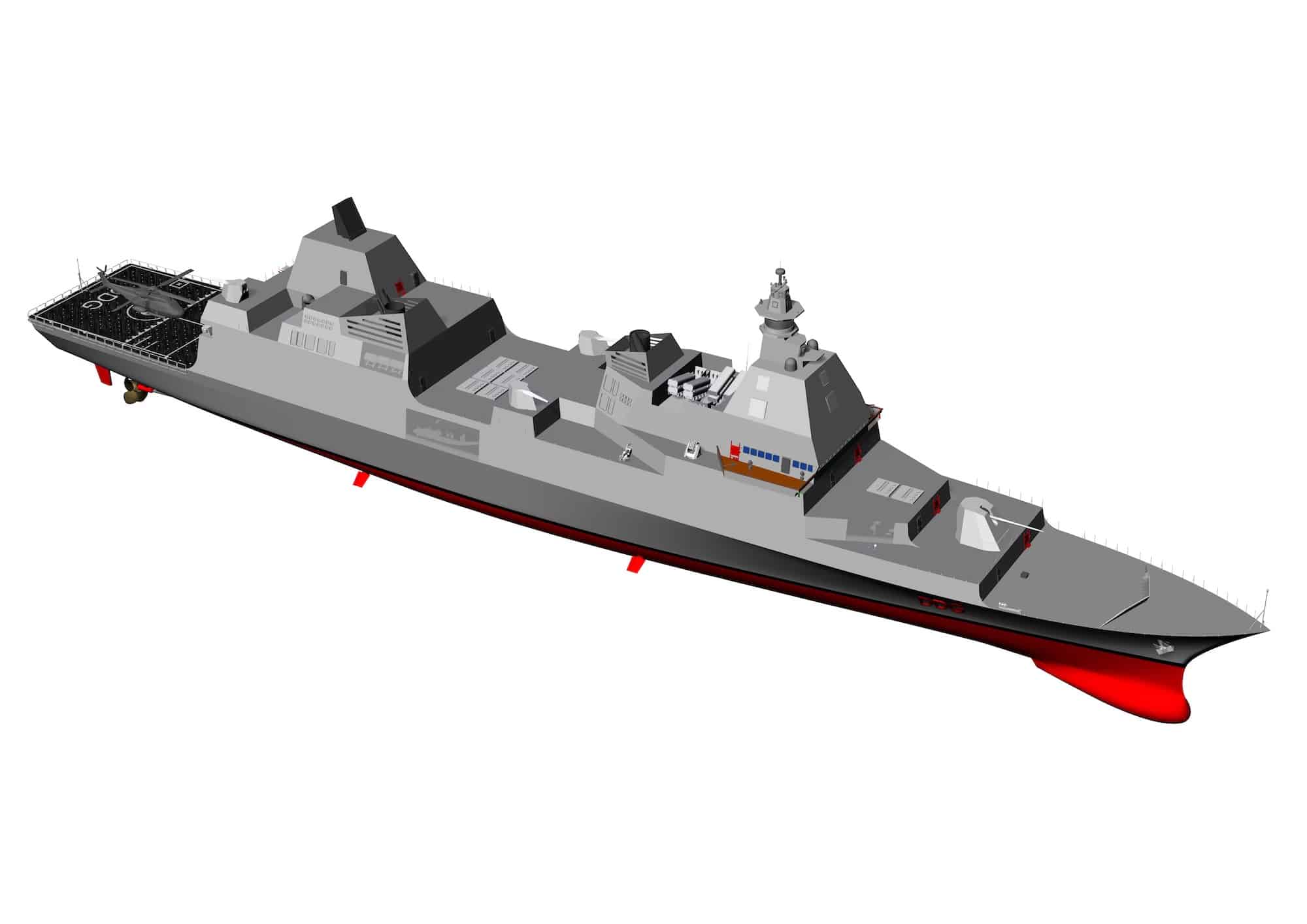
Orizzonte Sistemi Navali (OSN), the joint venture owned by Fincantieri and Leonardo, signed a contract worth approximately €3.7 billion, or roughly $4.2 billion, with the Organisation for Joint Armament Cooperation (OCCAR) on September 24, 2026. The deal covers development and production of two new DDX-class destroyers for the Italian Navy. The ships will replace the Navy’s two Horizon-class air defense destroyers, Andrea Doria and Caio Duilio, which entered service in 2007 and 2009.
The agreement covers development, production, logistics studies and initial in-service support. In the coming weeks OSN, which Fincantieri owns 51 percent and Leonardo 49 percent, is expected to sign subcontracts worth approximately €1.8 billion with Fincantieri and approximately €1.7 billion with Leonardo, out of a combined €1.3 billion in options across the overall deal. The Horizon-class ships were originally conceived as a trinational program with France and the United Kingdom before London withdrew in 1999 to pursue what became the Type 45 destroyer. Nearly two decades after Andrea Doria and Caio Duilio entered service, Italy is replacing them with a substantially larger, more heavily digitalized platform, part of a wider European push to modernize air and missile defense at sea as hypersonic threats proliferate.
DDX Destroyer Program Doubles Displacement Over Horizon Class
According to Fincantieri, the DDX platform will measure 180 meters in length and displace 13,500 tonnes, compared with 152.9 meters and 7,050 tonnes for the Horizon-class ships it replaces, an increase of roughly 90 percent in displacement on a one-for-one hull swap. Crew size is set at 251, versus roughly 200 aboard the older ships, a modest increase for the size difference that points to heavier reliance on automation. Fincantieri states the DDX will have a range of 4,000 nautical miles, though the company has not disclosed the speed basis for that figure, complicating comparison with the Horizon class’s 7,000 nautical miles at 18 knots.
The platform is built around what Fincantieri calls the Navis Sapiens concept, a digital architecture intended to collect, correlate and exploit data from every onboard system and turn it into information for operations, maintenance and lifecycle support. The design is open and scalable, according to the company, allowing new systems to be integrated as they mature. Fincantieri also plans a DC power sub-network paired with an energy storage system, an integrated stabilization and steering system, and a digital backbone linking the ship to shore infrastructure, forming a Digital Ecosystem connecting the Digital Ship to a Digital Naval Base for predictive maintenance and logistics support. At speeds up to 15 knots, the same backbone is designed to manage unmanned surface and underwater vehicles, extending detection and protection against aerial, surface and underwater threats. Propulsion machinery and maximum speed have not been disclosed.
SADOC 5 Radar and MBDA Weapons Anchor Air Defense Mission
The combat system is built around Leonardo’s new-generation SADOC 5 C5I command and combat-management suite, paired with a fully digital S-band active electronically scanned array (AESA) radar and a weapon system supplied by MBDA. Fincantieri and Leonardo describe the resulting fit as delivering integrated air and missile defense (IAMD) against aircraft, cruise missiles, ballistic missiles and hypersonic threats, tied into Leonardo’s wider Michelangelo architecture for multi-domain interoperability. Missile types, launcher cell counts and gun armament remain undisclosed, typically finalized later in detailed design.
The Horizon-class ships they replace carry the Principal Anti-Air Missile System, firing Aster 15 and Aster 30 missiles from a 48-cell Sylver A50 launcher cued by the European Multifunction Phased Array Radar (EMPAR), a fit designed in the 1990s primarily against aircraft and anti-ship missiles, not the ballistic and hypersonic threats now driving European air defense requirements. Fincantieri Chief Executive Pierroberto Folgiero called the deal “a strategic milestone for Fincantieri and for Italy’s national defence industry.” Delivery of the first ship is scheduled for 2033 and the second for 2035, leaving years for the combat system to mature before either vessel deploys.
Analysis: The contract signing puts Italy ahead of several NATO allies racing to replace 2000s-era air defense destroyers with systems built to counter ballistic and hypersonic threats. The contrast is sharpened by shared lineage: Italy’s Horizon-class ships and Britain’s Type 45 trace back to the same trinational program that split in 1999 when Britain went its own way. Britain’s intended Type 45 successor, the Type 83, was cancelled in June 2026 in favor of a Hybrid Navy concept built around crewed Common Combat Vessels coordinating networks of uncrewed surface, air and underwater systems, after years of funding uncertainty. Italy’s willingness to commit €3.7 billion and fixed delivery dates to a large, heavily crewed platform, even while building in unmanned-system integration of its own, signals a bet that manned high-end destroyers still anchor NATO’s maritime air defense architecture. Whether that bet pays off will depend on how well SADOC 5 and Leonardo’s sensors can share data with Aegis, SAMP/T and other allied systems once the ships enter service.
OSN’s subcontracts with Fincantieri and Leonardo are expected within weeks, formalizing the industrial split confirmed at signing. Construction milestones, including first steel-cutting, remain unscheduled publicly, and OCCAR has not said whether the order carries options for additional hulls beyond the pair under contract. Full technical specifications, including propulsion output, sensor arrangement and weapons fit, are likely to emerge as the detailed design phase advances toward the lead ship’s 2033 delivery.