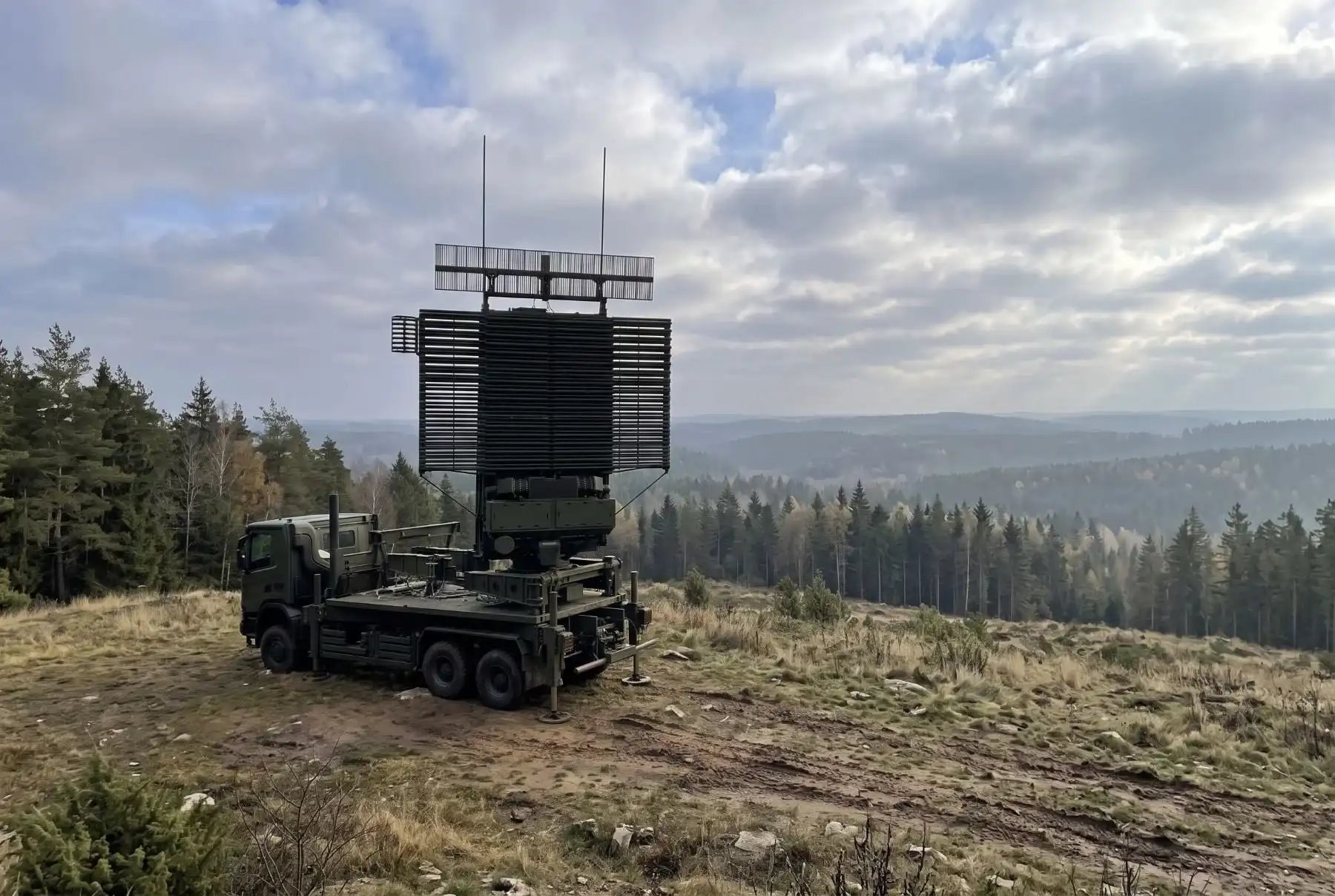
Lithuania has begun deploying U.S.-made AN/TPS-77 Multi-Role Radars (MRR), truck-mounted Lockheed Martin air surveillance systems that will push real-time track data into the NATO Integrated Air and Missile Defense System (NATINAMDS), the Lithuanian Ministry of National Defence announced on October 20, 2026. Vilnius is acquiring three of the radars through a U.S. Foreign Military Sales (FMS) case, with deliveries scheduled to conclude by February 2027.
The deployment addresses a specific vulnerability. Lithuanian air surveillance has relied primarily on fixed AN/FPS-117 long-range radars, which provide persistent coverage but sit at known, static locations. That posture is under growing strain along the border with Belarus, where Lithuanian authorities closed Vilnius International Airport several times in 2025 after smuggler balloons drifted across, and where drones have also entered Lithuanian airspace. To the west, Lithuania borders Russia’s Kaliningrad exclave, which hosts the Baltic Fleet along with S-400 air defense and Iskander-M missile units.
TPS-77 MRR Capabilities Behind Lithuania Air Surveillance Upgrade
The TPS-77 MRR is the most transportable member of Lockheed Martin’s TPS-77 family, itself the mobile counterpart of the AN/FPS-117 fixed radar Lithuania already operates. The system can run directly from its truck at unprepared sites or be dismounted for fixed installation. That flexibility complicates enemy targeting and lets commanders reposition coverage as the threat picture shifts, rather than defending a handful of permanent sites.
The radar operates in L-band (1,215 to 1,400 MHz) and, per publicly available specifications, detects and tracks aircraft out to roughly 250 nautical miles (about 463 km) and at altitudes up to 100,000 feet (30,480 m). L-band trades the fine resolution of higher-frequency fire control radars for long detection range and resilience against weather clutter, which fits the MRR’s role as an early warning and cueing sensor rather than an engagement radar.
Its defining feature is multi-role single-scan technology. Operators assign different missions to different sectors, for example long-range surveillance in one arc and medium-range low-level coverage optimized for helicopter detection in another, and the radar adjusts automatically as it rotates through each 360-degree sweep. For Lithuania, a single emitter can watch the wider airspace toward Kaliningrad while concentrating low-altitude coverage on the Belarusian border. The ministry has not said whether the radars are configured to track balloons or small drones, targets with very low radar cross-sections that long-range L-band sensors are not primarily designed to detect.
Lockheed Martin builds the MRR with gallium nitride (GaN) solid-state transmitters, which cut power consumption, simplify cooling, and improve reliability over earlier generations. Lower power draw also eases the logistics burden of operating from austere, generator-powered sites.
FMS Contract and BALTNET Integration on NATO’s Eastern Flank
The U.S. Air Force Life Cycle Management Center at Hanscom Air Force Base, Massachusetts, awarded Lockheed Martin the sole-source, firm-fixed-price contract (FA2383-23-C-B001) in September 2023. Valued at $52,613,273 at award, it covers three radars, operator training, spares, and interim contractor support, with work performed in Liverpool, New York, and a completion date of February 28, 2027. A September 2026 modification added up to $11.2 million for spare radar parts, bringing the contract’s cumulative face value to about $64.5 million, according to U.S. Department of War contract announcements. The United States is covering more than $29 million of the cost through its Building Partner Capacity program, according to published details of the deal.
The radars will feed BALTNET, the joint Baltic air surveillance network that predates the 2004 NATO accession of Estonia, Latvia, and Lithuania and now contributes a common air picture to the alliance’s northeastern flank. Neighboring Latvia already operates three TPS-77 MRRs, ordered in October 2015 with the first delivered in 2018, alongside three older AN/TPS-77s. Commonality between the two air forces opens the door to shared training and sustainment under a single industrial support base.
Analysis: The move from fixed to mobile sensors tracks a clear lesson from the war in Ukraine, where both sides have systematically hunted static radar sites with missiles and long-range drones. Three MRRs give Lithuania survivable long-range coverage that can relocate under threat, strengthening the early warning layer that cues NATO fighters on the Baltic Air Policing mission and ground-based interceptors. They will not, on their own, close the low-altitude gap exposed by balloons and small drones from Belarus. That problem calls for dense short-range gap-filler sensors, such as those tied to Lithuania’s NASAMS batteries, networked with the MRRs into one picture.
The February 2027 radar delivery deadline marks the next milestone. The ministry has not disclosed how many of the three radars are already operational, where they will be positioned, or whether Vilnius plans to order more. Watch also for whether Lithuania pairs the MRRs with dedicated low-altitude sensors before the 2027 delivery window closes.