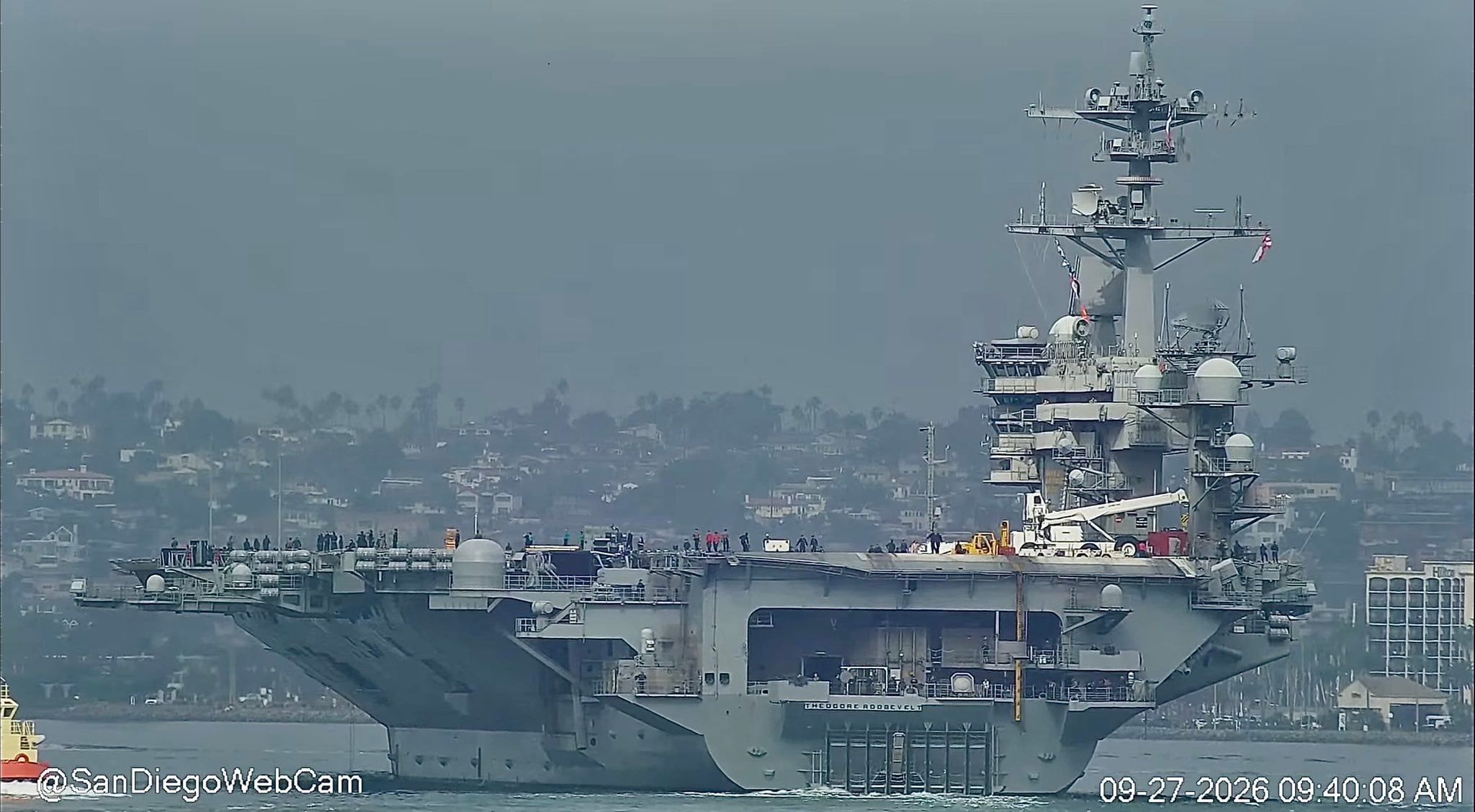
USS Theodore Roosevelt (CVN-71) departed San Diego on September 27, 2026, opening a US Navy carrier deployment that service leaders expect to exceed seven months. Harbor camera footage shows the Nimitz-class carrier outbound from San Diego Bay. The Navy does not discuss future movements, citing operational security, but Carrier Strike Group 9 (CSG-9) is expected to relieve USS George Washington (CVN-73) in the Arabian Sea.
Since Operation Epic Fury began on February 28, 2026, the Navy has kept a carrier in the Arabian Sea, first to launch strikes on Iran and later to enforce a blockade of Iranian ports. USS Gerald R. Ford returned in May after 326 days deployed, the longest carrier cruise in decades. USS Abraham Lincoln, deployed since November 21, 2025, is heading home after more than 300 days, and the Japan-based George Washington took over the station around August 19.
US Navy Carrier Deployment: Roosevelt Strike Group Composition and Timeline
Rear Adm. Marcos Jasso commands CSG-9. According to Navy statements earlier this year, the group comprises Theodore Roosevelt, Carrier Air Wing 11 (CVW-11), Destroyer Squadron 23 (DESRON 23), and the guided-missile cruiser USS Chosin (CG-65). The Navy has not published which destroyers or air wing squadrons deploy on this cruise, so both remain unconfirmed.
The predeployment cycle included advanced training in the US 3rd Fleet area in April, the lead role in Rim of the Pacific 2026 through July, a brief maintenance period in San Diego, and a September 5 sortie for further at-sea training. A Navy official said carriers follow a standard 36-month cycle of maintenance, training, and deployment.
Publicly available specifications indicate Theodore Roosevelt, commissioned in October 1986, displaces roughly 100,000 tons at full load, measures about 1,092 feet, and uses two A4W nuclear reactors driving four shafts for speeds above 30 knots. Reactor power removes fuel as a limit on range, so endurance depends on aviation fuel, munitions, spare parts, food, and crew resilience. A docking overhaul at Puget Sound Naval Shipyard from 2021 to 2023 retrofitted the flight deck to support the F-35C Lightning II, E-2D Advanced Hawkeye, and CMV-22B Osprey.
The Navy has concentrated its preparations on endurance. Chief of Naval Operations Adm. Daryl Caudle and Master Chief Petty Officer of the Navy John Perryman said on September 8 that the carrier has expanded storage for food and hygiene supplies, that a specialist team optimized its climate control systems, and that new fitness and entertainment equipment is being added. Perryman said in August that the crew is planning for eight months away.
Arabian Sea Blockade Mission: Missile Threat and Logistics Demands
Roughly 19 US warships operate in the Arabian Sea, and US Central Command (CENTCOM) reported that the blockade had redirected 110 commercial vessels as of September 21. CENTCOM said the Islamic Revolutionary Guard Corps (IRGC) targeted US warships with ballistic missiles in early September, that a carrier and a destroyer evaded the attacks without damage or casualties, and that US forces destroyed Iranian oil tankers in response.
Iranian-affiliated channels claimed the IRGC fired the Qassem Basir anti-ship ballistic missile, unveiled in May 2025 with a stated range of 1,200 kilometers. The claim is unverified. Open-source specifications list the carrier’s self-defense suite as Evolved Sea Sparrow Missiles, Rolling Airframe Missiles, and Phalanx close-in weapon systems, leaving area missile defense to its escorts. Aegis-equipped cruisers and destroyers can engage ballistic missiles in two layers, using Standard Missile-3 (SM-3) in the midcourse phase and Standard Missile-6 (SM-6) in the terminal phase, and both draw on a finite number of vertical launch system (VLS) cells.
Logistics carries equal weight. Caudle said in August that the Navy has built a combat logistics force supply chain able to sustain two carrier strike groups on station, drawing on Diego Garcia and parts flows from Singapore, Japan, and the Philippines. The service is weighing port calls in Africa, India, and Singapore for Arabian Sea carriers, after Lincoln went eight and a half months without one. Families of Lincoln sailors raised concerns in August about food and water shortages and mail disruptions, and the Navy says it is applying those lessons to Roosevelt.
Analysis: Roosevelt’s departure sustains the US Navy carrier deployment rate rather than raising it. The Navy is holding two carriers on station against Iran while the Western Pacific has no carrier on patrol, and it is paying for both with longer cruises and thinner maintenance margins. Deployments have averaged about 8.5 months since October 2023, and Roosevelt’s crew is planning for eight. Washington’s move from Japan and Lincoln’s transit home opened the Pacific gap, though a Navy official said regional posture remains strong. On September 24, Chinese warships and coast guard cutters obstructed a Philippine resupply mission to Second Thomas Shoal, according to Manila. The binding constraint is hulls and crews, not requirements.
The US Navy carrier deployment now turns on four decision points: disclosure of Roosevelt’s escorts and route; the handoff with Washington and its return to Western Pacific patrol; Lincoln’s arrival in San Diego, expected in early October, then a drydock period; and the Navy’s port-call plan for Arabian Sea carriers. As of late August, Caudle put the Navy’s need at $6 billion to $8 billion of a pending supplemental for Iran operations. The Navy has not said whether Roosevelt will exercise with allies en route.