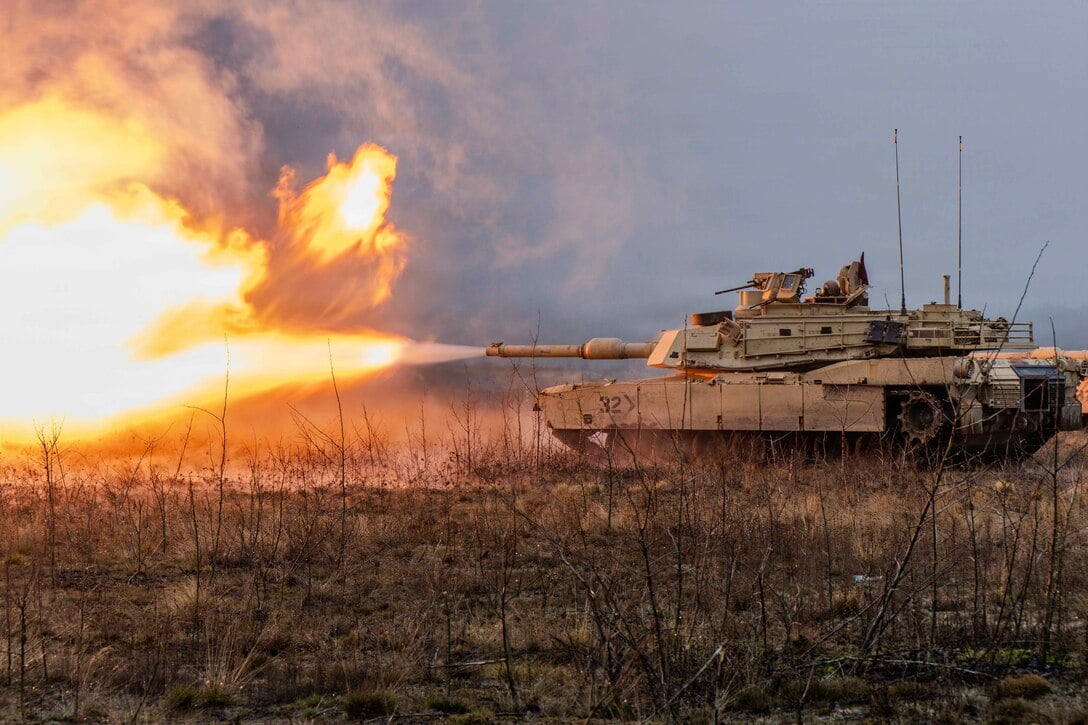
Two US Army battalions, a heavy battalion equipped with M1 Abrams main battle tanks and an engineer battalion, will arrive in Lithuania at the end of October, Lithuanian Minister of National Defence Robertas Kaunas said on September 23, 2026. The force of roughly 1,000 soldiers will serve a nine-month rotation, ending a gap of several months without a US rotational battalion in the Baltic state.
The announcement ends uncertainty that began in May, when the Pentagon announced a rebalancing of US forces in Europe, ordering the withdrawal of up to 5,000 troops from Germany and cancelling the planned positioning of a Fort Hood, Texas-based armored brigade in Poland. The previous Lithuania rotation, more than 1,000 soldiers, departed over the summer without a replacement. President Gitanas Nausėda announced the new rotation on September 22; Kaunas disclosed its size, composition, and timing a day later, after meeting Elbridge Colby, the Pentagon’s under secretary for policy.
US Army Lithuania Rotation Pairs Abrams Tanks With Engineers
US Army officials in Europe have linked the deployment to a routine rotation announced on August 24, under which the 2nd Brigade Combat Team, 1st Infantry Division, based at Fort Riley, Kansas, replaces the 1st Brigade Combat Team, 1st Armored Division. The Army has not named the battalions assigned to Lithuania, and US European Command has declined to confirm troop numbers, citing operational security. The figure of about 1,000 comes from Vilnius, which has said it can host up to 1,500 US troops.
Nor has the Army specified which Abrams variant will deploy. Publicly available specifications for the M1A2 System Enhancement Package version 3 (SEPv3), the most recent variant fielded to US armored units, indicate a combat weight of roughly 73 short tons, a 120mm M256 smoothbore gun, and a 1,500-horsepower AGT1500 gas turbine. Earlier US heavy rotations at the Pabradė Training Area, near the Belarusian border, fielded Abrams tanks alongside M2 Bradley infantry fighting vehicles and M109 Paladin self-propelled howitzers. Whether the incoming battalion brings the same combined-arms mix is undisclosed.
That weight is why the engineer battalion carries as much operational meaning as the tanks. A formation built around 70-ton-class vehicles depends on routes, bridges, and crossing sites able to bear it, and on units that can breach obstacles, clear mines, and prepare defensive positions. Kaunas said the engineers will support the development of Lithuania’s division, border protection, and defense projects. That tasking tracks Vilnius’ own priorities: the €710.5 million State Defence Fund allocation for 2026 funds the national division, counter-mobility measures, and military mobility infrastructure. Specific engineer tasks, sites, and equipment have not been published.
Host Nation Support Frames the Permanent Base Debate in Vilnius
Lithuania has worked to make US presence inexpensive for Washington to sustain. On November 26, 2025, Kaunas announced an open-ended expansion of Lithuania’s host nation support package, under which Vilnius covers all costs of sustaining US troops in the country, and described it as a €240 million investment alongside new barracks, dining, and fitness facilities at Pabradė. The two governments are also drafting a 20-year development plan for the training area.
At the Pentagon, Kaunas went a step further and proposed that Washington consider a permanent US base in Lithuania. He said no decision was taken and that the question remains open, noting that US officials described Lithuania as a reliable ally that invests in its own security. Permanent basing would also run into Article 137 of the Lithuanian Constitution, which bars foreign military bases and weapons of mass destruction from national territory. An amendment deleting the article, registered by 50 lawmakers on July 3, cleared the Seimas Committee on Legal Affairs on September 9. Adoption requires two votes of at least 94 of the Seimas’ 141 members, held at least three months apart.
The US battalions will also operate beside a permanent allied heavy force. Germany stood up Panzerbrigade 45 in Lithuania in 2025, with a planned strength of 4,800 soldiers and 200 civilian staff and full operational capability targeted for 2027. Lithuania has separately ordered 44 Leopard 2A8 tanks for its own tank battalion, building a layered armored posture in which the US heavy contribution remains rotational while Germany’s is permanent.
Analysis: The rotation restores capability without restoring certainty. By sending a heavy battalion rather than a lighter force, Washington keeps US armor inside Lithuania’s defense planning as Russian pressure persists, including a suspected Russian drone that allied fighters shot down over Lithuania on September 15. The summer gap, however, showed that rotational presence can lapse with a single posture decision. Vilnius is responding by lowering the cost of presence and clearing the legal ground for permanence, a bet that a US footprint cheaper to keep than to withdraw will survive future reviews. The engineer battalion adds substance to that bet: mobility and counter-mobility work bears directly on NATO’s ability to reinforce the Baltic states through the Suwałki Corridor, the roughly 65-kilometer strip of Polish-Lithuanian border between Belarus and Russia’s Kaliningrad exclave.
The next marker is the arrival: Kaunas did not say whether the full force will be in place by late October or will begin arriving then, and the Army has yet to name the units. A nine-month tour would run into summer 2027, leaving the successor rotation undecided. The Seimas votes on Article 137 and any Pentagon response to the permanent base proposal will show whether Lithuania can convert rotational presence into a fixed US footprint.