Iran is rebuilding Eagle 44, the Islamic Republic of Iran Air Force (IRIAF) underground airbase carved into a mountainside in Hormozgan province, despite at least three rounds of airstrikes on the site since February 28, 2026. Planet Labs satellite imagery captured on September 29, 2026, obtained exclusively and analyzed by The War Zone (TWZ), shows a newly finished taxiway segment, strike wreckage cleared from the pavement and runway obstructions removed.
The work cuts against official US assessments of Iranian airpower after Operation Epic Fury, the US-Israeli air campaign launched on February 28. Pentagon chief Pete Hegseth said in April that Iran’s air force had been “wiped out,” and US Central Command (CENTCOM) commander Adm. Brad Cooper told the Senate Armed Services Committee on May 14, 2026, that the IRIAF, which flew 30 to 100 sorties per day before the campaign, now flies none. Tehran is nonetheless investing in a remote base built to shelter strike aircraft, drones and potentially missiles, under a US naval blockade.
Eagle 44 Underground Airbase Layout and IRIAF Strike Role
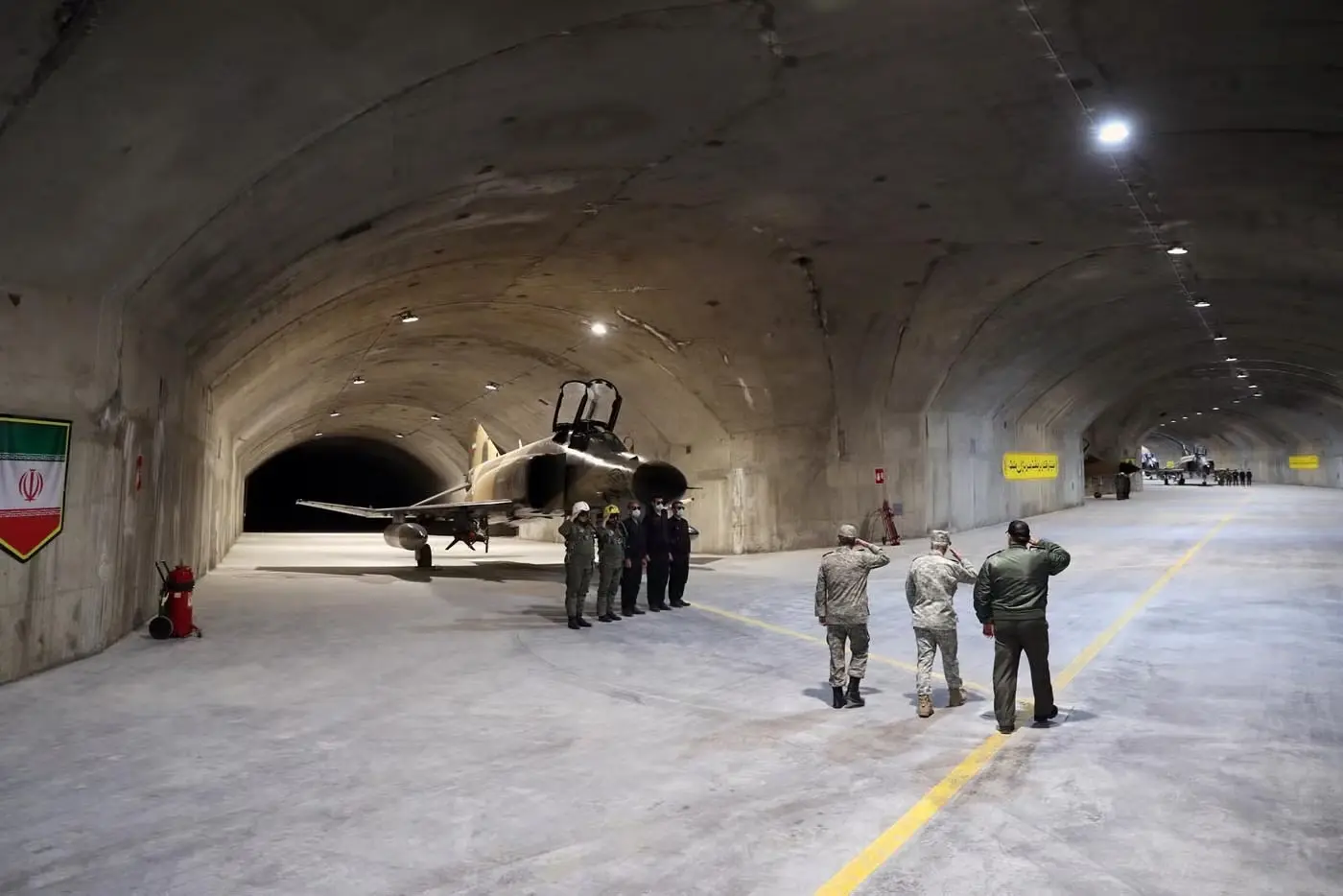
Iranian state media unveiled Eagle 44, also called Oghab 44 after the 44th anniversary of the 1979 revolution, on February 7, 2023, during a visit by then-Armed Forces Chief of Staff Maj. Gen. Mohammad Bagheri. The IRIAF, not the Islamic Revolutionary Guard Corps (IRGC) Aerospace Force, operates the facility, which sits in the Zagros foothills roughly 100 miles (160 kilometers) from the Strait of Hormuz.
Tunneling began in 2013. A 2.7-mile (4.3-kilometer) main runway on the valley floor followed roughly eight years later. Two taxiways cut through a smaller ridge to link the runway with four tunnel entrances, arranged in two pairs less than half a mile apart; only the eastern taxiway has been operational. Iranian officials described an alert area, command post, aircraft hangars, maintenance shops and fuel storage, and the 2023 footage showed at least one internal blast door and side galleries serving as revetments.
That footage featured F-4D/E Phantom IIs armed with AGM-65 Maverick missiles, laser and electro-optically guided bombs and domestically produced anti-ship missiles, alongside one-way attack drones. The IRIAF fielded roughly 60 Phantoms at the time, its most numerous combat jet. Publicly available specifications credit the F-4E with two General Electric J79-GE-17 turbojets producing about 17,900 pounds of afterburning thrust each and a top speed above Mach 2. Iranian media also tied the base to the Asef air-launched cruise missile, reportedly intended for Su-24 Fencer bombers, with a range of about 1,000 kilometers according to Washington Institute analyst Farzin Nadimi. How many Phantoms survive, and how many are flyable, is unknown.
Three Strike Waves Against Eagle 44 Since February 28
Eagle 44 lies within reach of US carrier air wings, Tomahawk-armed destroyers and Air Force bombers operating against Iran. Low-resolution imagery reviewed by TWZ through March 16 showed the base had been targeted with little visible damage. A second attack in late March proved more effective: high-resolution imagery reported in April showed craters on the taxiways near the tunnel entrances, one building leveled and earth mounds placed along the runway, apparently by Iranian forces to block hostile landings. The damage pattern pointed to an effort to sever the caverns from the runway and trap whatever was inside. Neither Washington nor Jerusalem claimed that strike, although US forces primarily covered Iran’s southern flank.
After the April ceasefire collapsed and a second blockade began, CENTCOM struck targets across Iran on July 15, hitting Eagle 44 at least a third time. Imagery from July 16 reviewed by satellite platform Soar Atlas identified four aimpoints, cratered taxiways and damage to structures it linked to the base’s construction unit, a claim TWZ has not independently verified. The Pentagon and CENTCOM have never named Eagle 44 publicly, and Iran has not acknowledged any strike on the base.
September 29 Imagery Shows Second Taxiway Advancing at Eagle 44
According to TWZ’s annotated analysis of the imagery, the runway is now clear of the obstacles placed earlier in the war. On the western taxiway, a new segment leading into the ridge pass-through is complete, with its upper concrete layer visible. Beyond the pass, the next segment is at the subgrade stage, with stabilized, compacted soil laid but not yet paved. Impact craters remain visible in front of the western tunnel entrances.
On the eastern taxiway, two dark streaks that appeared after the July strikes run off the pavement edge. Their width matches the wreckage seen earlier, which TWZ assesses indicates struck equipment was bulldozed aside to reopen the route rather than recovered. In the support compound beside the western taxiway, two buildings remain destroyed and a third damaged, with no sign of rebuilding.
That sequencing is operationally coherent. As TWZ notes, a second taxiway would give the western hangars a direct path to the runway, removing a single-lane bottleneck on sortie generation, and would ensure one cratered taxiway or collapsed pass-through no longer isolates the complex. The four tunnel portals appear intact, though the imaging angle does not show whether they are open or sealed.
Analysis: Eagle 44 fits a pattern visible across Iran’s hardened infrastructure: strikes on portals, taxiways and access roads impose delay, not destruction. Satellite imagery analysis published in late May found Iran had reopened 50 of 69 tunnel entrances struck at 18 underground missile facilities, largely with bulldozers and dump trucks. Reaching the caverns themselves would demand deep penetrators such as the 30,000-pound-class GBU-57 Massive Ordnance Penetrator, available in limited numbers and deliverable only by the B-2A Spirit; TWZ judges it highly unlikely Washington would expend them on this site. Repaving taxiways while under blockade indicates Tehran still values Eagle 44 as a hardened strike base near the Strait of Hormuz, whatever it currently shelters.
Key unknowns remain the contents of the caverns, the size of the surviving IRIAF fighter fleet and whether the portals are sealed. The next indicators are paving of the remaining western taxiway segment and any reconstruction of the support compound. If US or Israeli strikes resume after the current lull, the construction alone could, as TWZ notes, return Eagle 44 to the target list.