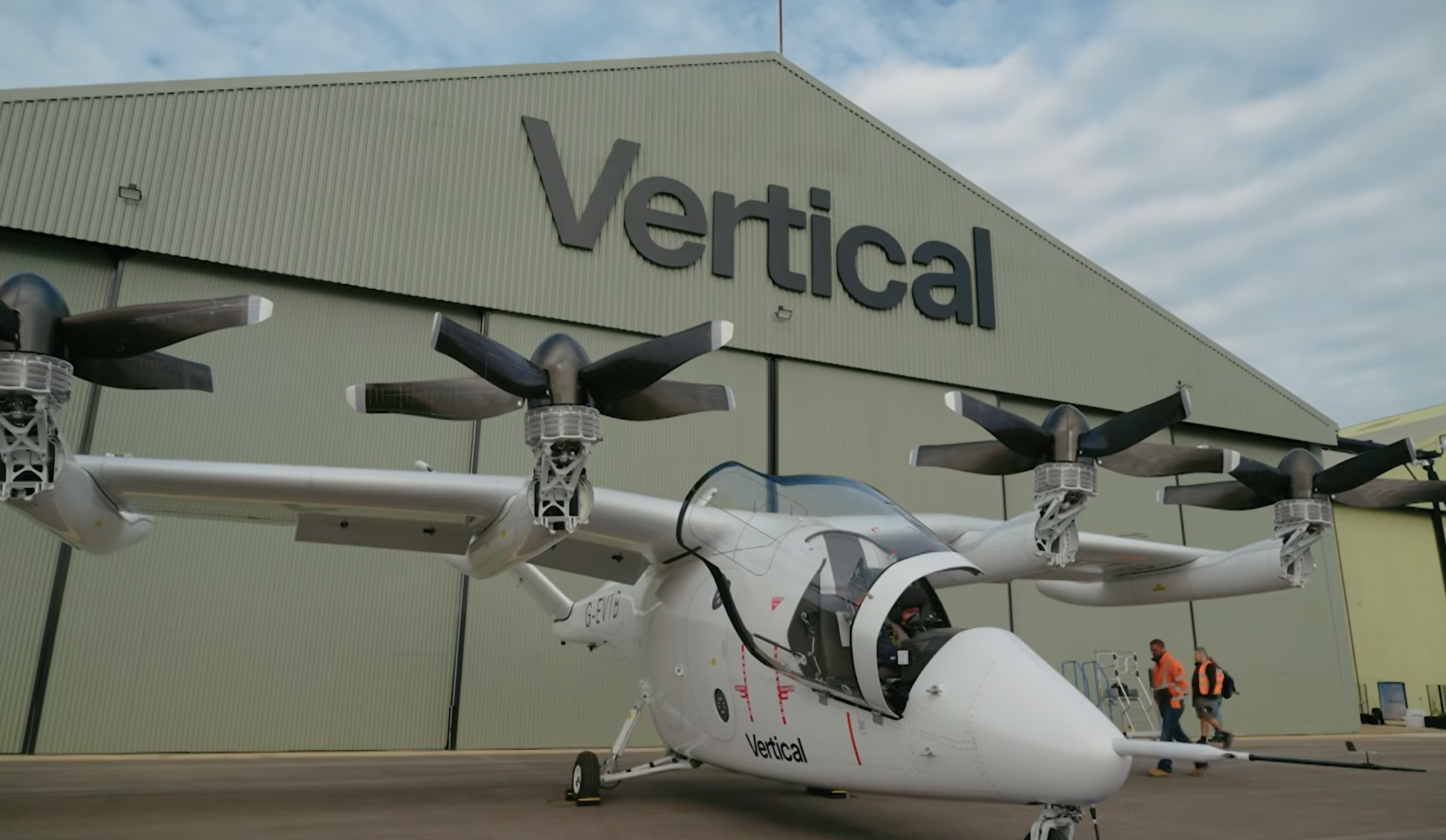
Vertical Aerospace, the British developer of the Valo electric vertical take-off and landing (eVTOL) aircraft, announced on September 25, 2026 that it has opened an Aircraft Assembly Centre at Cotswold Airport, Gloucestershire. The £1.5 million, 60,000-square-foot facility will build the certification-conforming Valo eVTOL airframes needed for UK Civil Aviation Authority (CAA) type certification, targeted for 2029, plus a hybrid-electric demonstrator central to the company’s defense pitch.
The opening caps a summer of schedule and financing changes. On July 13, 2026, Vertical pushed certification from 2028 to 2029 after re-baselining its program ahead of a Critical Design Review (CDR) due by year-end. At the Farnborough International Airshow that month, it said the UK Ministry of Defence (MoD) had confirmed interest in its hybrid-electric and autonomous capabilities. It then announced roughly $100 million in proposed financing and, on September 21, named former Airbus Commercial Aircraft chief executive Fabrice Brégier as chair.
Inside the Valo eVTOL Assembly Line at Cotswold Airport
The new center, a refurbished wartime hangar beside Vertical’s flight-test operation, brings the company’s footprint at the airfield to about 130,000 square feet. Final assembly will integrate airframe structures from Belgium’s Sonaca, electric propulsion units (EPUs) from Evolito, a 2021 spin-out of motor specialist YASA, Honeywell Aerospace flight control and aircraft management systems, and battery packs built in-house at the Vertical Energy Centre.
Co-locating the line with flight test lets airframes move straight from assembly into ground and flight trials and shortens feedback loops between manufacturing and engineering, a practical way to cut integration risk on a new aircraft class. Assembly of the first certification-conforming Valo is scheduled to begin in the fourth quarter of 2027, with conforming flight testing expected in 2028. Seven airframes are reportedly planned for the certification campaign.
Publicly available specifications indicate the all-electric Valo targets a range of up to 100 miles, a top speed of 150 mph and a 550 kg (1,200 lb) payload at entry into service. Eight EPUs, four of them tilting, each draw on multiple electrically isolated power lanes, and eight liquid-cooled under-floor battery packs allow a recharge of about 12 minutes on short missions. The cabin seats four passengers plus a pilot at launch, expandable to six. The aircraft is designed to the CAA and European Union Aviation Safety Agency (EASA) SC-VTOL Category Enhanced standard, the airliner-level tier of one catastrophic failure per billion flight hours.
Once certified, the center can assemble more than 25 aircraft a year, a low-rate initial production figure. Volume manufacturing will move to a separate plant that Vertical expects to announce in the fourth quarter of 2026, while an expanded Vertical Energy Centre opening later this year is meant to triple battery output over time.
How the Hybrid-Electric Valo Anchors Vertical’s Defense Strategy
The facility’s second task carries the defense angle. In the first half of 2027, engineers will retrofit a prototype with Vertical’s hybrid-electric powertrain for flight testing. The system pairs a sustainable aviation fuel (SAF)-compatible gas turbine with an electric generator, so the turbogenerator supplies electrical power rather than driving the rotors mechanically. Integration testing began on May 19, 2026 on the Hybrid Propulsion Evaluation Rig (HYPER) at Cotswold Airport, and Vertical expects to select a long-term turbogenerator supplier during 2026.
Company targets for the hybrid variant include up to 1,000 miles of range, ten times the all-electric figure, up to 1,100 kg of payload over shorter distances, crewed and uncrewed operation, and low acoustic and thermal signatures suited to sensitive missions. None of these has been demonstrated in flight, and the schedule has already moved: when Vertical launched the hybrid program in May 2025, it projected flight testing in the second quarter of 2026.
Autonomy is the second thread. In July 2026, Vertical signed a memorandum of understanding with Pittsburgh-based Near Earth Autonomy to integrate autonomous flight systems into Valo’s next-generation architecture, a partnership the company frames as a route into near-term defense programs. That month, a VX4 prototype also flew into RAF Brize Norton and RAF Benson under an expanded CAA Permit to Fly en route to Farnborough.
What the MoD’s interest means in practice remains undisclosed. Neither the company nor the ministry has publicly identified a requirement, a funding line, a trial program or a target mission set. For now, it is a statement, not a contract.
Analysis: The £1.5 million outlay signals capital discipline more than industrial scale: Vertical converted an existing hangar rather than tooling a production line. With Germany’s Lilium and Volocopter both having gone through insolvency proceedings, Vertical is one of very few European developers flying a piloted aircraft through full transition, keeping a sovereign British option open in electric and hybrid vertical lift. But a 100-mile all-electric aircraft offers the military little beyond short-range liaison and base logistics, so the defense case rests on a hybrid variant that has not flown and whose flight-test date has slipped by about a year. Until the MoD attaches money or a requirement, defense remains an option on the platform, not a revenue line.
CDR, the production site announcement, the turbogenerator supplier choice and the Vertical Energy Centre expansion are all due by the end of 2026. Hybrid-electric flight testing follows in the first half of 2027, conforming-aircraft assembly in the fourth quarter of 2027 and type certification in 2029. The open question is whether the MoD funds a trial before the hybrid demonstrator flies.