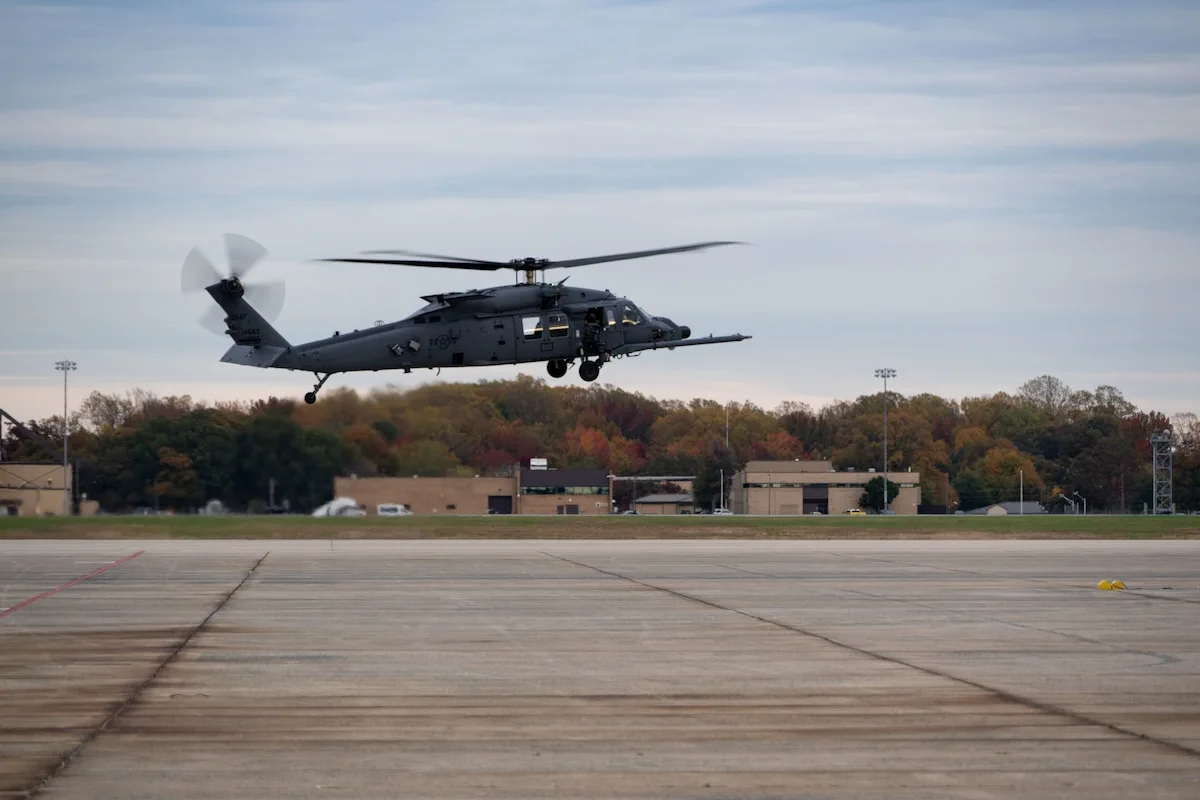
The U.S. Air Force received its first HH-60W Jolly Green II at Joint Base Andrews, Maryland, on November 2, 2026, starting the replacement of the UH-1N Huey fleet that has flown senior leader airlift and contingency response over the National Capital Region since 1971. The helicopter joins the newly activated 5th Helicopter Squadron.
The delivery follows the Department of the Air Force’s August 12, 2026, selection of Andrews as the preferred location to replace its 26 UH-1Ns with 26 HH-60Ws, and the August 27 activation of the 5th Helicopter Squadron, the base’s first new Air Force helicopter unit in 60 years. The Huey’s age is showing: the fleet’s mission capable rate slipped below 75 percent in 2024, and three Andrews airframes date back to the Vietnam War.
HH-60W Jolly Green II vs UH-1N: Speed, Range, and Lift
The HH-60W is a Sikorsky derivative of the UH-60M Black Hawk, developed under the Combat Rescue Helicopter program to replace the HH-60G Pave Hawk. It first flew on May 17, 2019, and was declared at initial operational capability in October 2022. It retains the UH-60M’s T700-GE-701D turboshafts and wide-chord rotor blades but adds new structures, notably enlarged internal fuel tanks.
Publicly available specifications indicate a maximum gross weight of 22,500 lb, more than double the UH-1N’s 10,500 lb, with each engine rated at 1,857 shp. A 644-gallon main fuel tank, up from 360 gallons on earlier aircraft and roughly double the HH-60G’s internal capacity, supports a published range of 690 miles, extendable by aerial refueling. The UH-1N is credited with just over 300 miles and cannot refuel in flight.
The Air Force says the Jolly Green II delivers nearly three times the Huey’s airlift capability. For Andrews, that means more passengers or cargo per sortie and longer dispersal legs without a fuel stop, both central to evacuating officials from the capital in a crisis.
A digital glass cockpit replaces the Huey’s analog instruments, and the HH-60W both transmits and receives ADS-B data, where the UH-1N only transmits, a real margin in Washington’s congested airspace. The baseline rescue configuration also carries a survivability suite, including radar, missile and laser warning, chaff and flare dispensers and cockpit and cabin armor. The planned Andrews modifications will remove the combat search and rescue gun system, the chaff and flare buckets, the armor and the personnel litter, and reconfigure the cabin for 11 passengers.
How the Air Force Sourced 26 HH-60Ws From Backup Inventory
Andrews was not originally slated for the Jolly Green II. For years, the Air Force planned to replace the capital’s Hueys with the Boeing MH-139A Grey Wolf, a militarized Leonardo AW139 bought primarily for intercontinental ballistic missile field security. Budget cuts reduced the Grey Wolf buy from 84 aircraft to 42, confining it to the nuclear security mission and leaving executive airlift in the National Capital Region without a funded replacement.
The fiscal 2026 budget closed that gap with aircraft the service already owned. Budget documents allocated $15.1 million in supplemental funds, plus discretionary funds, to modify 26 HH-60Ws held in backup inventory for Air Force District of Washington requirements. The Air Force said modifying previously procured airframes was more cost effective than buying additional MH-139As.
The math rests on congressional add-ons. The service once planned 113 HH-60Ws and cut the program to 85 in its fiscal 2023 budget, but Congress restored funding, and the fiscal 2026 request states that funding is available for 100 aircraft, including 11 test airframes. Drawing 26 from that pool leaves roughly 74 for combat search and rescue.
The MH-139A has since recovered. Its program objective rose to 56 aircraft in the fiscal 2026 budget, and Boeing announced on September 29, 2026, a four-aircraft order, the program’s first full-rate production award, with 27 helicopters delivered to date.
5th Helicopter Squadron Roadmap to Full Operational Capability in 2030
The transition is built around one constraint: the alert mission cannot pause. The 1st Helicopter Squadron, which has conducted immediate-response contingency operations since 1969, must keep crews on call throughout. The 5th will train the force and build the new fleet while the 1st holds the mission on the UH-1N.
Formal aircrew conversion begins in 2027, when designated classes from both squadrons receive familiarization training from certified Sikorsky aircrews. Select graduates will then qualify to instruct fellow crewmembers in HH-60W safety and familiarization procedures, creating an organic training pipeline at Andrews. As classes graduate, both squadrons will build a pool of crews qualified on both types, allowing responsibilities to shift incrementally rather than in a single cutover.
“It is inherently a joint airframe, meaning that almost any branch or agency in the area can call on us and we can lend a hand, or an aircraft,” said Capt. Joshua Lemon, 316th Operations Group executive officer and UH-1N instructor pilot, who will join the first transition class.
The Air Force targets initial operational capability in 2029 and full operational capability in 2030, when both squadrons are expected to fly the HH-60W full time. The new unit adds about 60 personnel to the base. Col. Karl W. Seekamp, 316th Wing and installation commander, said the mission “deserves the modern capability and safety upgrades that are available today.”
Analysis: The Andrews plan trades combat rescue depth for a fast, low-cost answer to a continuity of government gap that budget cuts left open. Repurposing 26 airframes avoids a new procurement line and gives the capital a helicopter with aerial refueling, which the Huey lacks. The cost is margin: the rescue community keeps roughly 74 Jolly Green IIs as Air Force officials explore alternatives for recovering downed aircrew in a high-end fight.
Next milestones are the delivery pace of the remaining 25 aircraft, the 2027 start of Sikorsky-led training and the 2029 initial operational capability date. The Air Force has not disclosed the delivery schedule. Budget documents place the VIP-transport modifications in fiscal 2028 through 2030, and unmodified HH-60Ws will be used to qualify aircrew in the meantime. Until 2030, the Huey still anchors the capital’s alert helicopter mission.