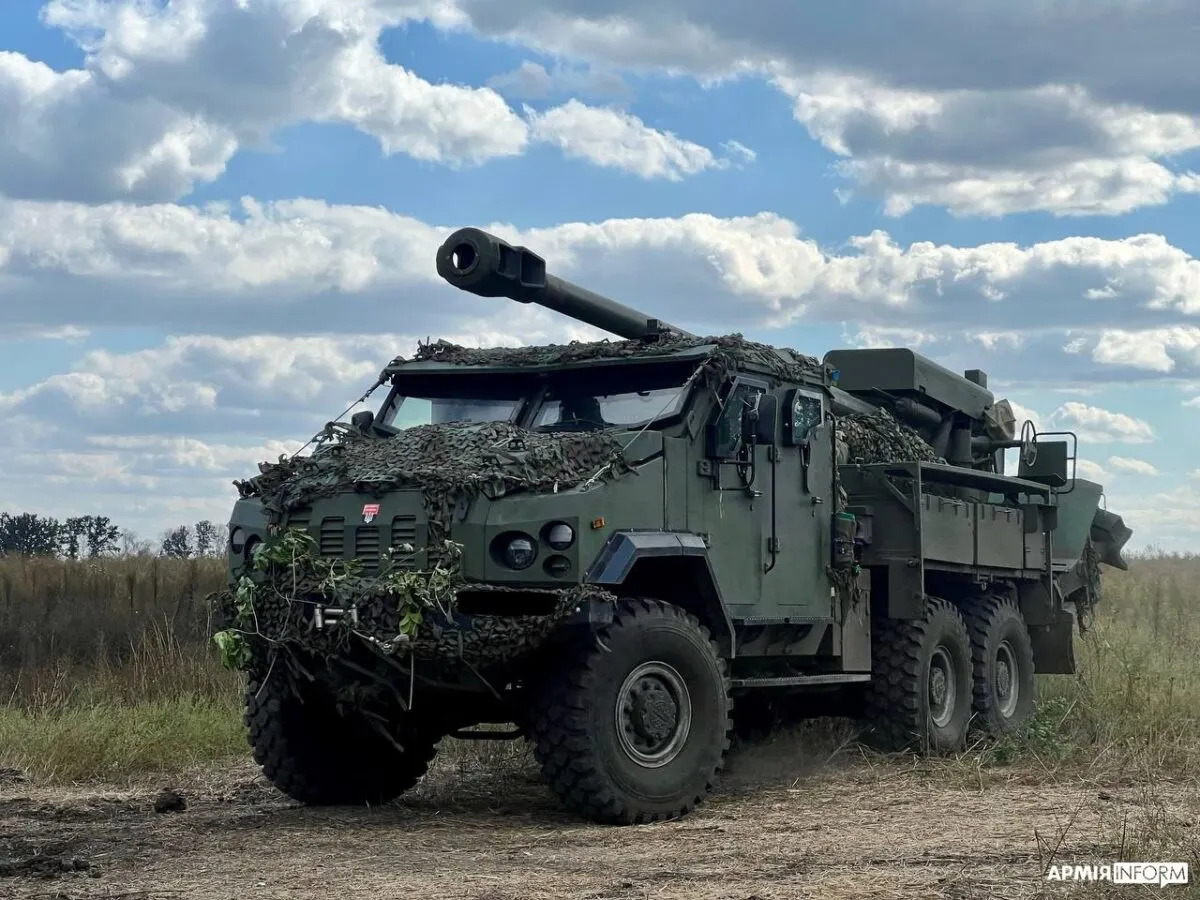
Polish defense firms PK MIL and SZCZĘŚNIAK Pojazdy Specjalne have signed a memorandum of understanding (MoU) to select and adapt wheeled chassis for the Ukrainian-designed 2S22 Bohdana, a 155mm self-propelled howitzer that PK MIL plans to build in Poland, where the partners spell it Bogdana. The MoU was signed on September 11, 2026, at the 34th MSPO International Defense Industry Exhibition in Kielce, company representatives told Ukrainian defense outlet Militarnyi, which reported the agreement on November 3, 2026.
PK MIL SA is the joint venture established in October 2025 by PONAR Wadowice and Ukraine’s Kramatorsk Heavy Machine Tool Building Plant, the Bohdana’s designer, with PONAR holding a 51% stake. Plans for Polish production became public in March 2026, targeting both the Polish Armed Forces and foreign buyers, with the towed Bohdana-BG variant also on the roadmap. Building on allied territory opens export markets that Ukrainian-made weapons cannot readily reach. The partners have disclosed no production timeline, contract value, or chassis choice.
Bohdana Howitzer Production in Poland: PK MIL and SZCZĘŚNIAK Roles
Under the agreed division of work, PK MIL will handle the artillery system, while SZCZĘŚNIAK will contribute vehicle design, automotive chassis integration, and adaptation of the carrier to military requirements. The family-owned company, based in Bielsko-Biała, builds heavy recovery and rescue vehicles and fire engines on chassis from MAN, Scania, and SISU. According to the companies, the two sides previously cooperated on 45 heavy recovery and technical rescue vehicles for the Swedish Armed Forces, which carry a complete hydraulic system built by PONAR Wadowice, PK MIL’s parent company. PONAR and SZCZĘŚNIAK also signed a strategic cooperation agreement on April 23, 2026, at the European Economic Congress in Katowice.
The chassis choice is the commercial core of the deal. Jacek Zygmunt, a member of PK MIL’s management board, said platform selection must follow each buyer’s support network, warning that “a chassis that performs perfectly in one region may face servicing infrastructure barriers elsewhere.” For an export customer, a howitzer mounted on a truck family already in its fleet means shared spare parts, mechanics, and driver training rather than a standalone logistics tail.
The scope also extends beyond manufacturing. Marek Warzecha, chairman of PK MIL’s management board, said the cooperation will include maintenance, repair, and operational support delivered directly at end users’ facilities, a through-life offer that weighs heavily in artillery tenders.
Both firms bring adjacent work. PONAR Wadowice supplies hydraulic systems for Poland’s Krab howitzer and Borsuk infantry fighting vehicle, holds a technology transfer to maintain and overhaul K2 tank components, and is developing hydropneumatic suspension for JELCZ heavy trucks with the Polish Armaments Group (PGZ). SZCZĘŚNIAK has signed agreements with Finland’s SISU Auto and will develop tactical and armored versions of the STAR Hyperion 8×8 for WB Group’s GLADIUS reconnaissance and strike system.
2S22 Bohdana Specifications and the Multi-Chassis Production Model
The Bohdana mounts a 155mm L/52 gun firing NATO-standard ammunition, a break from the Soviet 152mm caliber that dominated Ukraine’s prewar artillery. Publicly available specifications indicate a weight of about 28 tonnes, a five-person crew, a six-round loading magazine, 20 rounds carried onboard, elevation from +5 to +65 degrees, and 30 degrees of traverse either side. The manufacturer cites a rate of about five rounds per minute and a maximum range of 41.3 kilometers with conventional rounds, while the companies put range at up to 50 kilometers (31 miles) depending on ammunition. Open-source reporting indicates compatibility with the US M982 Excalibur guided projectile and a deployment time of about 90 seconds. The fire control configuration for Polish-built units has not been disclosed.
That 155mm/52 configuration places the Bohdana in the same class as France’s CAESAR and Sweden’s Archer, but its distinguishing feature is platform flexibility. The 2018 prototype rode on a KrAZ-6322 6×6; later builds moved to the MAZ-6317, Tatra T815-7, and Tatra Phoenix 8×8, with Mercedes-Benz Zetros chassis also supplied for the German-funded Marta variant, which carries a shorter 39-caliber barrel. Vladyslav Belbas, chief executive of chassis integrator Ukrainian Armor, told Militarnyi in January 2026 that the howitzer was being assembled on four chassis types at once because truck supply, not the artillery unit, had become the bottleneck. Ukrainian output reached 40 systems per month in 2025, according to the same report.
Reporting in March 2026 put cumulative production of the self-propelled and towed variants above 600 units. For PK MIL, that record is the business case: the gun module is combat-proven, and the variable is the vehicle underneath.
Export Outlook and Next Steps for a Polish-Built Bohdana Howitzer
Analysis: The MoU targets the layer that Ukraine’s own production run exposed as the constraint. Pairing a combat-proven artillery module with an integrator fluent in MAN, Scania, and SISU platforms lets PK MIL market the Bohdana as a configurable system rather than a fixed vehicle, competing on price and logistics fit against CAESAR, Archer, Zuzana 2, and ATMOS. The partners estimate global demand for wheeled self-propelled artillery could reach several thousand vehicles a year. For NATO, a second Bohdana source on allied territory adds 155mm capacity outside the war zone. Domestic demand remains unproven: Warsaw has invested heavily in tracked Krab and K9 howitzers, and no Polish order for the Bohdana has been announced.
Next steps include finalizing technical requirements and selecting a chassis. As of March 2026, PK MIL was still completing the formal procedures required to manufacture weapons in Poland and has not said whether they are finished. Watch whether the partners settle on a Polish JELCZ platform, given PONAR’s suspension work with PGZ, or a commercial MAN, Scania, or SISU truck, and whether a launch customer, Polish or foreign, commits before serial production starts. No production rate, investment figure, or delivery schedule has been released.