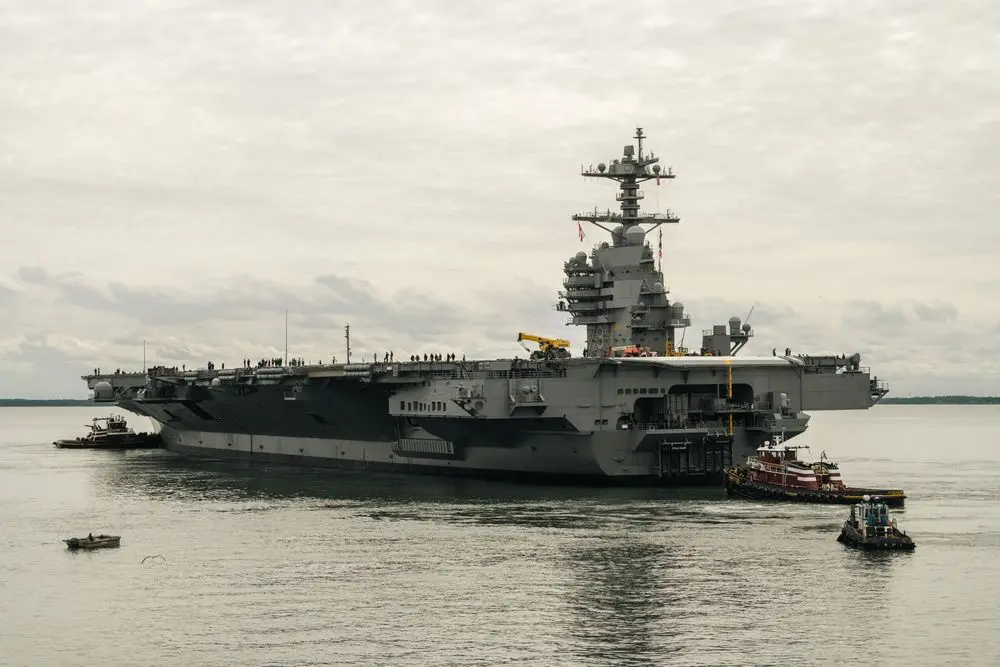
The U.S. Navy took preliminary acceptance of the future USS John F. Kennedy (CVN 79) from Newport News Shipbuilding (NNS), a division of Huntington Ingalls Industries (HII), on September 29, 2026, clearing the second Gerald R. Ford-class nuclear-powered aircraft carrier to begin Navy-led underway test and evaluation ahead of formal delivery in spring 2027. The carrier departed the shipyard the same day and will transition to Naval Station Norfolk.
The step follows acceptance trials completed on August 15, 2026, in which the Navy’s Board of Inspection and Survey (INSURV) assessed the ship against contract specifications. The Navy’s fiscal 2013 budget projected CVN 79 delivery in September 2022; the fiscal 2026 submission moved it to March 2027, a 54-month delay according to the Congressional Research Service (CRS). That budget estimated total procurement cost at about $13.2 billion, including a $150 million cost-to-complete request, against roughly $11.3 billion estimated in 2018.
CVN 79 Preliminary Acceptance and the Four Remaining Weapons Elevators
Preliminary acceptance is a contractual step short of delivery. It lets the Navy take the ship to sea to test systems unique to CVN 79 and build crew proficiency while NNS completes final ship systems testing. According to the Navy, Kennedy is approximately 99 percent complete and all major systems are finished; the outstanding work centers on testing the last four of the ship’s 11 Advanced Weapons Elevators (AWE).
“Achieving preliminary acceptance marks a new phase for the ship and her crew, allowing them to get more water under the keel as they test and train underway,” said Capt. Mark Johnson, the Navy’s program manager for Gerald R. Ford-class new construction. Bryan Caccavale, NNS vice president of program management, called the milestone “another step toward ensuring the U.S. Navy has the aircraft carriers it needs.”
The AWE and the Advanced Arresting Gear (AAG) drove the last major slip. The Navy’s fiscal 2026 budget justification attributed the move from July 2025 to March 2027 to AAG certification and continued AWE work. Seven of the 11 elevators had been delivered before acceptance trials, according to a Navy notification to Congress. The elevators use linear motors rather than cables to move ordnance between magazines, the hangar deck, and the flight deck, and their availability directly governs how quickly an air wing can be rearmed during sustained strike operations. On the lead ship, USS Gerald R. Ford (CVN 78), the final elevator was not turned over until 2021, four years after commissioning. The Navy has not published a completion date for the four outstanding elevators.
How SPY-6 Radar and F-35C Integration Set Kennedy Apart From Ford
Kennedy shares the Ford-class hull and propulsion baseline. Publicly available specifications indicate a length of 1,092 feet, a full-load displacement of about 100,000 tons, a flight deck 256 feet wide, and two Bechtel A1B reactors producing nearly three times the electrical generating capacity of the A4W plant in Nimitz-class carriers. That power margin feeds the Electromagnetic Aircraft Launch System (EMALS), along with the AAG and the elevators. Published Navy program figures set the class sortie generation requirement at 160 sorties per day sustained and 270 surged, against 120 and 240 for the Nimitz class; those remain design requirements, not demonstrated fleet averages.
Two changes separate CVN 79 from its lead ship. Kennedy replaces the Dual Band Radar fitted to Ford with the AN/SPY-6(V)3 Enterprise Air Surveillance Radar (EASR), a fixed, three-face S-band active electronically scanned array built from the same radar modular assemblies as the SPY-6(V)1 on Flight III Arleigh Burke-class destroyers. That commonality is intended to simplify spares, training, and software updates across the fleet.
The Navy also dropped a planned two-phase delivery in 2020, which would have fitted the warfare system after an initial handover. Section 124 of the fiscal 2020 National Defense Authorization Act required CVN 79 to be capable of operating and deploying the F-35C before completing its post-shakedown availability, and the single-phase approach folded reinforced jet blast deflectors and fifth-generation fighter support systems into construction. Unlike Ford, Kennedy is slated to deliver F-35C-capable. Crewing also tightens: Navy homeporting documents assign roughly 2,800 personnel to Kennedy’s crew requirement, about 340 fewer than for the Nimitz-class carrier it will replace.
Analysis: Preliminary acceptance is less a capability milestone than a force-structure hedge. Federal law, 10 U.S.C. 8062(b), requires 11 operational aircraft carriers, and the Navy has held USS Nimitz (CVN 68) in commission until March 2027 to bridge the gap to Kennedy’s delivery. Getting the crew underway roughly six months before delivery compresses the post-delivery work-up while a 51-year-old carrier holds the line. The larger signal concerns the industrial base: HII has said Kennedy was too far along in construction to absorb many Ford lessons learned, which shifts the burden of proving the class learning curve to Enterprise (CVN 80), slated in the fiscal 2026 budget for July 2030 delivery.
Near-term milestones include completion of the four remaining elevators, formal delivery, commissioning, and the inactivation of Nimitz at Newport News. Kennedy then faces its post-shakedown availability, air wing integration including F-35C flight operations, and a homeport shift to Naval Base Kitsap-Bremerton, Washington, where Navy environmental documents set arrival no earlier than fiscal 2029. It would become the first Ford-class carrier based on the West Coast. The Navy has not released an initial operational capability date or a first deployment window.