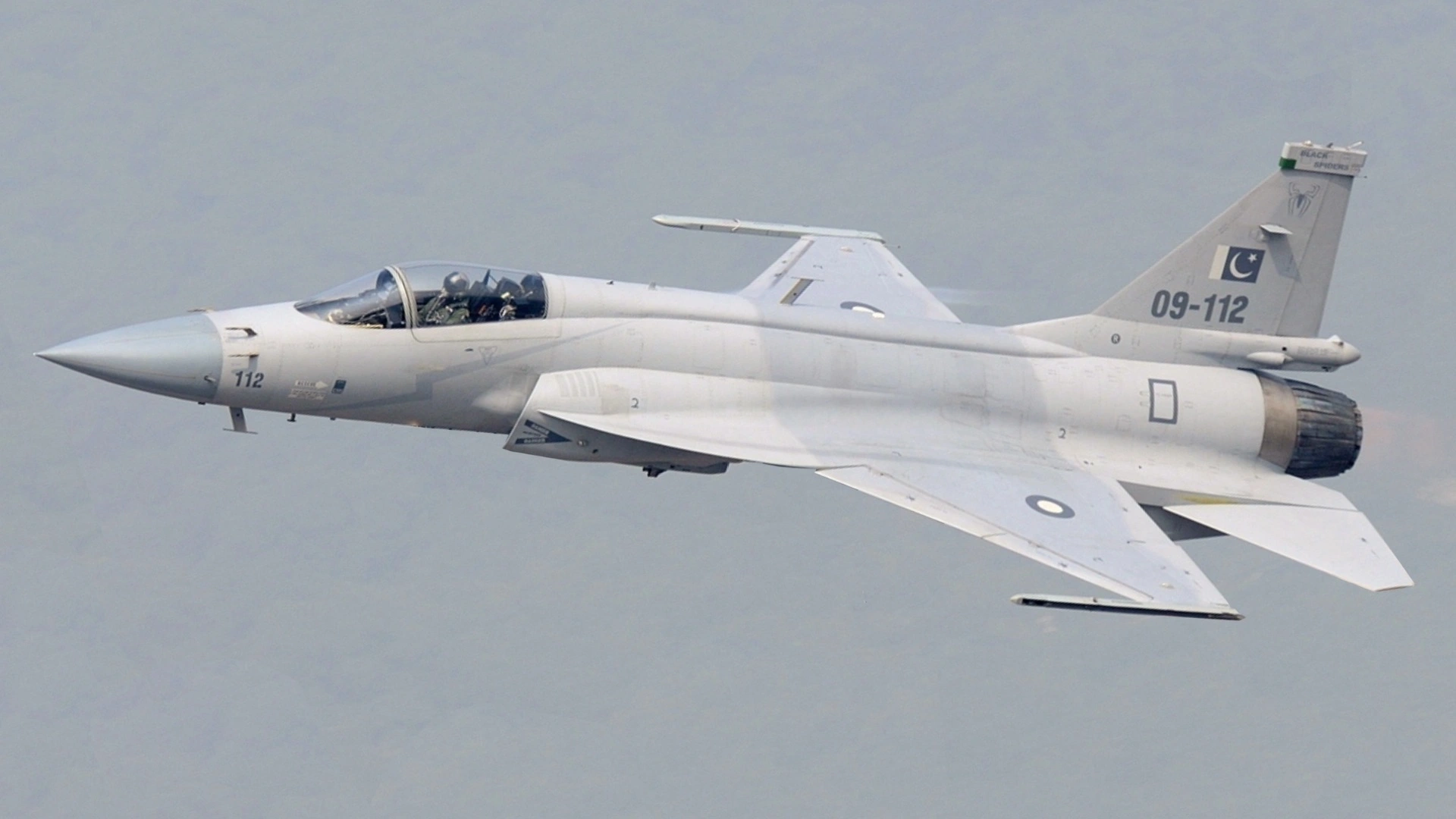
Somalia has reportedly concluded a deal with Pakistan to buy JF-17 Thunder multirole fighters, according to a report by Turkish outlet TRHaber published in early October, but neither government had confirmed a contract as of November 8, 2026. The report disclosed no aircraft count, price, or delivery schedule. Earlier unconfirmed reports described up to 24 JF-17 Block III aircraft in a package worth about $900 million.
Somalia has operated no fighters since its air force collapsed in 1991, and the United Nations Security Council lifted its arms embargo on the federal government only on December 1, 2023. The two governments signed a defense memorandum of understanding in Islamabad in August, and a Pakistan Air Force delegation led by Air Marshal Muhammad Sarfraz presented the Somali air chief with a JF-17 model in Mogadishu in September. Neither side has said the memorandum covers combat aircraft.
Somalia JF-17 Deal: What the Block III Would Deliver
The JF-17, developed by Pakistan Aeronautical Complex and China’s Chengdu Aircraft Corporation, is a lightweight single-engine fighter built around low acquisition cost. The Block III entered serial production in December 2020 and reached the Pakistan Air Force from 2023. Publicly available specifications indicate a top speed of Mach 1.6 to 1.8 depending on the source, eight hardpoints including a chin station for a targeting pod, about 3,600 kg of external stores, a 23 mm GSh-23-2 cannon, and a Russian Klimov RD-93MA afterburning turbofan producing about 91 kN.
The main gain lies in sensors and weapons. The KLJ-7A active electronically scanned array radar is reported to track 15 targets and engage four at once. The aircraft adds a helmet-mounted display, three-axis fly-by-wire controls, infrared search and track, missile approach warning, and integration of the PL-10 short-range missile and the PL-15 beyond-visual-range missile, whose export PL-15E variant is credited with about 145 km of range.
Those systems answer an air threat that al-Shabaab, which fields no combat aircraft, does not present. Their value lies in interstate deterrence and airspace control. Geography sharpens that distinction. Published figures, largely drawn from manufacturer brochures, put the JF-17’s combat radius at about 900 km on internal fuel and about 1,740 km with three drop tanks, while Hargeisa lies roughly 850 km from Mogadishu and the Somaliland port of Berbera about 930 km. On paper, a Mogadishu-based JF-17 could reach Hargeisa on internal fuel and Berbera only with external tanks. The JF-17 gained in-flight refueling with the Block II, but no tanker appears in Somalia’s listed inventory, which consists of helicopters and Turkish-built armed drones.
Funding and Basing Gaps Facing a Somali Fighter Force
Pakistan’s Defence Production Minister, Raza Hayat Harraj, has put the JF-17’s unit cost at $30 million to $40 million. At $900 million for 24 aircraft, the package works out to $37.5 million per airframe, leaving little margin for the pilot training, weapons integration, and logistics support that earlier reports placed inside the package.
Somalia’s finances offer little room. Parliament passed a 2026 federal budget of $1.39 billion, and the finance ministry allocated $275.6 million of it to security while expecting $878.8 million in grants against $479 million in domestic revenue. The reported package would equal about 65% of that budget and more than three times the security allocation. The cabinet’s 2027 draft, approved on October 27, falls to $1.26 billion. Earlier reporting raised possible Saudi financing, which no government has confirmed.
Force generation is the second constraint. Mogadishu would need fast-jet pilots, maintainers, munitions storage, and a secure operating base. Türkiye built facilities for its own F-16s at Aden Adde International Airport, where three of the jets landed on January 28, 2026, alongside T129 ATAK helicopters. Whether Somali JF-17s could share that site is unknown. Critics of the purchase, including a commentary in The Times of Israel, argue that supersonic jets burn more fuel, loiter less, and cost more per flight hour than the drones and turboprops better suited to hunting small militant units. Others, including Aerospace Global News, read the deal as a statement of sovereignty rather than a counterinsurgency tool.
Iraq’s F-16 Dispute Offers a Precedent for Hargeisa
Hargeisa’s public concern has so far centered on Turkish assets, a focus sharpened since Israel recognized Somaliland on December 26, 2025. “We need air defense systems,” Mohamed Osman Fadal, a senior foreign affairs adviser to Somaliland’s president, told Middle East Eye in early October, citing the F-16s in Mogadishu and Turkish plans for a drone base. Somaliland’s defense minister confirmed in June that Israel trains its military and police, while denying talks on an Israeli base.
Iraq offers an imperfect parallel, as Forbes contributor Paul Iddon noted. In 2012, Iraqi Kurdish leader Masoud Barzani lobbied Washington against selling F-16s to Baghdad, alleging that Prime Minister Nouri al-Maliki had told officers to wait for the jets before moving against Erbil. Iraq, which made its first payment for the aircraft in 2011, ordered 36 F-16IQ Block 52 fighters, but the first four reached Balad Air Base only on July 13, 2015, after delays tied to security at the base. By then Maliki had left office, and the jets flew against the Islamic State rather than the Kurds.
Iraqi Kurdistan and Somaliland both consolidated their positions after 1991, and neither has air defenses able to counter fast jets. The differences also matter. Erbil sits inside Iraq’s constitutional order while Somaliland claims statehood, and Iraq bought through U.S. government channels that gave Washington leverage over sustainment.
Analysis: Hargeisa’s immediate concern is Turkish airpower already based in Mogadishu; a Somali JF-17 force would take years to field even under a signed contract. The reported purchase matters more as a political claim over all Somali airspace and as an extension of Pakistan’s defense network into a theater where Türkiye and Saudi Arabia back Mogadishu while the United Arab Emirates and Israel work with Hargeisa. It would also bind a donor-funded state to Pakistani training, Chinese sensors, and Russian engines.
The next markers are an official statement from either government, any fighter-related line when parliament takes up the 2027 budget, and evidence of Somali pilots training in Pakistan. The aircraft count, variant, financing, delivery schedule, and intended base all remain unknown.