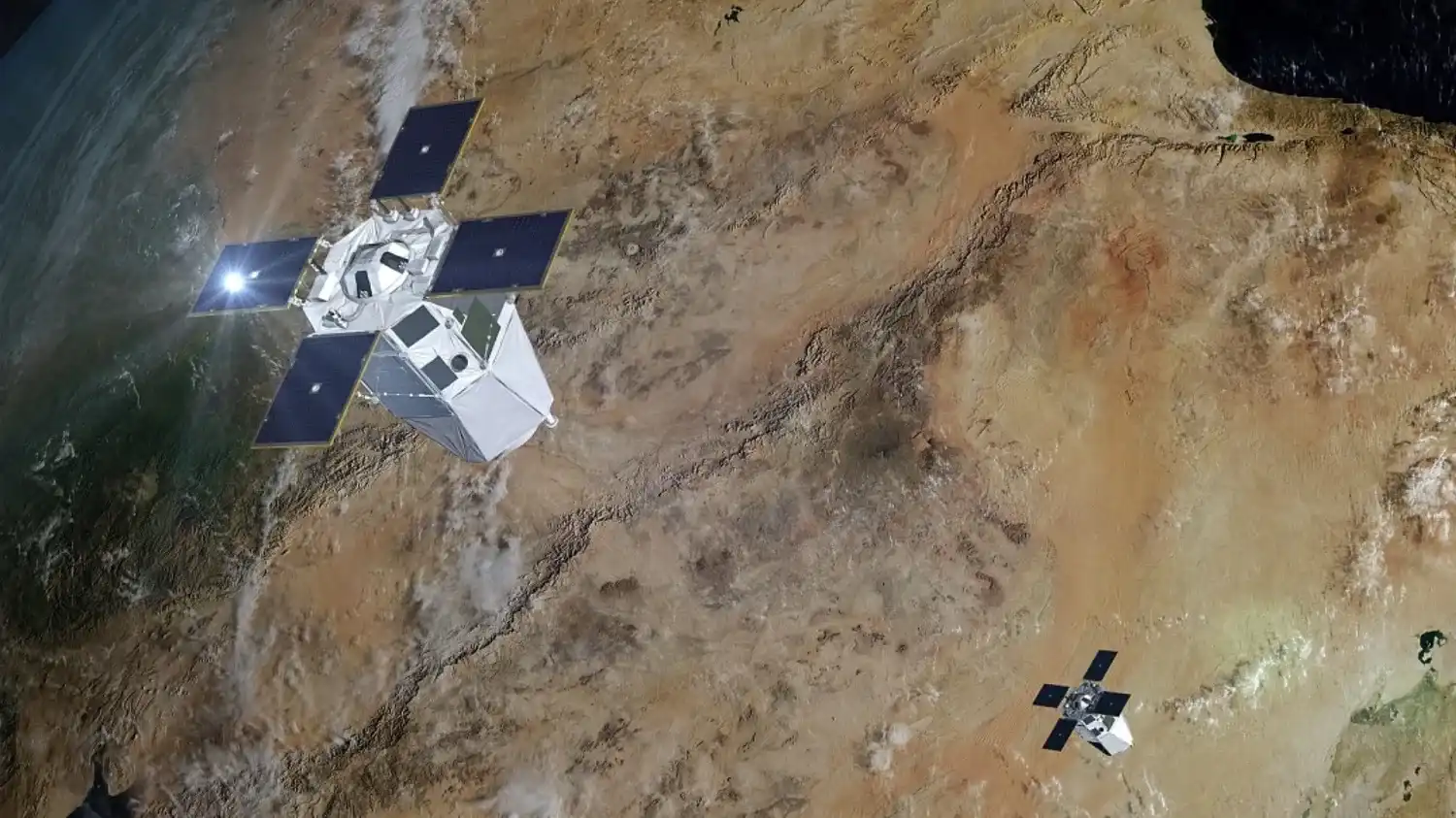
France’s defense procurement agency, the Direction générale de l’armement (DGA), notified Airbus Defence and Space and Thales Alenia Space on November 5, 2026, of the production contract for two IRIS satellites, a deal Airbus values at more than €1.5 billion for the consortium. The military observation spacecraft will replace France’s three Composante Spatiale Optique (CSO) reconnaissance satellites by 2035.
The award moves the successor to France’s main space-based imagery intelligence (IMINT) system into production seven years after the program began in July 2019. Paris once aimed to start the handover in 2030; the updated 2024-2030 military programming law now sets the first satellite’s entry into service around 2033 and places both in orbit by 2035. IRIS, for Instruments de Renseignement et d’Imagerie Spatiale, is separate from the European Union’s IRIS² communications constellation.
IRIS Satellites Contract Splits Platforms, Payloads, and Ground Segment
The contract runs to the end of the 2030s. According to Airbus, it covers detailed design, manufacture, and testing of both spacecraft, the control and user ground segments, and in-orbit operations and maintenance. The DGA also lists an image quality segment within the production phase. Airbus describes itself as lead contractor, while Thales Alenia Space, a joint venture of Thales (67 percent) and Leonardo (33 percent), describes a joint prime contractorship.
Airbus will supply both satellite platforms and a significant share of the first satellite’s payload, and it will hold responsibility for the ground segment. Thales Alenia Space will develop a next-generation payload for the second satellite, provide critical elements of the first payload, and contribute to the ground segment. The companies describe the first-payload split differently, and neither has published work shares. The arrangement builds on CSO, where Airbus built the spacecraft and Thales Alenia Space supplied the optical instrument, but it gives Airbus a larger role in the imaging chain.
The DGA named Lynred, Pyxalis, Sodern, Safran Reosc, and Air Liquide Advanced Technologies among the subcontractors, and Thales Alenia Space also cites Thales SESO. Those firms specialize in infrared detectors, image sensors, space optronics, precision optics, and cryogenics, although their specific IRIS roles remain undisclosed. The list points to a focal plane, mirror, and cooling supply chain anchored largely in France, which gives practical weight to the sovereignty argument Paris attaches to the program.
Extremely High Resolution, Infrared Imaging, and Space Object Surveillance
Neither the DGA nor its contractors have released a resolution figure, orbit, spacecraft mass, or launcher for IRIS. Official descriptions specify day and night collection in the visible and infrared spectrum over any point on Earth at extremely high resolution, with better image quality and faster delivery to users.
Each CSO satellite has a mass of about 3,500 kilograms and a 10-year design life, according to the French space agency, CNES. CSO-1 and CSO-3 fly at about 800 kilometers for coverage and revisit, while CSO-2 operates at 480 kilometers for identification. Public estimates, not official specifications, put ground resolution at about 35 centimeters from the higher orbit and 20 from the lower.
Thales Alenia Space says the first IRIS satellite will replace CSO-1 and CSO-2, while the second will follow CSO-3’s retirement and bring a significant increase in resolution. The company cites a highly stable telescope with latest-generation active optics, very high-sensitivity digital sensors, and artificial intelligence-based image processing. Open sources, unconfirmed by the DGA, designate the spacecraft EHRmin and EHRmax, with silicon carbide mirrors on the former. Those gains carry operational weight because two satellites must eventually do the work of three.
IRIS will also image objects in space to support space surveillance and the characterization of space threats. For the Commandement de l’Espace (CDE), France’s Space Command and the future operator, that requirement adds a non-Earth imaging mission to the country’s main reconnaissance asset, alongside the Yoda and Toutatis on-orbit demonstrators. Imagery of a foreign spacecraft can reveal configuration details that radar tracking alone cannot provide.
Schedule Slip Leaves CSO Fleet Bridging the Gap to 2033
France said in 2023 that it would accelerate IRIS to begin replacing CSO from 2030. Additional risk-reduction studies requested from industry then pushed the schedule right, according to a French parliamentary report, while the ministry cited the need to consolidate the operational requirement and mature critical technologies.
The delay collides with the age of the fleet. Applied to launch dates of December 2018, December 2020, and March 2025, the 10-year design life takes CSO-1 to late 2028, CSO-2 to late 2030, and CSO-3 to early 2035. The first IRIS satellite is due around 2033, at least four years after CSO-1 reaches that limit. CSO-3 itself reached orbit late, after Soyuz launchers became unavailable and the mission moved to Ariane 6.
General Fabien Mandon, chief of the defense staff, told senators on April 29 that the succession of both signals and imagery intelligence satellites was at risk, and said the DGA was working with industry to extend current spacecraft and avoid a capability gap. The ministry has also described space data purchases as a first complementary capability by 2030, to be consolidated by 2035. Reports that France may add small satellites to improve revisit remain unconfirmed.
Musis, the Multinational Space-based Imaging System that frames CSO, includes eight European partners. The DGA says IRIS remains open to cooperation that would give partner nations access to the French system, but it has named no participant.
Analysis: The award commits France to sovereign high-end imagery through the 2030s but does not remove the near-term risk. Until 2033, French space-based optical IMINT will rest on an aging CSO fleet, extended where possible, and purchased data. The shift from three spacecraft to two also concentrates collection on fewer platforms that must share Earth reconnaissance with orbital surveillance. Revisit, more than resolution, is the metric that will show whether the smaller fleet meets operational demand.
The published milestones are entry into service of the first satellite around 2033 and both spacecraft in orbit by 2035. Still unknown are the launcher, any complementary small satellite plan, and which partners will join.