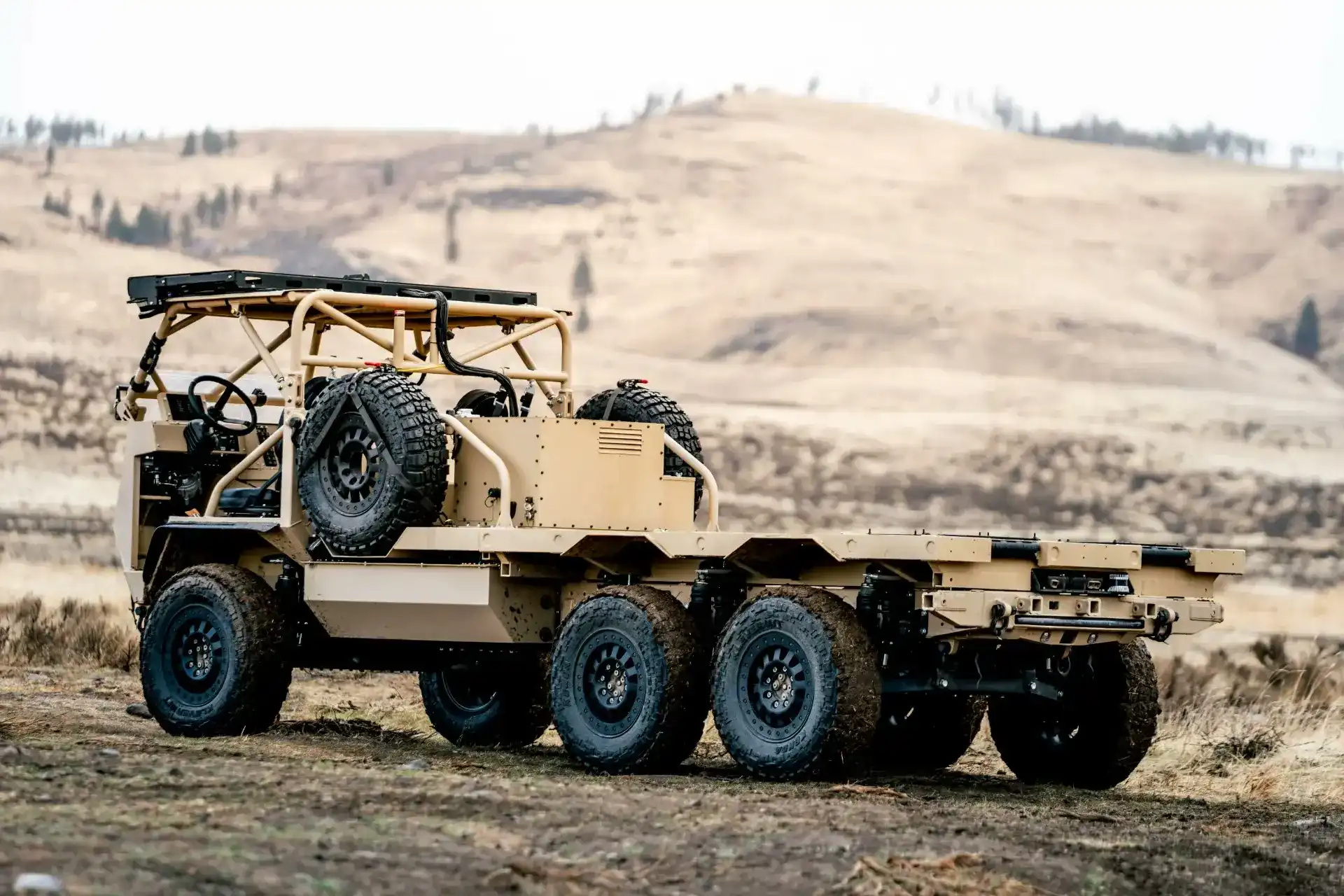
Overland AI has released footage of the RCR 6WAP, a six-wheeled platform built by Richard Childress Racing’s manufacturing arm, driving itself across rough terrain while carrying a heavy payload. The Seattle-based company said in a social media post on November 10, 2026, that the vehicle had been upfitted with its OverDrive autonomy software and core sensing components. “This is what we mean when we say we can make any vehicle autonomous,” the company said.
The demonstration speaks to a central question in US ground robotics: whether autonomy can be added to existing vehicles rather than delivered only through new, purpose-built fleets. Overland AI pursues both paths, selling its SPARK upfit kit alongside its own ULTRA and IBEX vehicles. The company disclosed no payload weight, test location, distance traveled, or whether a safety driver or remote operator was on standby.
Overland AI Autonomy Upfit on the RCR 6WAP Mothership Platform
The 6WAP, short for 6-Wheeled Adaptable Platform and also marketed as the Mothership, is built by RCR Manufacturing Solutions, a defense supplier since 2014 and part of the Richard Childress Racing group behind the NASCAR team. RCR describes the 6×6 as lightweight and modular. Its dimensions, curb weight, powertrain, and rated payload have not been made public.
Before its debut at the Modern Day Marine exhibition in Washington, D.C., April 28 to 30, the platform carried Lockheed Martin’s JAGM Quad Launcher during a live demonstration in which the Joint Air-to-Ground Missile, normally an air-launched weapon, was fired vertically from the ground. At the Association of the United States Army (AUSA) annual meeting in October, Parker Hannifin displayed MDH Strategic Services’ Airwolf counter-drone system on the same vehicle. Overland AI now lists the 6WAP as an autonomous payload platform for missions from drone transport to long-range fires.
The autonomy hardware is SPARK, launched in March 2025. According to company materials, the kit runs OverDrive on a compact ruggedized compute module linked through drive-by-wire interfaces and fed by LiDAR, stereo cameras, GPS, and an inertial measurement unit. Overland AI says OverDrive lets vehicles navigate off-road without GPS or direct operator control, a baseline requirement for units expecting jamming, while the drive-by-wire design preserves manual driving.
From SMET to ROGUE Fires: Overland AI’s Retrofit Track Record
In 2025 the company integrated its autonomy package on General Dynamics Land Systems’ Small Multipurpose Equipment Transport (SMET) for the US Army’s Project Convergence Capstone 5 exercise. It has also integrated OverDrive on Textron’s Ripsaw and Polaris’ RZR, and in April 2026 on a prototype of the US Marine Corps’ Remotely Operated Ground Unit for Expeditionary Fires (ROGUE Fires) launcher.
OverDrive traces back to the Defense Advanced Research Projects Agency (DARPA) Robotic Autonomy in Complex Environments with Resiliency (RACER) program, which tested high-speed off-road driving without GPS or preloaded maps. In an October DARPA demonstration, Overland AI-equipped vehicles worked with Anduril drones to locate and engage simulated targets, with a human approving each strike.
Founded in 2022 as a University of Washington spinout, the company raised $100 million in February 2026. In June it won a $19.7 million Marine Corps production agreement to supply autonomous vehicles for the Marine Air Defense Integrated System (MADIS), which it describes as the first production contract primed by a ground autonomy company. A $4.5 million modification for the Army’s 75th Ranger Regiment raised the total to $24.5 million for more than a dozen IBEX vehicles, with production due to be completed by early 2027.
Analysis: The 6WAP clip matters less as a vehicle test than as evidence for Overland AI’s two-track model. Purpose-built IBEX and ULTRA vehicles give the company a controlled baseline, while each third-party chassis tests whether OverDrive generalizes without extensive retuning, the portability that services with large legacy fleets would buy. A chassis that has hosted both a missile launcher and a counter-drone system points toward uncrewed fires and air defense carriers. A promotional video with undisclosed load, route, and supervision data, however, remains a capability claim, not a validated result.
No military customer has been named for an autonomous 6WAP, and neither company has announced a joint program. Nearer-term markers are IBEX deliveries under MADIS in 2027 and ROGUE Fires integration. Payload, distance, and intervention data from the 6WAP trials would show how close the demonstration sits to an operational offer.