Naval Air Systems Command (NAVAIR) has awarded Leonardo DRS a three-year indefinite-delivery/indefinite-quantity (IDIQ) contract for low-rate initial production (LRIP) of the AN/AAQ-45 Distributed Aperture Infrared Countermeasure (DAIRCM), the company announced on November 10, 2026. The award moves the integrated aircraft survivability suite, built for small and medium helicopters facing infrared-guided missiles, from urgent-need fielding into low-rate production as a program of record.
DAIRCM traces back to Joint Urgent Operational Needs Statement SO-0010, dated March 30, 2015, which called for a lightweight defense against man-portable air-defense systems (MANPADS). Leonardo DRS did not disclose a contract value. Pentagon contract records list a sole-source, three-year LRIP IDIQ for DAIRCM awarded to the company’s DRS Systems unit on March 30, 2026, valued at $533,287,672 and covering the same Dallas, San Diego, and Fort Walton Beach work sites, which points to the same vehicle.
DAIRCM Production Contract Covers Sensors, Lasers, and Fiber Links
Under the contract, DRS will provide hardware production, aircraft integration, systems engineering, program management, and logistics support. Hardware will be built at DRS facilities in Dallas, Texas, and San Diego, California, while aircraft integration and logistics will run from the company’s Fort Walton Beach, Florida, site. The Pentagon announcement splits the work 50% San Diego, 43% Dallas, and 7% Fort Walton Beach, with completion expected by April 2030.
The contract caps LRIP deliveries at 690 sensors, 134 processors, 134 Laser I units, 52 fiber optic cables I, and 52 FOCA II assemblies, alongside engineering support for the Navy and the Army. It also funds multi-spectral test sets, field service representatives, far-field test station upgrades, and electrical equivalent test benches. No money was obligated at award; funding flows through individual orders.
The quantities offer a rough read on scale. Matching ceilings of 134 processors and 134 lasers point to as many as 134 aircraft installation sets if each aircraft carries one of each, with roughly five sensor apertures per set. LRIP lots of this size stabilize the line and feed operational testing rather than equip whole fleets; the Navy has not published a platform breakdown.
How DAIRCM Fuses Missile Warning and Directed Infrared Countermeasures
DAIRCM packs four functions into one modular suite: missile warning, laser warning, hostile-fire indication, and directed infrared countermeasures (DIRCM). Distributed infrared sensor apertures around the airframe detect and track threats, while Pentagon operational test reporting indicates the system uses a single, centrally installed laser that feeds all of the beam directors. The fiber optic cable line items in the production contract reflect that architecture, routing laser energy from one source to multiple apertures rather than mounting a separate jamming turret at each quadrant.
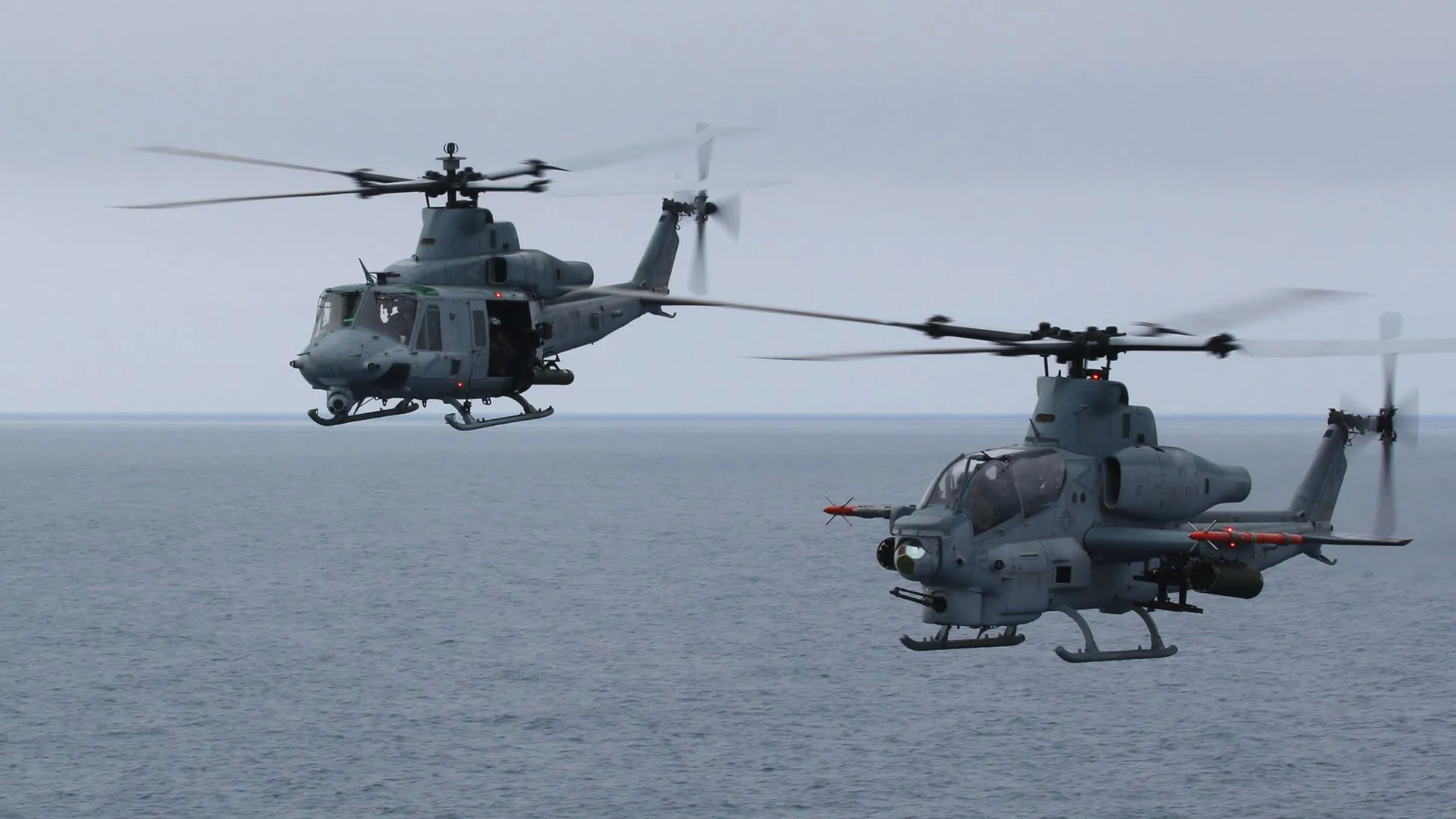
That design choice drives the system’s value on small aircraft. Large-platform DIRCM systems such as the AN/AAQ-24 Nemesis family rely on turreted laser heads sized for transports and heavy helicopters. DAIRCM targets airframes such as the AH-1Z Viper and MH-60S, where every pound of survivability equipment trades directly against fuel, weapons, or cabin load. Leonardo DRS has not published a system weight.
Folding warning and countermeasure functions into one suite also cuts the number of processing boxes and harnesses an integrator must certify. The US Army takes a federated route, pairing the Northrop Grumman-led Common Infrared Countermeasure (CIRCM) with a separate missile warning system. DAIRCM’s laser work runs through the company’s Daylight Solutions unit in San Diego, the quantum cascade laser specialist that also supplies laser sources for CIRCM.
From Urgent Need to Program of Record on H-1 and H-60 Fleets
The Navy flight-tested DAIRCM on the MH-60S and the Marine Corps AH-1Z in 2019, followed by further MH-60S testing in March 2020 and UH-1Y testing in June 2020, under the Program Office for Advanced Tactical Aircraft Protection Systems (PMA-272). Pentagon operational test reports concluded the system as installed on all three helicopters could defeat the MANPADS threat specified in the urgent-need statement as well as vehicle-launched infrared-guided missiles, and could detect laser-guided threats and hostile fire. The Marine Corps made its fielding decision for the AH-1Z and UH-1Y in February 2020, and the Navy issued a separate decision for the MH-60S.
The Air Force moved in parallel. Under a December 2018 Air Force Materiel Command contract covering 30 HH-60G Pave Hawk combat rescue helicopters plus 16 additional kits, Leonardo DRS announced in March 2020 that the first DAIRCM systems had deployed on the HH-60G. NAVAIR then awarded a $120 million contract in June 2020 for engineering development and production-representative weapons replaceable assemblies, followed by a $23.5 million contract modification in March 2024. The company says that Engineering and Manufacturing Development phase added capability and producibility enhancements.
The Marine Corps H-1 program office lists the DAIRCM program of record among its survivability upgrades for the UH-1Y and AH-1Z, alongside the AN/APR-39D(V)2 radar warning receiver. The contract also names the Army as a customer, though its intended platforms remain undisclosed.
Analysis: The award locks in the Navy and Marine Corps bet on a single, integrated distributed-aperture suite for small rotorcraft rather than a stack of separate warning receivers and jammer turrets. For Marine aviation, whose H-1 and H-60 crews would fly low inside the MANPADS envelope in any expeditionary fight, that matters as much as raw jamming performance: a lighter suite preserves payload and time on station for aircraft with little margin to spare. Industrially, the sole-source award strengthens Leonardo DRS’s position across the US small-platform laser countermeasure market, with the company now producing a complete Navy suite while also supplying laser sources to the Army’s federated architecture.
The next markers are the pace of delivery orders against the IDIQ, whose ordering period runs through March 31, 2029, and the integration schedule across Navy, Marine Corps, and Army aircraft. Unit cost, total aircraft count, and the timing of a full-rate production decision remain undisclosed. Operational testing of the LRIP configuration will determine whether the program reaches that decision before contract work concludes in April 2030.