Germany’s Persistent German Airborne Surveillance System (PEGASUS) will enter Bundeswehr service roughly 18 months later than planned, with the first of three Bombardier Global 6000-based signals intelligence (SIGINT) aircraft now scheduled for handover in 2027. Prime contractor Hensoldt confirmed the revised timeline in a program update published on November 10, 2026, citing global supply chain disruption and the delayed provision of U.S. military GPS equipment.
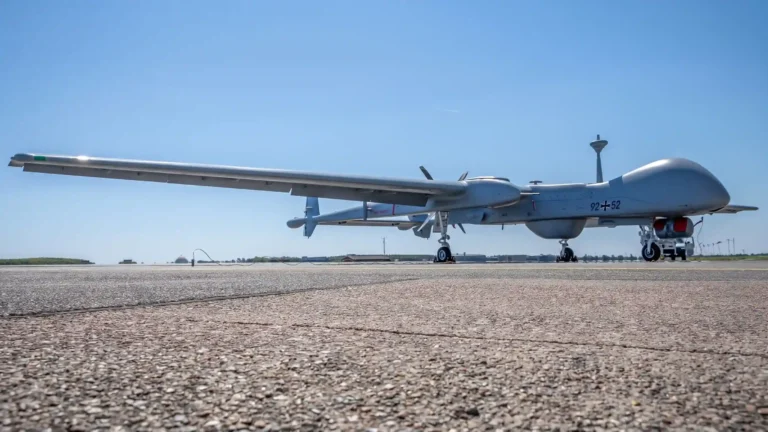
The program closes a gap that has stood since 2010, when the German Navy retired its Breguet Atlantic SIGINT aircraft. Berlin’s first replacement attempt, the Euro Hawk unmanned aircraft, was cancelled in 2013 after it failed to secure airworthiness certification, and a follow-on plan built around the MQ-4C Triton was dropped in favor of a manned business jet solution. The Federal Office of Bundeswehr Equipment, Information Technology and In-Service Support (BAAINBw) signed the PEGASUS contract with Hensoldt on June 29, 2021, after the Bundestag budget committee cleared the program, valued at approximately €1.54 billion.
PEGASUS SIGINT Aircraft Program Slips 18 Months Toward 2027 Handover
Since the contract award, the program has cleared its critical design review in November 2023, flew its first modified Global 6000 at Bombardier’s Wichita, Kansas, facility in September 2024, and delivered that airframe to Lufthansa Technik Defense in Hamburg in December 2025.
Hensoldt now places the introduction about one and a half years behind the original plan. The company did not specify the GPS component involved. Christian Fenzel, a sales team lead at Hensoldt, told Janes in April 2026 that Lufthansa Technik Defense would complete mission system integration by the end of 2026 and that the second aircraft would follow the first by about six months. The Bundeswehr has set 2028 as the target for initial operational capability.
To limit the operational cost of the delay, the program will build capability in phases, allowing crews to gain initial operational experience during the introduction period. Hensoldt also states that PEGASUS is the first strategic SIGINT system of this complexity developed on a civilian airframe and certified to European Union Aviation Safety Agency (EASA) standards, the same certification hurdle that ended Euro Hawk.
Kalaetron Integral Payload and Global 6000 Mission Profile
The core of PEGASUS is Hensoldt’s Kalaetron Integral, a purely passive SIGINT suite that combines communications intelligence (COMINT) and electronic intelligence (ELINT) in a single mission system. It detects radio traffic, radar emissions and digital data links, classifies them, geolocates their sources and processes large data volumes in real time while airborne. According to Hensoldt, the payload weighs more than one tonne and uses over 50 antenna elements. Emitting nothing, it offers an adversary no signal to target.
The Global 6000 provides the reach and altitude that a strategic collector needs. Publicly available specifications indicate two Rolls-Royce BR710A2-20 turbofans, a range of approximately 11,000 km, a cruise speed near 950 km/h and a maximum operating altitude of 51,000 ft. Altitude matters directly for SIGINT: at that ceiling, the geometric radio horizon extends to roughly 500 km, letting the aircraft collect deep into a target area while orbiting outside the engagement envelope of most ground-based air defenses.
PEGASUS is delivered as a full system rather than three aircraft. It includes ground stations for mission planning, execution and evaluation, plus training and reference systems, with a separate Global 6000 training aircraft ordered from Lufthansa Technik in July 2026. Luftwaffe crews will fly the aircraft from Tactical Air Force Squadron 51 “Immelmann” at Schleswig-Jagel, while specialists from the Cyber and Information Domain Service (CIR) will task the sensors and exploit the data. Around 30 additional German companies support Hensoldt, Bombardier Defense and Lufthansa Technik Defense.
Analysis: PEGASUS is primarily a sovereignty purchase. For 16 years, Germany has depended on allied collectors for airborne SIGINT, which limited its ability to form an independent electronic order of battle on NATO’s eastern flank. The business jet route, also taken by France with its Falcon 8X-based Archange program, trades the endurance of a high-altitude drone for certifiable, lower-risk integration, a direct lesson from Euro Hawk. The constraint is fleet size: with three aircraft and normal maintenance cycles, the Luftwaffe will struggle to sustain continuous orbits over more than one area of interest, which explains why Hensoldt is already pointing to potential future procurement steps.
The next milestones are completion of mission system integration at Hamburg by the end of 2026, acceptance testing and the first handover in 2027, followed by the second aircraft about six months later. Key unknowns remain whether the 2028 initial operational capability target holds after the delay, the extent of PEGASUS contributions to NATO tasking, and whether Berlin funds additional airframes beyond the initial three.