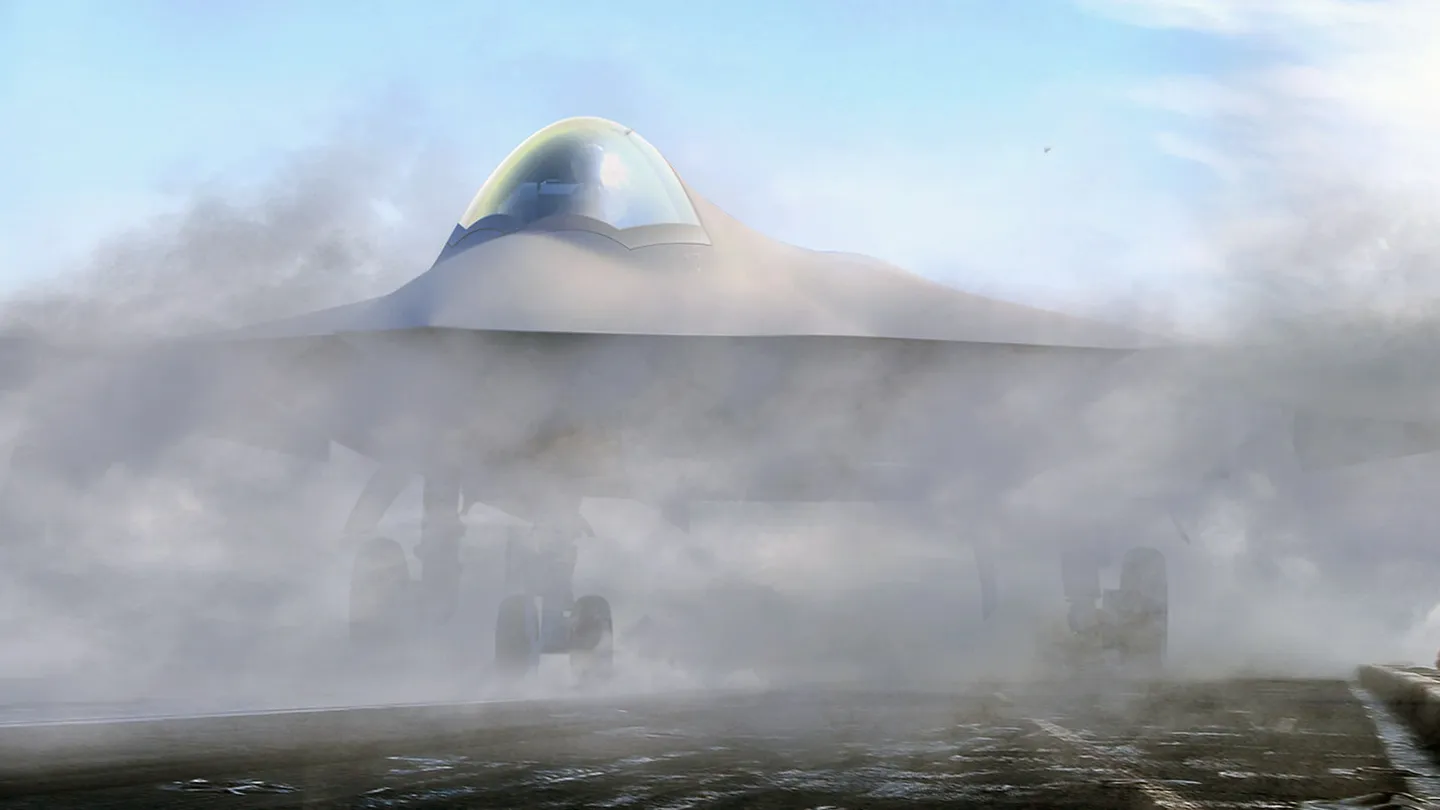
The US Navy selected Boeing on September 29, 2026, to build its F/A-XX sixth-generation carrier-based fighter, and the newly released rendering of the winning design offers the first credible basis for comparing it with Boeing’s F-47 for the US Air Force. It shows a broad, tailless, single-seat jet sharing the F-47’s design language but bearing clear marks of carrier aviation.
The contract, valued at approximately $20 billion, covers full-scale development and multiple test aircraft, according to the Pentagon. Defense leaders moved to freeze F/A-XX in June 2025, three months after Boeing won the Air Force’s Next Generation Air Dominance (NGAD) fighter competition on March 21, 2025, arguing that the industrial base could not sustain two sixth-generation fighters simultaneously. Congress kept the program alive, and Boeing’s win over Northrop Grumman now places both services’ crewed sixth-generation fighters with one prime contractor in St. Louis.
Boeing F/A-XX and F-47: Shared Planform, Divergent Naval Requirements
Any comparison rests on two publicly released F/A-XX renderings and a handful of official F-47 images, all deliberately shaped to conceal critical features. With that caveat, the family resemblance is clear. Both aircraft are depicted as tailless designs with wings set at positive dihedral, a configuration that has become a signature of Boeing’s sixth-generation work and traces back to the company’s Bird of Prey stealth demonstrator, which flew in the late 1990s.
The differences begin at the nose. Official F-47 renderings show a flat, shovel-like forward fuselage, while the F/A-XX nose is more contoured and noticeably broad, consistent with the F/A-XX image Boeing released earlier this year. That width points to a large-aperture active electronically scanned array (AESA) radar, a logical priority for a carrier fighter expected to detect and engage threats far from the strike group. A pronounced chine line wraps the forward fuselage, a standard low-observable shaping feature that manages radar returns from the frontal and side aspects.
The engine intakes sit beneath the aft end of that chine, mounted low on the fuselage sides in what appears to be a blended trapezoidal arrangement set well back from the nose. Overall, the F/A-XX reads as a very broad, heavy tactical aircraft in which internal volume for fuel, sensors, and weapons clearly drove the design. The depth of commonality beneath the skin remains unknown. Boeing could deliver what amounts to a navalized F-47 or a substantially reproportioned airframe; in either case, mission systems hardware and software are the most likely areas of shared investment.
Canards, Landing Gear, and Flaps: How Carrier Operations Reshape the Design
Carrier suitability explains most of the visible divergence. The new image shows the jet taxiing toward a catapult on a twin-wheel nose gear and heavy main landing gear, standard features for an aircraft that must absorb repeated catapult launches and arrested recoveries across its service life. Large trailing-edge flaps are shown deployed, supporting the slow, tightly controlled approach speeds that arrested landings demand. Every carrier aircraft also pays a structural weight penalty for strengthened gear, an arresting hook, and airframe reinforcement, weight that the land-based F-47 can devote to fuel or payload instead.
The most debated feature is absent, or at least hidden. Official F-47 renderings show canard foreplanes, and Boeing’s earlier F/A-XX image hinted at them. In the new rendering, no canards are clearly visible; they may be blended into the fuselage above the intakes and obscured by catapult steam, or omitted entirely. The engineering case for canards is arguably stronger on the naval jet than on the F-47. A tailless aircraft lacks horizontal stabilizers to generate pitch authority at low speed, and carrier approaches require exactly that authority at high angles of attack with minimal margin for error.
Carrier integration also imposes size and weight limits set by deck elevators, hangar bays, catapult energy, and arresting gear, constraints the land-based F-47 does not face. How Boeing reconciled a volume-driven design with those limits is not visible. Dimensions, weights, and weapons bay configurations for both aircraft remain classified, and Boeing has said technical and programmatic details are protected under US national security and export laws.
Range, Propulsion, and Crew: F/A-XX vs F-47 Performance Targets
Published performance goals point to two aircraft optimized for different operating concepts. The Air Force has stated that the F-47 will have a combat radius exceeding 1,000 nautical miles, a top speed above Mach 2, and an inventory of at least 185 aircraft, according to a May 2025 infographic from then-Chief of Staff Gen. David Allvin. In April 2025, Rear Adm. Michael Donnelly, then head of the Navy’s Air Warfare Division, said F/A-XX would offer roughly 125% of the unrefueled range of current carrier fighters. Measured against the F-35C’s commonly cited combat radius of about 670 nautical miles, that implies roughly 840 nautical miles, an estimate rather than an official figure. The Navy plans to close the gap with organic tanking from the MQ-25 Stingray.
Propulsion follows the same split. The Air Force continues to fund the Next Generation Adaptive Propulsion (NGAP) program, with GE Aerospace’s XA102 and Pratt & Whitney’s XA103 adaptive-cycle prototypes, although it has not publicly confirmed the F-47’s powerplant. Navy officials said in late 2024 that F/A-XX proposals relied on a derivative-type engine rather than an adaptive-cycle design, an approach that favors technical maturity over the fuel-efficiency gains adaptive engines promise.
The cockpit marks a further break with current practice. The rendering shows a single-piece canopy covering one pilot, with limited rearward visibility. Replacing the two-seat F/A-18F Super Hornet and EA-18G Growler with a single-seat jet would end frontline two-seat tactical aviation in the carrier air wing, shifting electronic attack and Collaborative Combat Aircraft (CCA) control workloads onto automation and onboard artificial intelligence.
Analysis: The renderings indicate Boeing is pursuing a design family rather than two clean-sheet fighters, a likely factor in the Navy’s selection. Shared aerodynamic concepts, mission systems, and production infrastructure in St. Louis reduce development risk for both programs and address the industrial capacity concerns that nearly killed F/A-XX in 2025. The trade-off is concentration: with the F-47, F/A-XX, F-15EX, T-7A, and MQ-25 all tied to the same site, any disruption there would ripple across both services’ future tactical aviation. The single-seat configuration is the bolder wager, resting on automation maturity in a jet slated to replace the Growler.
The next milestones are the Navy’s formal designation for the aircraft, not yet announced, and the F-47’s first flight, expected by 2028, which will yield the first hard data on the shared design. The key unknowns remain the F/A-XX first-flight date, its final engine selection, and how quickly Boeing can begin replacing Super Hornets and Growlers in the 2030s.