A Dutch industrial consortium led by Guardian Dynamics signed a memorandum of understanding (MOU) on November 11, 2026, in The Hague to develop WARDEN, a sovereign short-range air defense missile built to counter drones, loitering munitions and subsonic cruise missiles in volume. Guardian Dynamics, engineering group Demcon, Axient Systems and the Netherlands Organisation for Applied Scientific Research (TNO) signed the agreement at the European Defence Innovation Forum (EDIF) 2026, working in close cooperation with the Dutch Ministry of Defence (MoD) and operational end users.
The program targets the cost-exchange problem exposed in Ukraine and the Gulf, where defenders have repeatedly expended interceptors worth far more than the one-way attack drones they destroy. WARDEN is positioned as a gap-filler beneath high-end systems such as Patriot, not a replacement for them. “We need the right effector for the right threat, and we need enough of them,” said Saulo Waardenburg, chief executive of Guardian Dynamics. The MOU extends a broader Dutch counter-unmanned aircraft systems (C-UAS) push; in August 2026, the MoD’s Materiel and IT Command (COMMIT) contracted Destinus to integrate its Hornet B2 kinetic interceptor aboard several Royal Netherlands Navy warships under a concept development and evaluation program.
WARDEN Air Defense Missile: Mk 3 Specifications and Target Set
Guardian Dynamics describes WARDEN as a family of software-defined interceptors rather than a complete air defense system. The consortium is concentrating on the effector itself, built on a common modular architecture and intended for integration with existing Western launchers, sensors and command-and-control networks. Three versions are planned, with engagement ranges of up to 5 km, 10 km and 20 km.
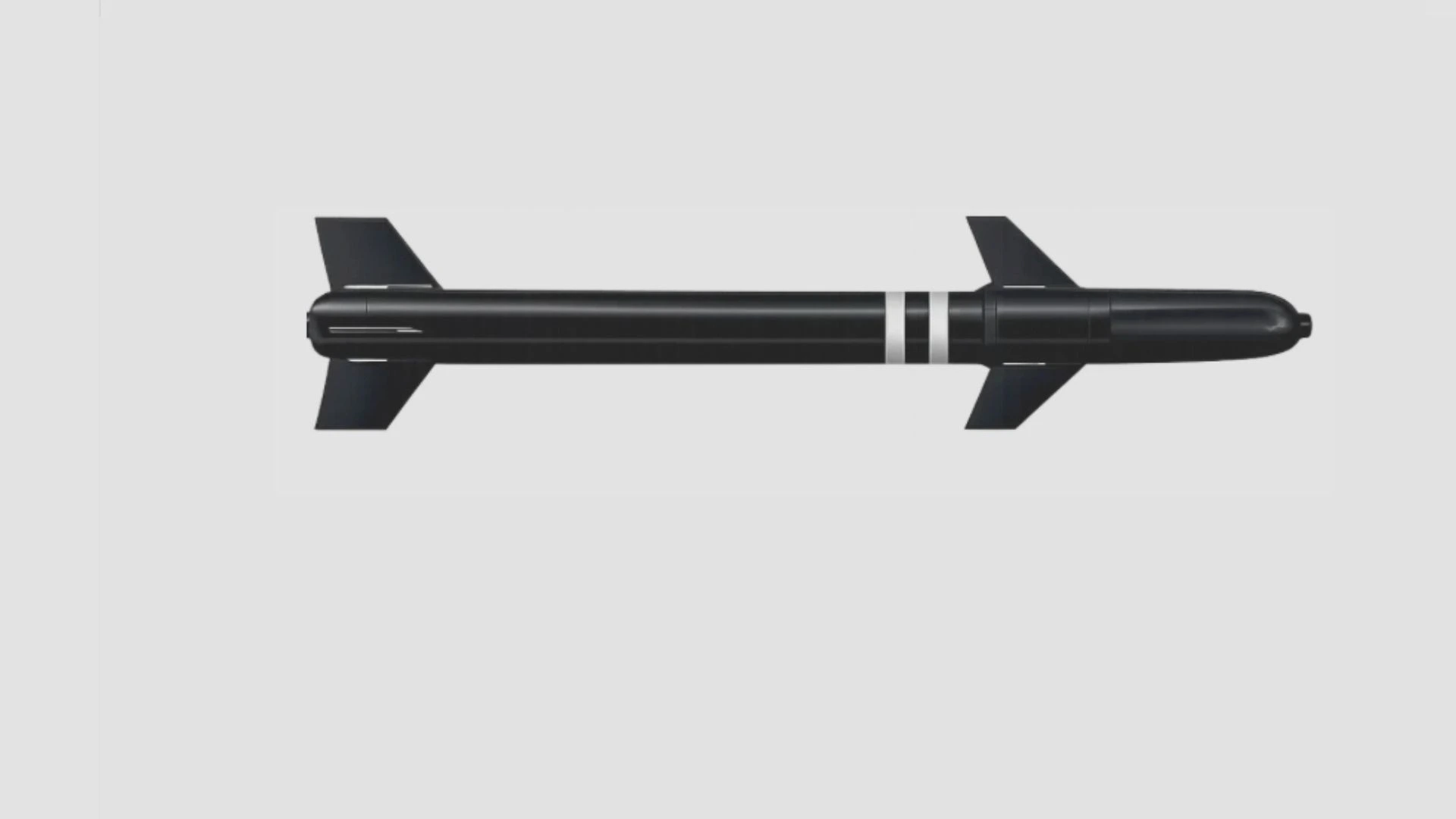
Company data for the longest-range variant, WARDEN Mk 3 NATO, which Guardian Dynamics labels a system in development, list a length of 3,200 mm, a diameter of 170 mm and a top speed of Mach 2. Propulsion is a boost-sustain solid-fuel rocket motor, trading a fast launch for preserved energy in the endgame. The missile fires from a canister launcher, easing storage and vehicle integration. Guidance combines command updates in the midcourse phase with an autonomous seeker for terminal homing. The seeker type, warhead, fuzing and datalink have not been disclosed.
The quoted engagement envelope extends to 20 km in range and 6 km in altitude. Primary targets are Class II and III unmanned aircraft, loitering munitions and subsonic cruise missiles; publicly available data place the roughly 200 kg Shahed-136 in Class II. Rotary-wing and slow fixed-wing aircraft are secondary targets, while ballistic, hypersonic and supersonic cruise missile threats are explicitly out of scope. That envelope sits above shoulder-fired weapons such as the FIM-92 Stinger and inside the vehicle-launched short-range air defense (SHORAD) class, leaving faster and longer-range threats to NASAMS and Patriot. Unit cost, the figure that will determine whether WARDEN actually fixes the exchange ratio, has not been published.
How Demcon, Axient Systems and TNO Divide the WARDEN Workload
Guardian Dynamics, which describes itself as a Dutch missile original equipment manufacturer (OEM), serves as consortium lead, design authority and prime contractor. Its co-founders include chief strategy officer John van den Bosch, most recently regional managing director for Europe and the Americas at BAE Systems, and its advisory board is chaired by retired General Dick Berlijn, a former Dutch Chief of Defence.
Demcon, a group of more than 1,200 employees, is the principal engineering partner. It is responsible for systems engineering, multidisciplinary development, preparation for manufacture, and integration of the interceptor, launch platform and supporting systems, including subsystem interface management. In practice, Demcon owns the transition from prototype to producible design.
Axient Systems, which the MoD recognizes as lead mission integrator for the Royal Netherlands Air and Space Force (RNLASF) PAMI-1 space program, contributes modeling and simulation and integrated air and missile defense (IAMD) expertise, assessing WARDEN against operational requirements. TNO supplies applied defense research and supports development, assessment and qualification. Dutch control over the design and core software, backed by appropriate rights to partner technology, is central to the arrangement. Berlijn framed sovereignty as “retaining the knowledge, rights, and industrial capability to control its future.”
Automotive Lines and Ukrainian Suppliers in the WARDEN Production Model
The consortium presents WARDEN as an industrial scaling program as much as a missile development effort. Rather than build dedicated plants, it plans to qualify existing manufacturing capacity, including automotive production lines, and develop multiple qualified suppliers and production sites. Waardenburg said the consortium does not intend to build new factories because the capacity already exists. The aim is to cut single-supplier dependence and let output surge with demand.
The program runs two parallel workstreams: research and development in the Netherlands, and industrialization for volume production. Ukrainian defense companies are slated to join the manufacturing cluster, producing components and assemblies under a distributed model, though none has been named. Guardian Dynamics says it draws on Ukrainian operational experience, but it has not publicly identified any Ukrainian design underpinning WARDEN. Automotive-grade lines bring high-rate machining, assembly and quality systems, yet energetics, rocket motors and seekers remain the classic bottlenecks in missile production. The announcement does not say who will supply those subsystems, or where.
Analysis: WARDEN’s significance lies less in its specifications, which sit in a crowded SHORAD class, than in its production thesis. Europe’s air defense shortfall since 2022 has been a magazine-depth problem: interceptors are consumed faster than established primes can build them. A Dutch-controlled design with distributed, dual-use manufacturing and a Ukrainian supply leg targets exactly that constraint. The test is whether the consortium can publish a credible unit cost and secure a funded development contract. An MOU commits the partners to cooperate; it does not commit the MoD to buy.
First WARDEN missile tests are planned for 2027 in the Netherlands and Ukraine, and the missile is also being considered for Ukrainian air defense requirements. Open questions include the seeker and warhead configuration, launcher integration targets, unit price, the identity of Ukrainian industrial partners and whether the MoD converts its support into development and procurement funding. The MOU also provides for international partners, leaving room for other European customers.