Elbit Systems has won a contract worth approximately $260 million to supply Precise & Universal Launching System (PULS) rocket artillery systems and munitions to a European NATO member country, the Haifa-based company announced on November 12, 2026. The work will run over five years. Elbit did not name the customer, the number of launchers, or the munition types included in the package.
The award is Elbit’s second PULS order in less than four weeks and extends a European sales run that began with Denmark and the Netherlands in 2023. Since Russia’s full-scale invasion of Ukraine in 2022, NATO armies have moved to rebuild long-range fires capacity drained by transfers to Kyiv. PULS has emerged as one of the main alternatives to the US-built M142 High Mobility Artillery Rocket System (HIMARS), competing in Europe with South Korea’s K239 Chunmoo.
PULS Rocket Artillery Architecture and Its Munition Family
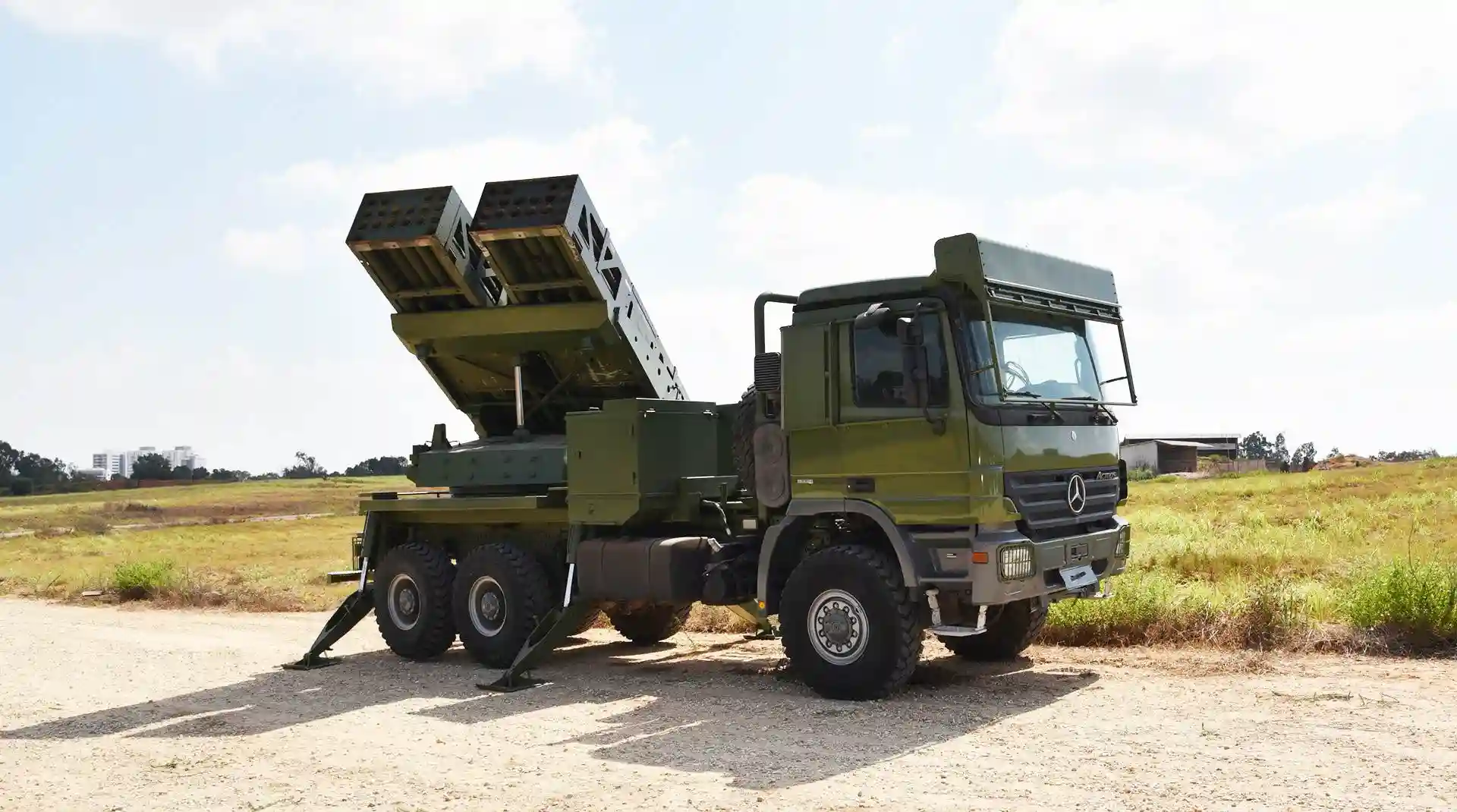
According to Elbit, PULS fires unguided rockets, precision-guided munitions and missiles of various ranges from a single launcher, and is fully adaptable to existing wheeled and tracked platforms. The company says that adaptability reduces maintenance and training costs, a point that matters for armies seeking to mount the launcher on trucks already in their fleets rather than build a new logistics tail.
Publicly available specifications indicate the launcher carries two interchangeable munition pods and covers an engagement envelope from roughly 12 km to 300 km depending on the round. The release did not list the munitions in this package. When Elbit sold a $130 million rocket package to another European PULS operator in April 2025, the order included the ACCULAR, with a range of up to 35 km, the EXTRA, up to 150 km, and the Predator Hawk, up to 300 km. The October 19 contract added the EXTRA-MR, a medium-range guided rocket rated at up to 80 km.
That spread lets a single PULS battery shift from close counter-battery fire to deep strikes against command posts, air defense sites and logistics nodes without changing launchers. The Predator Hawk’s 300 km reach places PULS in the same range class as the Army Tactical Missile System (ATACMS) fired from HIMARS and the M270. Elbit also emphasizes an open architecture designed to integrate legacy command, control, communications, computers and intelligence (C4I) systems, which eases connection to national fire control networks.
Europe’s Growing PULS User Base and the EuroPULS Push
Several NATO members have bought PULS publicly. The Netherlands ordered 20 launchers under a $305 million contract in May 2023, integrated on Scania Gryphus trucks. Denmark received its first launchers that same year and has taken delivery of all eight it ordered. Germany approved the purchase of five launchers in December 2024, procured with the Netherlands to replace MARS II launchers donated to Ukraine. Greece signed a $750 million deal on April 6, 2026, covering launchers, precision-guided rockets and loitering munitions, with four years of deliveries followed by 10 years of support.
The October 19 award, valued at about $235 million, covered PULS launchers, EXTRA-MR rockets and integrated logistics support over three years for a customer Elbit described only as European, without the NATO qualifier used in the latest release. Israeli press reports citing unnamed sources identified that buyer as Azerbaijan, which is not a NATO member. Elbit has not confirmed those reports.
Elbit is also building a European industrial footprint. In March 2026, it launched a joint venture with KNDS, called EuroPULS, to market the system across Europe. In October, Elbit Systems Sweden announced plans for the company’s first European production and maintenance center, with operations expected to begin in 2027.
Analysis: The award reinforces PULS as a shared fires baseline among several NATO armies, from the North Sea to the Aegean. Commonality across Dutch, Danish, German and Greek inventories opens the door to pooled munitions stocks, combined training and cross-border maintenance, the logic EuroPULS is designed to industrialize. The program also carries political exposure. Spain cancelled its contract for 12 SILAM launchers, a PULS derivative worth nearly €700 million, on September 9, 2025, as part of its arms embargo on Israel. Localization through KNDS and Swedish production is Elbit’s answer to that risk, and to buyers that want sovereign control over munitions supply in wartime.
The identity of the customer remains the main open question, along with launcher numbers and the munition mix, details that may surface through national procurement or parliamentary disclosures. Elbit reports third-quarter results on November 17, which will show how the latest PULS awards feed a backlog that stood at $32.0 billion as of June 30, 2026, against quarterly revenue of $2,287.1 million. The next test is whether EuroPULS can turn European demand into locally produced launchers and rockets at the pace a five-year contract requires.