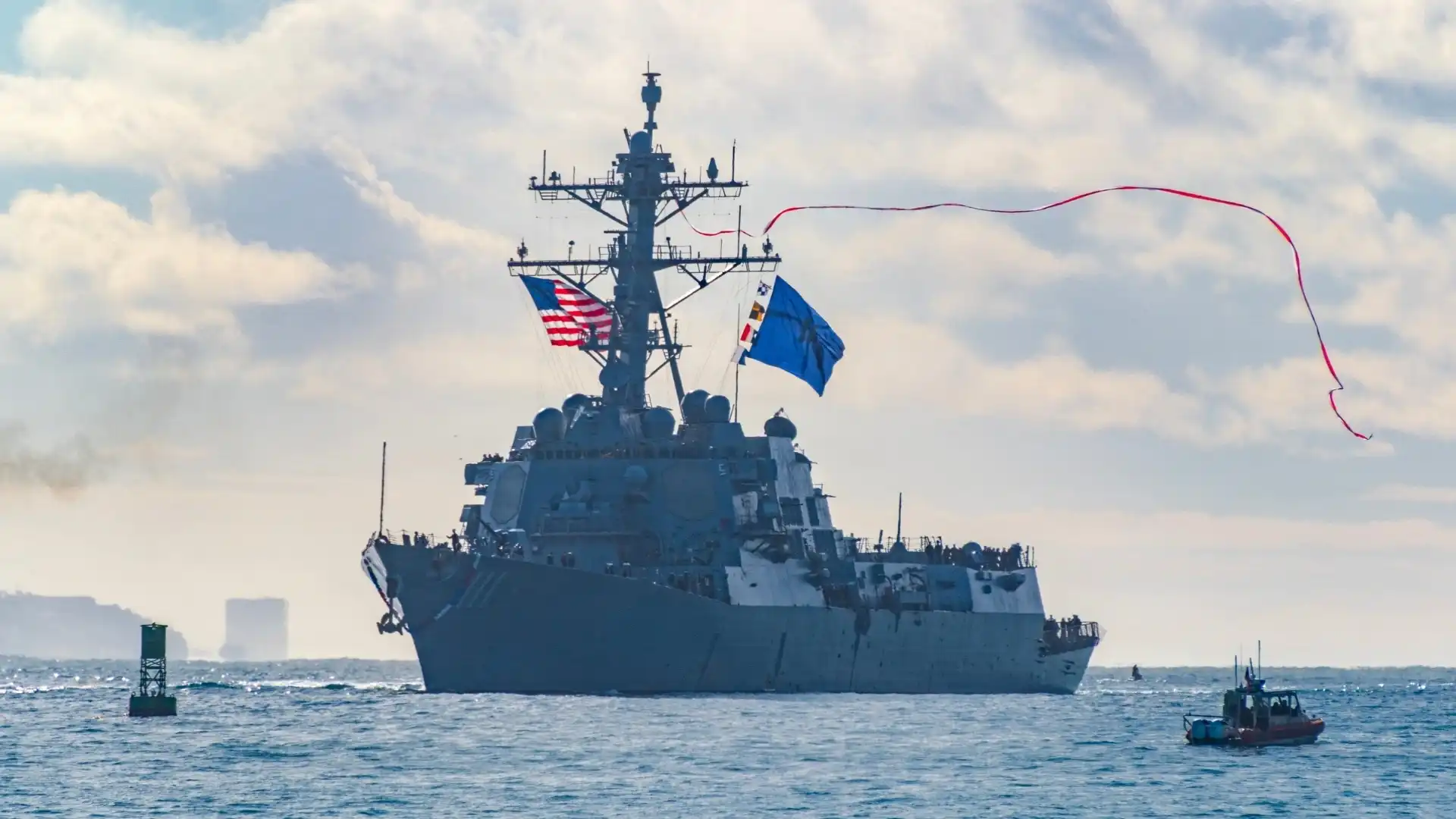
The Arleigh Burke-class guided-missile destroyer USS Spruance (DDG 111) returned to Naval Base San Diego on November 13, 2026, closing out a 12-month deployment across the U.S. 3rd, 7th, and 5th Fleet areas of operations that included sustained combat in Operation Epic Fury. According to U.S. 3rd Fleet, the destroyer steamed more than 88,000 nautical miles, destroyed 12 unmanned aerial vehicles and four anti-ship cruise missiles, and launched dozens of Tomahawk Land-Attack Missiles against Iranian military targets.
Spruance deployed under Destroyer Squadron (DESRON) 21 as part of the Abraham Lincoln Carrier Strike Group (ABECSG), alongside the Nimitz-class aircraft carrier USS Abraham Lincoln (CVN 72), the destroyers USS Michael Murphy (DDG 112) and USS Frank E. Petersen Jr. (DDG 121), and Carrier Air Wing (CVW) 9. The strike group left San Diego in November 2025 and was redirected to the Middle East, where the United States launched Operation Epic Fury against Iran, alongside Israeli strikes, on February 28, 2026. Abraham Lincoln, initially due home in May, returned on October 8 after 321 days; Spruance follows five weeks later. The Navy’s release does not explain the gap. Spruance and the strike group’s units received the Presidential Unit Citation and the Combat Action Ribbon for their performance in the U.S. Central Command (CENTCOM) area of responsibility.
USS Spruance Combat Record: Air Defense and Tomahawk Strikes
The Navy says Spruance operated under persistent threat from anti-ship cruise missiles and one-way attack drones throughout its time in theater. The Navy did not disclose which interceptors were fired, the engagement ranges involved, or whether the drones and missiles were aimed at Spruance or at other units it was protecting.
Publicly available specifications indicate Spruance, a Flight IIA ship commissioned in October 2011, carries the Aegis Combat System with the AN/SPY-1D(V) radar and 96 Mk 41 Vertical Launching System (VLS) cells. Those cells can hold Standard Missile-2 and Evolved Sea Sparrow Missile interceptors for area and point defense alongside Tomahawk. Because Mk 41 cells are not routinely reloaded at sea, every Tomahawk launched between February and August 2026 drew down the same finite magazine that defended the ship and the strike group. The Navy has not released an exact Tomahawk count.
Spruance also managed the force tactical datalink architecture across multiple strike groups and amphibious ready groups, maintaining a real-time joint air and surface picture for units operating in close proximity to Iranian coastal defenses.
Hormuz Blockade Operations and Year-Long Sustainment at Sea
Acting as Surface Action Group Commander, Spruance led forward probing maneuvers near the Strait of Hormuz and enforced the U.S. blockade of Iranian ports, which began on April 13, 2026. The ship enforced maritime compliance across 15 vessels. Its most visible action came on April 19, when it intercepted the Iranian-flagged container ship M/V Touska in the north Arabian Sea as the vessel sailed at 17 knots toward Bandar Abbas. After six hours of unanswered warnings, Spruance ordered the crew to evacuate the engine room, then disabled the ship’s propulsion with several rounds from its 5-inch Mk 45 gun. Marines from the 31st Marine Expeditionary Unit, launched from the amphibious assault ship USS Tripoli (LHA 7), then boarded and seized the vessel.
While operating in the 7th Fleet area of operations, Spruance conducted navigational transits of the San Bernardino, Singapore, Malacca, Balabac, and Surigao straits. Over the full deployment, the ship completed 43 underway replenishments, transferring 8.6 million gallons of fuel, while its embarked HSM-71 detachment flew more than 190 sorties and 1,150 flight hours.
“Spruance Sailors made a difference,” said Cmdr. Leigh R. Tate, the ship’s commanding officer, who also credited the crew’s families for their contribution.
Analysis: Spruance’s deployment shows a single 15-year-old destroyer performing four roles at once: air defense picket, land-attack shooter, blockade enforcer, and force datalink manager. Each of those roles competed for the same 96 cells, the same helicopter detachment, and the same crew. The combination of 16 intercepts and dozens of Tomahawk launches from one hull underlines why magazine depth and at-sea rearming have moved to the center of U.S. Navy surface warfare planning. The Touska interdiction, which required gunfire into an engine room before Marines could board, also shows that blockade enforcement, not only missile defense, became part of the destroyer force’s workload after April 13.
Spruance now enters its post-deployment period. The Navy has not announced the timing or scope of the ship’s next maintenance availability. Defense Secretary Pete Hegseth credited the Abraham Lincoln Carrier Strike Group with 450 Tomahawk launches in October, but no ship-by-ship breakdown or interceptor expenditure has been released. Those figures will shape how quickly DESRON 21 can regenerate ready destroyers for the Pacific.