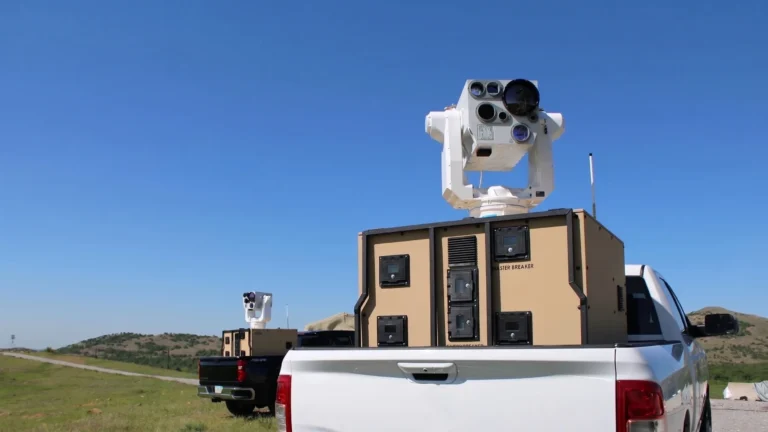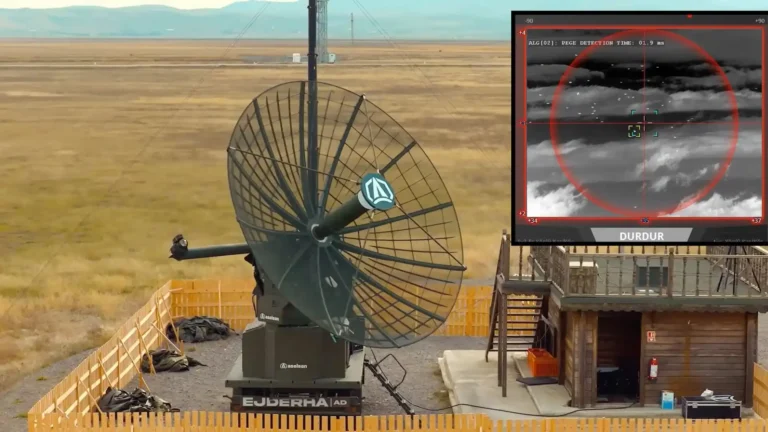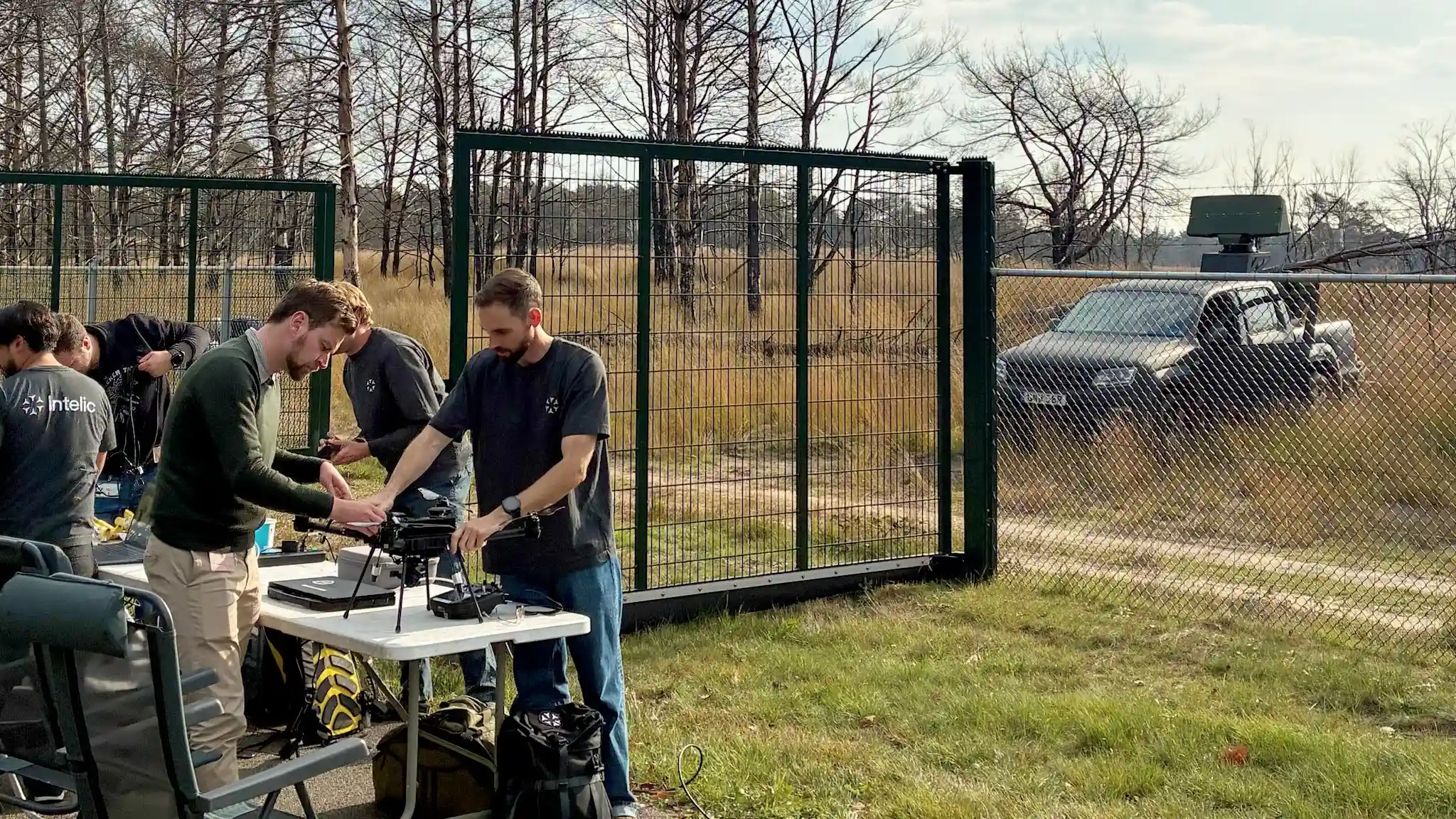
Intelic linked Saab’s Giraffe 1X radar to its NEXUS counter-drone command-and-control (C2) platform in 30 minutes during a field test at a Dutch military base, the company announced on November 16, 2026. The Giraffe 1X is an X-band short-range 3D air surveillance radar with a 75 km instrumented range and a one-second 360-degree update rate. Its tracks fed directly into the NEXUS operator interface, where commanders and drone operators could assess aerial threats and initiate an interception response from a single screen.
The demonstration targets a persistent bottleneck in European counter-unmanned aircraft systems (C-UAS) procurement: connecting sensors and effectors built by different vendors. Systems that rely on different software, data formats and communication protocols typically require weeks or months of engineering and testing before they exchange data reliably, according to Intelic. With the Netherlands alone planning up to €3.5 billion in new counter-drone spending, integration speed has become a procurement variable in its own right. “European armed forces cannot afford to spend months connecting systems from different manufacturers while threats continue to evolve,” said Maurits Korthals Altes, Intelic’s chief executive.
How Intelic NEXUS Fused Giraffe 1X Tracks Into One Air Picture
During the trial, the Giraffe 1X detected and tracked aerial targets flying at varying altitudes and speeds, including maneuvering targets, according to Intelic. The radar filtered out birds, helping personnel separate relevant threats from friendly drones and benign objects. Qualifying tracks were then displayed in NEXUS, where operators could cue interceptors through the same interface. Intelic has not disclosed the test date, the base, whether a live intercept took place, which interceptor types were connected, or the data protocol used to ingest the radar’s track output.
NEXUS is a platform-agnostic C2 layer that combines a military user interface with an autonomy agent installed on a drone’s companion computer. It brings sensors, reconnaissance and interceptor drones and personnel into a common operating picture, and is designed to absorb new hardware without replacing equipment already in service. Intelic, founded in Amsterdam in 2021 as Avalor AI, says NEXUS has supported Ukrainian frontline operations since 2025. In July 2026, the Dutch Ministry of Defence signed a three-year strategic partnership built around the platform, worth more than €30 million, and in September the company said it had closed a counter-drone sensor-to-effector loop in Latvia. A January 2026 agreement with DroneShield already linked that firm’s detection and electronic countermeasure systems to NEXUS.
Giraffe 1X Radar Specifications and the C-UAS Timeline Problem
Publicly available specifications indicate the Giraffe 1X is an X-band (8 to 12 GHz) 3D radar built around an active electronically scanned array (AESA) antenna with digital beamforming. Rotating at 60 rpm, it provides a one-second 360-degree update rate, elevation coverage up to 70 degrees and a 75 km instrumented range in its land configuration. Saab’s Enhanced Low, Slow and Small (ELSS) function adds a dedicated small-drone mode, with open-source figures placing small UAS detection at around 4 km. Total system weight below 150 kg allows installation on light tactical vehicles, masts and fixed sites. The radar is in service or on order with Sweden, the United Kingdom and Denmark, and the US Army placed an order worth about $46 million in 2025 to supply Giraffe 1X systems to security cooperation partners.
Intelic frames the pairing in terms of reaction time. A Shahed-type drone flying at 500 km/h covers 10 km in roughly 72 seconds, the company notes. That speed falls within the range reported for jet-powered derivatives such as the Russian Geran-3 rather than the propeller-driven Shahed-136, which cruises at about 185 km/h, but the logic holds: every second spent passing data between sensor, decision-maker and effector is taken from an already narrow engagement window.
Analysis: The 30-minute figure is a vendor claim from a controlled field event, not an operational certification, and the release leaves open security accreditation, interface standards and end-to-end engagement timelines. The demonstration nonetheless reflects where European C-UAS spending is heading: buyers increasingly treat the C2 layer as the integration hub and sensors as interchangeable inputs. With Giraffe 1X spread across several NATO inventories, a vendor-neutral C2 able to ingest it quickly would lower the cost of mixing allied sensors and effectors in a shared air defense picture. Whether that holds beyond bilateral demonstrations, in accredited multinational architectures, remains unproven.
Intelic has not announced a contract tied to the Giraffe 1X integration or further testing with Saab. Key indicators to watch include whether the Royal Netherlands Army folds the radar-to-NEXUS configuration into its partnership with Intelic, whether a live intercept is publicly demonstrated with the radar in the loop, and whether other Giraffe 1X operators adopt the pairing.