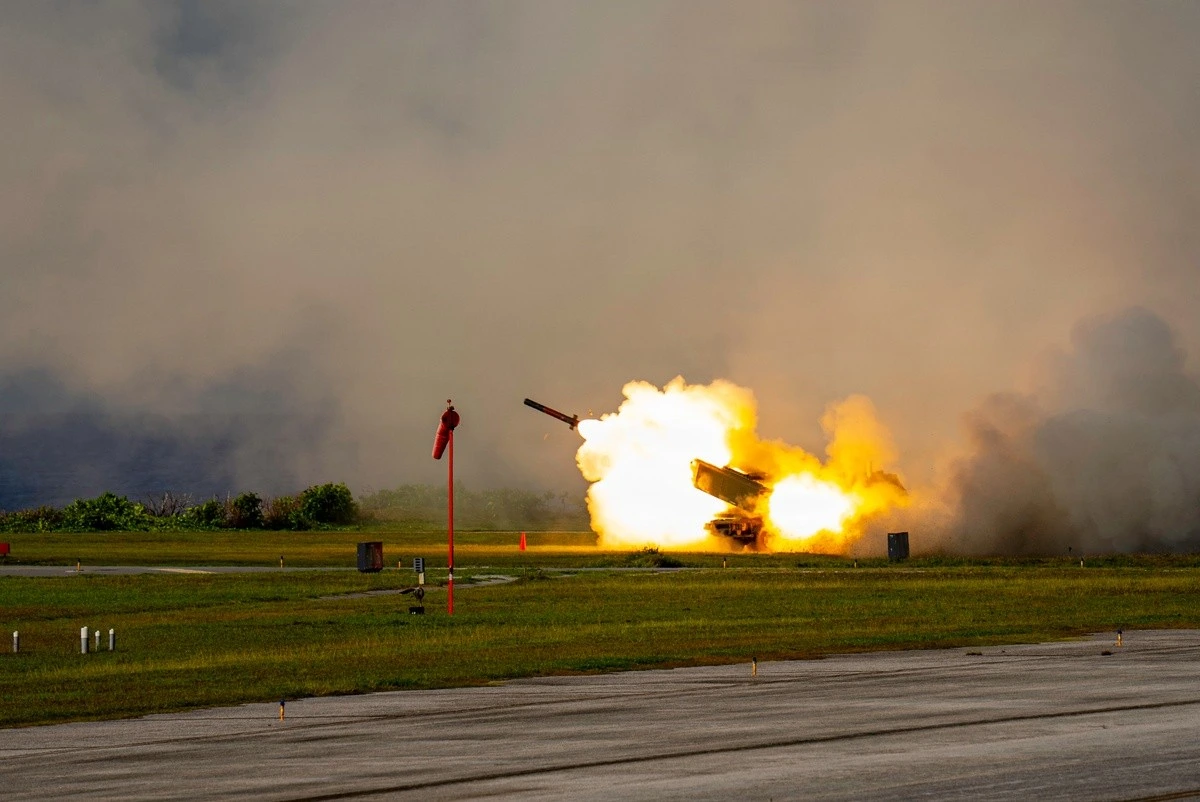
The US Army’s 25th Infantry Division fired High Mobility Artillery Rocket System (HIMARS) launchers at Kwajalein Atoll in the Marshall Islands on November 13, 2026, after a HIMARS Rapid Infiltration (HIRAIN) airlift from Hawaii. The live fire closed back-to-back HIRAIN missions during Joint Pacific Multinational Readiness Center (JPMRC) Rotation 27-01, according to the US Army. Launchers from the 2nd Battalion, 11th Field Artillery Regiment (2-11 FA), 25th Division Artillery, were airlifted by C-17 aircrews of the US Air Force’s 15th Wing, offloaded, and moved directly into a firing posture. The division frames the drill as preparation for its scheduled spring and summer deployments to the Philippines.
The live fire caps a fast conversion. The division received its first HIMARS at Joint Base Pearl Harbor-Hickam on July 14, 2025, and converted 2-11 FA from a howitzer battalion into a 16-launcher HIMARS battalion. It rehearsed HIRAIN at Wake Island during JPMRC 26-01 in November 2025. In April 2026, during Exercise Salaknib 26, it forward deployed and fired HIMARS in a partner nation’s training area for the first time, launching 12 rockets at Laur, Nueva Ecija, in the Philippines; the Philippine Army said the drill used reduced-range practice rockets. Kwajalein, home to the Ronald Reagan Ballistic Missile Defense Test Site, lies more than 2,000 miles southwest of Honolulu, a distance that mirrors the Army’s core problem in the Western Pacific.
How the 25th Infantry Division Executes HIMARS Rapid Infiltration
A HIRAIN mission pairs a fire unit with airlift. Aircraft insert a launcher into an austere location, the crew fires, and the system is reloaded and extracted before an adversary can locate it and return counterfire. The concept trades persistence for survivability: the launcher never presents a static signature on the ground.
The division first validated the sequence with a dry-fire exercise on Kauai. “Whenever we prepare for these missions, we’re focused on speed and keeping up the communications,” said 1st Lt. Cameron Richardson, a platoon leader with Bravo Battery, 2-11 FA, noting that runways in the islands are usually very limited and that crews constantly refine their footprint. He said the drill depends on tight coordination between Army crews and Air Force loadmasters to load, secure, and ready the launchers for immediate employment on landing.
At Kwajalein, US unmanned aircraft systems provided continuous aerial observation as 2-11 FA engaged targets in the maritime domain. According to the Army, commanders used encrypted networks and what the service calls Super-Intelligence (SI) decision aids to process sensor data, confirm targets, and align the fire mission with the broader scheme of maneuver. “By executing these missions, we are rehearsing our ability to rapidly project long-range fires into the most austere environments in the region,” said Col. Bryan Fanning, commander of 25th Division Artillery. The Army has not disclosed how many launchers deployed, which munition was fired, the engagement range, or whether the targets were moving.
M142 HIMARS Specifications and Long-Range Fires Reach in the Pacific
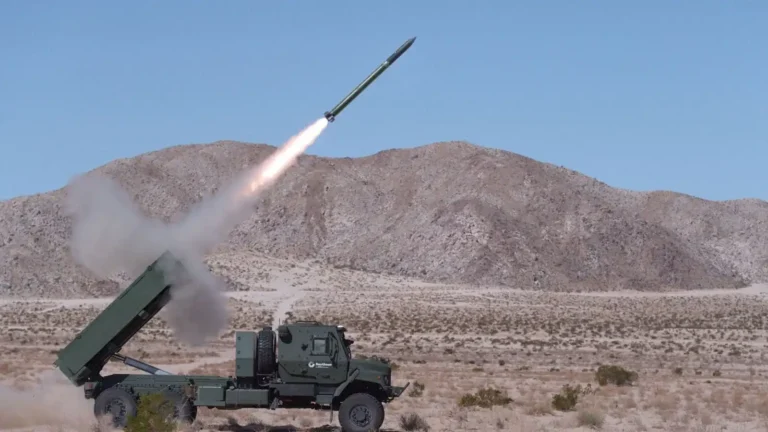
The Lockheed Martin M142 HIMARS rides on a 5-ton Family of Medium Tactical Vehicles (FMTV) 6×6 chassis and carries a single launcher pod. Publicly available specifications put its combat weight at about 35,800 lb (16,250 kg), with a three-person crew and a road range of roughly 480 km. The pod holds six Guided Multiple Launch Rocket System (GMLRS) rockets, one Army Tactical Missile System (ATACMS) missile, or two Precision Strike Missiles (PrSM).
That weight is what makes HIRAIN practical. HIMARS fits aboard C-130, C-17, and C-5 aircraft, whereas the tracked M270 Multiple Launch Rocket System, at roughly 53,000 to 55,000 lb combat-loaded depending on the variant, is not C-130 transportable. Munition choice then defines the threat a dispersed battery poses. Publicly available figures credit baseline GMLRS with about 70 km of range and the Extended-Range GMLRS with 150 km, while PrSM Increment 1 exceeds 400 km. PrSM Increment 2, still in development, adds a multimode seeker for moving land and maritime targets, the capability most relevant to the division’s stated maritime strike role.
Analysis: The Kwajalein shot matters less as a gunnery event than as a logistics proof. HIRAIN turns HIMARS from a fixed theater asset into a launcher that can appear on any suitable airstrip within C-17 reach, multiplying the locations an adversary must watch and complicating its targeting cycle. The constraint is equally clear. The concept depends on airlift sorties, runway access, and Air Force aircraft that will be in heavy demand during a crisis, and those aircraft and airfields are targets themselves. Until the Army pairs HIRAIN with a fielded anti-ship munition such as PrSM Increment 2, the maritime strike mission rehearsed here validates the delivery system more than the effect.
Those Philippine rotations fall under Operation Pathways, US Army Pacific’s theater campaign with allies and partners. “This capability ensures we can rapidly project lethal fires to deter and defeat threats deep within the maritime domain,” said Maj. Andrea Swett, operations officer for 25th Division Artillery. Open questions include whether 2-11 FA will fly launchers into the First Island Chain during those rotations, whether future HIRAIN missions will include PrSM live fires, and how quickly the model scales across the Army’s Pacific fires formations.