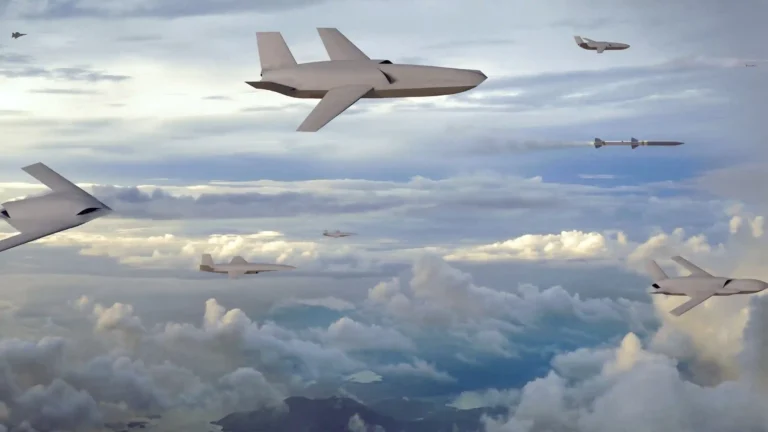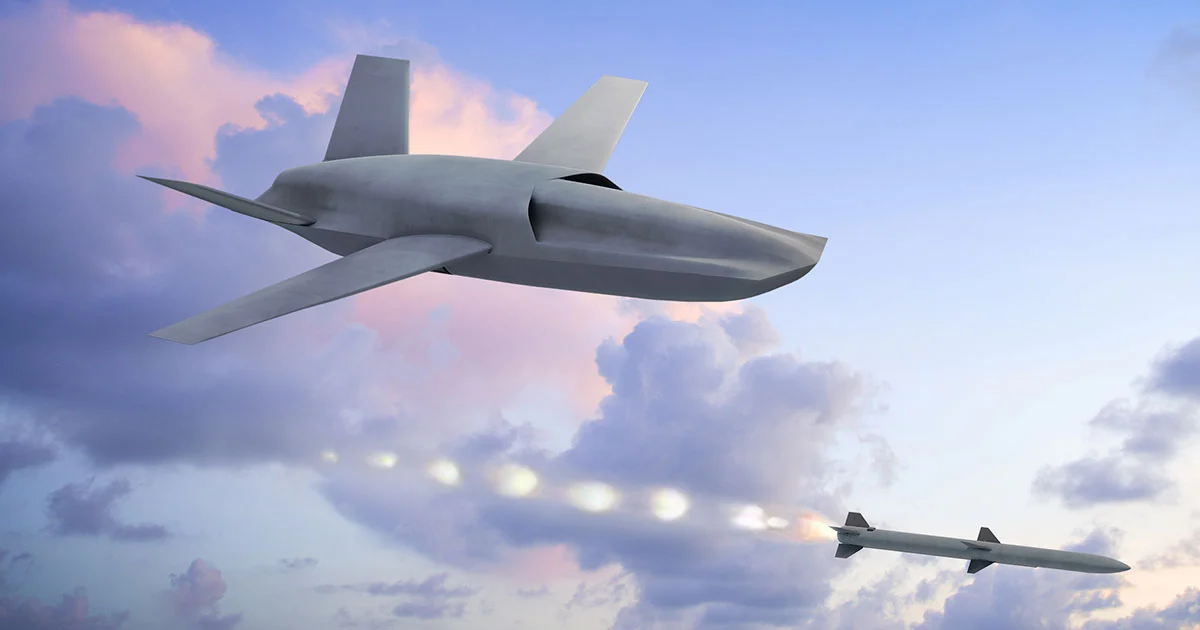
The General Atomics Gambit uncrewed combat aircraft was the focus of Bavarian Minister-President Markus Söder’s November 13, 2026 visit to General Atomics AeroTec Systems (GA-ATS) at Oberpfaffenhofen. Using a full-scale model, General Atomics pitched the site for mission system integration, technical support and, eventually, manufacturing of a Luftwaffe-adapted Collaborative Combat Aircraft (CCA) built on the FQ-42A now in U.S. Air Force production. German aircraft tests are expected from 2027, and none of these roles is yet backed by a German order.
The visit lands at a fluid moment for Berlin’s drone wingman plans. Germany had aimed to field a CCA alongside its Eurofighter fleet by 2029, but in October 2026 the Federal Ministry of Defence told Boeing it would not directly procure the MQ-28 Ghost Bat, a decision first reported by Politico and confirmed by Boeing to Breaking Defense. According to Politico, the capability is now expected in the early 2030s, with aircraft tests from 2027 that remain open to several contenders. Airbus and Kratos fly an adapted Valkyrie, Helsing promotes its CA-1 Europa, and General Atomics Aeronautical Systems (GA-ASI) is positioning the Gambit family. Germany’s June 2026 exit from the Future Combat Air System (FCAS) fighter effort has raised the stakes further.
General Atomics Gambit and the Luftwaffe CCA Requirement
Gambit is a modular family of uncrewed jets. GA-ASI states that about 70 percent of key components, including landing gear, baseline avionics and core airframe structures, are shared across variants. GA-ASI lists six configurations: Gambit 1 for long-endurance intelligence, surveillance and reconnaissance (ISR), Gambit 2 for air-to-air combat, Gambit 3 for adversary training, Gambit 4 for low-observable combat reconnaissance, Gambit 5 for carrier operations, and Gambit 6 for air-to-ground missions including electronic warfare and suppression and destruction of enemy air defenses (SEAD/DEAD).
The family’s operational anchor is the FQ-42A Dark Merlin, which GA-ATS describes as already flying and in production. Its prototype, then designated YFQ-42A, first flew in August 2025, and the U.S. Air Force awarded production contracts for both the FQ-42A and Anduril’s FQ-44A under CCA Increment 1 in June 2026. For a European buyer, that lineage is the core argument: a production airframe cuts development risk and leaves national budgets for sensors, weapons and autonomy.
For Germany, General Atomics frames the offer as American platform technology paired with German and European mission systems, adapted to Luftwaffe requirements through an open systems architecture. In June 2026 at ILA Berlin, GA-ASI signed a memorandum of understanding with INTEC Group covering mission system architecture and integration, entry into service and logistic support for Gambit. GA-ASI has also stated that Gambit 6 airframes could be available for international procurement from 2027, with European missionized versions deliverable by 2029. Those dates are company targets. GA-ASI has not published range, payload, speed or engine data for the export variants.
Oberpfaffenhofen Industrial Base: Do228 NXT, NH90 and Nordholz
GA-ATS combines engineering, aircraft manufacturing, in-house workshops, maintenance, repair and technical support at Oberpfaffenhofen. It builds the Do228 NXT, a multipurpose twin turboprop unveiled in June 2026 for passenger and cargo transport and special missions such as maritime surveillance and medical evacuation, and it supports the worldwide Do228 fleet.
GA-ATS also holds DEMAR-145 certification and performs base maintenance on the Bundeswehr’s NH90 transport helicopters. The company is establishing a new site in Nordholz, Lower Saxony, to add maintenance and repair capacity for Bundeswehr aviation systems. That footprint gives General Atomics an established channel into Bundeswehr maintenance and certification.
GA-ASI chief executive Linden P. Blue tied future capital commitments to demand. “Where orders and production volumes provide a sound economic basis, we would also like to invest further in Germany,” he said, noting the company has invested in German businesses for more than 30 years. Harald Robl, Managing Director of General Atomics Europe, said the company wants to build on the site’s capabilities to “take on roles within the Gambit program” in the future. GA-ATS states that the scope and structure of any involvement will depend on German requirements, government decisions and agreements with industrial partners.
Analysis: General Atomics is running the same playbook as Airbus and Kratos, a proven American airframe married to a German mission system, but without a German prime of Airbus’s scale. GA-ATS, the INTEC agreement and the NH90 support record are its substitutes for that domestic anchor. The conditional investment language signals that General Atomics will not commit manufacturing capital in Bavaria before Berlin selects a platform. Söder’s visit should also be read as regional industrial policy rather than an endorsement, since Bavaria hosts rival bids as well, with Airbus preparing its Valkyrie derivative at Manching and Helsing headquartered in Munich. Berlin has given no official reason for dropping the direct Ghost Bat buy, but the episode suggests operational maturity alone will not settle the competition; German workshare and sovereign control of mission systems weigh as heavily.
The next decision points sit with the Federal Ministry of Defence and the Bundestag, which must approve major procurements. Test flights expected from 2027 will be the first opportunity for Gambit to fly against its rivals under German requirements. Until then, the Oberpfaffenhofen role remains a proposal: no German Gambit contract, flight test campaign or production commitment has been announced.