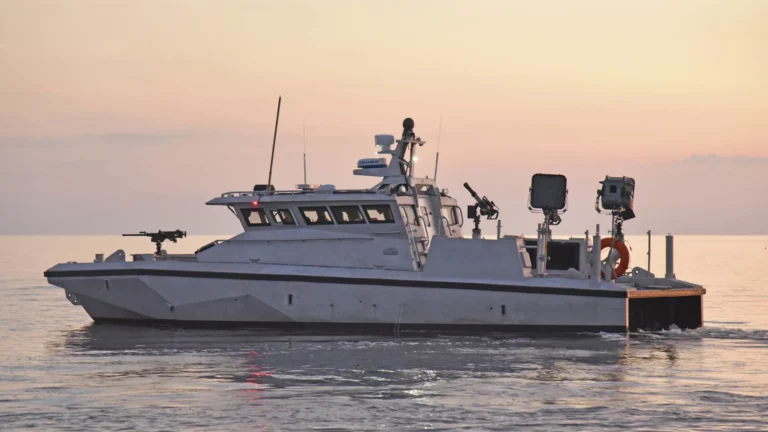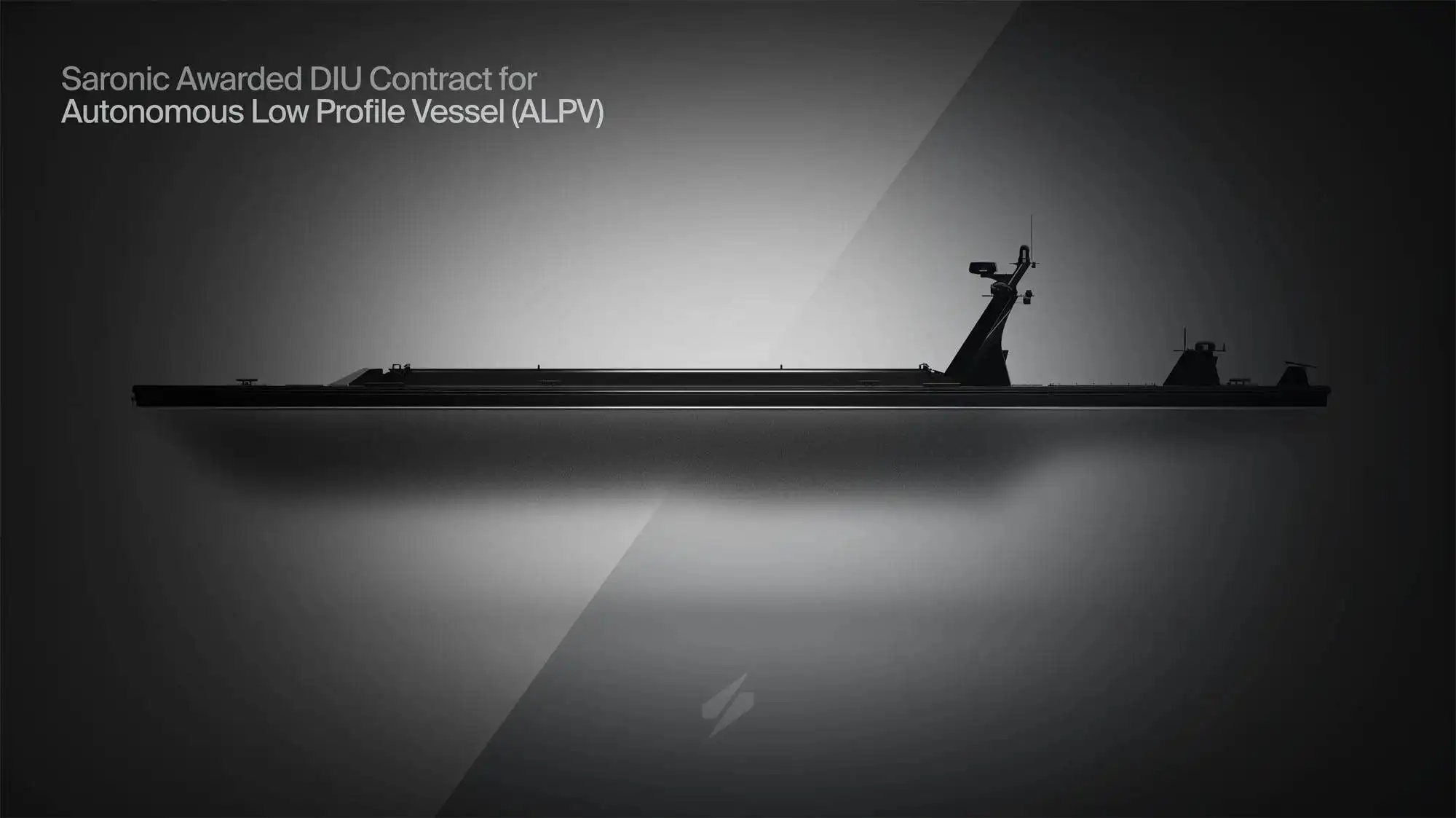
The Saronic ALPV, an Autonomous Low Profile Vessel that Saronic Technologies will deliver to the Defense Innovation Unit (DIU) under a prototype agreement announced November 16, 2026, pairs passive perception with a beachable hull. The hull is built for volume production, and the Austin, Texas-based company says the uncrewed logistics connector will deliver any class of supply ship-to-ship and ship-to-shore for Marine Corps resupply, using autonomy software validated over more than 350,000 nautical miles. DIU requires prototypes to be demonstrable within 180 days of award, pointing to demonstrations around mid-2027.
Saronic is one of three companies, alongside Sea Machines Robotics and Rudder Industries, that DIU selected on November 9 to prototype an autonomous craft able to resupply Marine Corps units spread across wide distances in contested littoral environments. DIU is seeking vessels that carry at least 18,000 pounds of cargo over 1,000 to 2,000 nautical miles, as detailed in our coverage of the DIU ALPV prototype awards. Neither DIU nor Saronic has disclosed the value of Saronic’s prototype Other Transaction (OT) agreement, the number of hulls covered, or a delivery schedule.
Inside the Saronic ALPV: Passive Perception, Beachability, and Volume Production
Saronic frames contested logistics as the problem of getting food, fuel, and supplies to forces within reach of enemy weapons without putting operators at risk, a mission it says demands platforms that are autonomous, low-cost, easy to offload, and scalable. Its answer combines advanced autonomy and passive perception with a hull designed for maneuverability, beachability, and production at scale. The company describes a unique form factor intended to deliver any class of supply, with assured navigation, collaborative teaming, and other autonomous behaviors enabling a range of missions, and a modular open systems architecture meant to support a wide range of rapid integrations.
The vessel inherits the autonomy software Saronic has advanced across each of its vessel models, validated over more than 350,000 nautical miles and 55,000 hours of operation. Passive perception has already been tested on the company’s larger hulls: during the Navy’s Medium Unmanned Surface Vessel (MUSV) at-sea evaluation, Saronic’s 180-foot Marauder ran more than 140 scenarios over eight days of continuous operations, including tests that required it to detect, track, and follow traffic without relying on active radar. Saronic has not released dimensions, displacement, propulsion, payload, or range figures for its ALPV.
How the Saronic ALPV Maps to DIU’s Contested Logistics Requirements
Several features Saronic highlights line up directly with DIU’s solicitation. Passive perception answers the requirement to keep sensing under emissions control or when communications are lost, after transiting congested waters with M-Code GPS and active sensors. Beachability matches DIU’s stated preference for beach operations with self-withdrawal after cargo discharge, and the emphasis on easy offloading tracks the call for minimal material handling equipment. Collaborative teaming fits the requirement for one operator to control multiple craft, while assured navigation addresses a capability DIU says must be demonstrated before prototyping is complete: positioning, navigation, and timing in GPS-degraded or GPS-denied conditions.
“This award recognizes that winning in contested waters starts with keeping forces supplied,” said Rob Lehman, Saronic co-founder and chief commercial officer. “Saronic’s ALPV gives Marines a low-signature, autonomous way to move critical cargo across contested seas, without putting a crew in harm’s way.” Beyond the prototype itself, the agreement covers government testing and Marine Corps planning for how the ALPV would be brought into service, including how it would be operated, staffed, trained on, and supported.
Corsair, Marauder, and LCU: The Production Base Behind Saronic’s ALPV
The ALPV award extends a run of U.S. Navy contracts. Saronic holds a $392 million production OT for Corsair, its 24-foot autonomous surface vessel, awarded in December 2025, and a production OT under the Navy’s Medium Unmanned Surface Vessel (MUSV) Marketplace for 10 hulls of Marauder, its 180-foot autonomous ship, at an average Navy-stated cost of about $40 million per vessel. In September 2026, the Navy selected Saronic alongside Conrad Shipyard and Master Boat Builders for LCU 1700 landing craft prototype agreements worth a combined $280.5 million; Saronic’s craft will be the first build at Port Alpha, its planned shipyard in Brownsville, Texas, with production expected to start in 2028.
Analysis: Saronic is presenting the ALPV less as a bespoke boat than as another product off a common autonomy stack and production line. If the Marines adopt it alongside Corsair and Marauder, shared software could simplify command and control and training across several hull types. The solicitation also allows a follow-on production award without further competition under 10 U.S.C. 4022(f), the same authority that moved Marauder into production, so a successful prototype could transition quickly. The open question is the hull itself: with no payload, range, or speed figures released, Saronic’s design cannot yet be measured against DIU’s 18,000-pound floor or its 12-knot laden speed threshold, and the demonstrations due around mid-2027 should be the first test of those claims.
Key unknowns remain the value of Saronic’s agreement, the per-unit cost DIU will accept, the quantities the Marine Corps intends to buy, and whether the service will field one design or several from the three competing vendors.