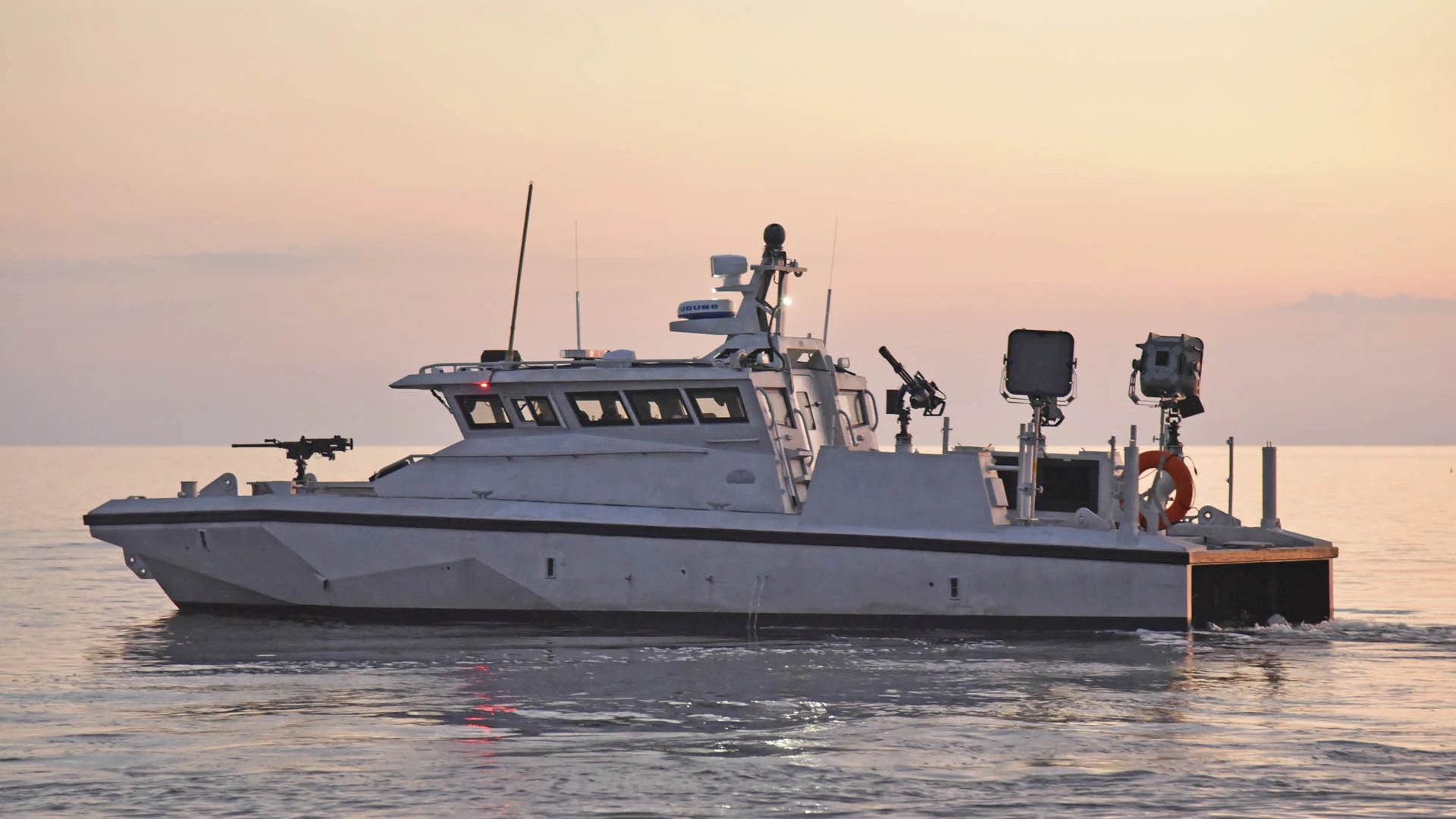
The U.S. Navy has ordered four additional 40 PB Flight 2 patrol boats from Louisiana-based Metal Shark, the company announced on November 16, 2026. The 40-foot Patrol Boat (40 PB) is a welded-aluminum, ballistic-protected craft powered by twin inboard diesel engines and waterjets, built for Navy Expeditionary Combat Command (NECC). Neither the Navy nor the company has disclosed the value of the order or a delivery schedule.
The award lands seven months after Metal Shark announced the completion of the 40 PB Flight 1 program on April 10, 2026 with the delivery of its 57th and final hull. According to the company, three Flight 2 boats have been accepted or delivered so far and six more are in production, so the new order feeds an active line rather than a restart. The 40 PB replaces up to 160 legacy patrol craft of the Maritime Expeditionary Security Force (MESF), known as the Coastal Riverine Force until September 2020, which secures ports, harbors, high-value units, and critical maritime infrastructure.
40 PB Flight 2 Contract Structure and Production Status
Metal Shark won the Patrol Boat X (PB(X)) competition in 2017 against six other shipbuilders, with an initial order for 11 boats. The design passed first-article testing and operational test and evaluation before the Navy authorized full-rate production in 2020. Metal Shark then delivered the entire 57-boat Flight 1 fleet from its Jeanerette, Louisiana, facility.
Flight 2 moved the program to a dual-source model. In May 2024, Naval Sea Systems Command (NAVSEA) awarded firm-fixed-price, indefinite-delivery, indefinite-quantity (IDIQ) contracts to Gravois Aluminum Boats, doing business as Metal Shark, and to ReconCraft of Clackamas, Oregon. The two contracts share a combined ceiling of $290 million over seven years for up to 73 boats, with individual delivery orders placed under fair-opportunity procedures. Metal Shark received an initial order of $6,507,040 for two boats; ReconCraft took a $7,737,536 initial order. Federal contract data also show a June 2025 Metal Shark delivery order, worth up to $18,240,915, for a foreign military sales (FMS) variant of the Flight 2 boat.
With the new order, Metal Shark has publicly accounted for 13 Flight 2 hulls that are delivered, in build, or on order; the company has not said whether any of the six boats in production are FMS variants. CEO Chris Allard said the award “demonstrates the Navy’s continued confidence in our vessels and our ability to deliver.” ReconCraft’s Flight 2 tally has not been disclosed, so open sources do not show how much of the 73-boat ceiling is already committed.
Hull, Propulsion, and Protection: Inside the 40 PB Patrol Boat
The 40 PB is a welded-aluminum pilothouse monohull with a hull length of 40 feet 3 inches, an overall length of 43 feet 11 inches, and a beam of 11 feet 10 inches, per the builder’s published specifications. Its faceted, angular superstructure reflects the Navy’s emphasis on visual deterrence during source selection, a relevant factor for a craft whose routine work involves warning off vessels approaching anchored warships and piers.
The first Navy boats were powered by twin Cummins QSB 6.7 diesel inboards driving Hamilton HTX30 waterjets through Twin Disc MG5065SC transmissions. The November 2026 announcement describes the boat as powered by twin inboard diesels and waterjets but does not name the Flight 2 components. The hull was optimized for efficiency at 10 to 15 knots, the escort and cruise band where the boats spend most of their service life, while publicly available figures put sprint speed between 35 and 40 knots. That is slower than the 45-knot Mark VI patrol boat the Navy moved to divest in its fiscal 2022 budget, although NAVSEA has said the 40 PB is not a replacement for the Mark VI.
The boat carries a command, control, communications, computers, intelligence, surveillance, and reconnaissance (C4ISR) suite and can be armed with crew-served and remotely operated weapons. In the Navy configuration published by the builder, it has six MK 16 weapon foundations plus a forward foundation for a stabilized, remotely operated MK 49 or MK 50 system. Metal Shark has not said whether Flight 2 changes that layout.
Analysis: The order is small, but it shows the Navy continuing to fund expeditionary harbor security. Port and anchorage defense has gained weight since Ukraine’s uncrewed surface vessel strikes on Russian ships in the Black Sea, including the August 2023 attack that damaged the landing ship Olenegorsky Gornyak at the Novorossiysk naval base, exposed how vulnerable vessels are pierside or at anchor, exactly where a 40 PB operates. The dual-source Flight 2 structure also lets NAVSEA compete each delivery order between two production lines. The open question is whether Flight 2 adds dedicated counter-drone or counter-USV sensors, which would determine how well the boat matches the threat it screens against.
The Flight 2 IDIQ runs into 2031, leaving room for further orders to either builder. Next markers include the delivery schedule for the four new boats, any contract value disclosed in Pentagon announcements, ReconCraft’s delivery progress, and NECC’s total fleet objective for the 40 PB across both flights. Additional FMS orders under the Flight 2 vehicle would also signal whether the design is gaining traction with partner navies.