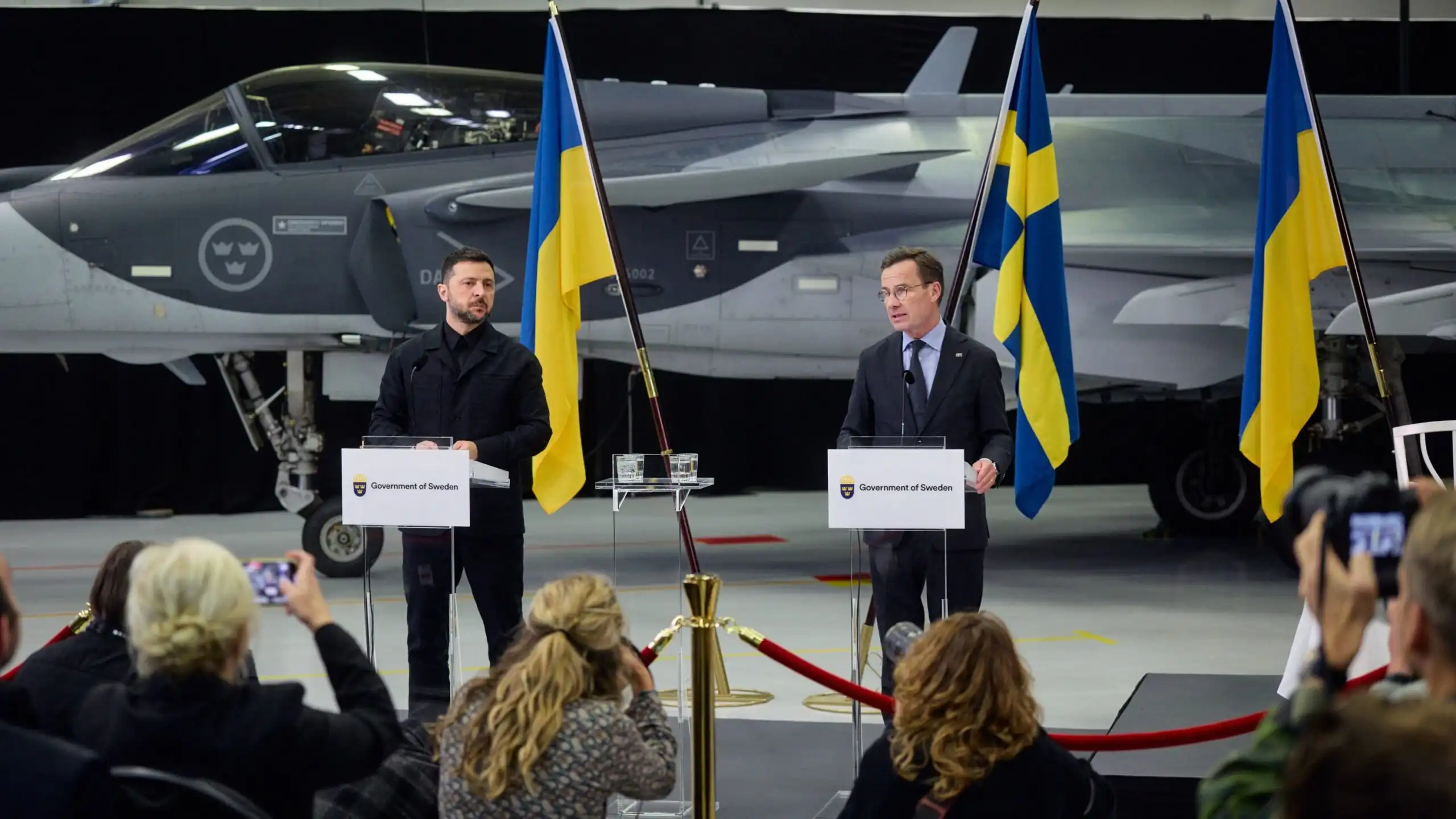
Ukraine named Gripen Meteor missiles its top priority as it signed a letter of intent (LoI) with Sweden and the UK on November 17, 2026, covering ammunition, materiel and spare parts for its Gripens. Ukrainian Minister of Defence Evgeniy Khmara, Swedish Minister for Defence Pål Jonson and UK Defence Secretary Wes Streeting signed the document in Brussels on the sidelines of the Ukraine Defence Contact Group (UDCG) meeting. The MBDA Meteor is a ramjet-powered beyond-visual-range air-to-air missile (BVRAAM) that Saab credits with a range above 100 km and a speed above Mach 4.
The agreement targets the gap between airframes and weapons that has shaped Western fighter transfers to Ukraine. Sweden is donating 16 Gripen C/D aircraft from Swedish Air Force stocks, with first deliveries expected in early 2027, while Ukraine has purchased 16 new-build Gripen E fighters. Kyiv wants munitions to arrive with the jets so they can enter combat quickly. The priority target is Russian aircraft launching glide bombs on frontline positions and cities.
Gripen Meteor Missiles Top a Synchronized Weapons Package
According to the Swedish government, the three countries intend to provide Gripen weapons packages in connection with aircraft deliveries and to maintain long-term capability. The cooperation covers procurement, delivery, training and integration of weapons systems, and applies to donated, purchased and any future Gripen aircraft. The Ukrainian Ministry of Defence said the parties plan to synchronize deliveries of ammunition, equipment and spare parts with the arrival of the aircraft in the Ukrainian Air Force.
Khmara called Meteor the core requirement. “The key priority is Meteor missiles. With them, Gripens will be able to destroy enemy glide bomb carriers and protect frontline cities and warriors’ positions,” he said. Jonson described the LoI as “a basis for the fighter jets to be operational over time.”
Publicly available specifications indicate that Meteor uses a solid-fuel, variable-flow ducted rocket (ramjet) that sustains thrust through to intercept, unlike the boost-coast motor of the AIM-120 Advanced Medium-Range Air-to-Air Missile (AMRAAM). The missile measures about 3.65 m, weighs roughly 190 kg and cruises above Mach 4. Saab cites an operational range above 100 km and a no-escape zone exceeding 60 km, the largest claimed for any air-to-air missile. Guidance combines inertial navigation, a two-way datalink for mid-course updates and an active radar seeker, with a blast-fragmentation warhead fitted with impact and proximity fuzes. The Gripen C/D became the first fighter operational with Meteor in July 2016.
The operational logic is direct. Russian Su-34 strike aircraft release glide bombs fitted with UMPK wing kits from standoff distances that open-source estimates place at several dozen kilometers, often covered by Su-35S fighters and MiG-31BM interceptors carrying the R-37M, a missile with a reported range of about 200 km. Ukraine’s F-16s rely on AMRAAM variants with shorter reach. Meteor’s retained energy would let a Gripen threaten the launch aircraft, not just the bombs, and push the release line back.
From Donated Gripen C/D to Gripen E: Fleet and Funding Roadmap
The LoI builds on a sequence of agreements. Sweden and Ukraine signed an initial LoI on October 22, 2025, framing a long-term requirement of 100 to 150 Gripen E. On May 28, 2026, Stockholm announced the donation of up to 16 Gripen C/D under its 22nd military support package, conditional on Ukraine purchasing Gripen E/F; the Swedish government said the accompanying munitions may consist of IRIS-T, AMRAAM and Meteor missiles. On June 30, 2026, Saab signed a contract with the Swedish Defence Materiel Administration (FMV) worth about SEK 24.6 billion, roughly $2.5 billion, for 16 Gripen E for Ukraine, with deliveries planned for 2029 and 2030 and financing through the EU’s Ukraine Support Loan with British support.
The two variants differ significantly. The Gripen C/D carries the PS-05/A mechanically scanned radar and the RM12 engine, a derivative of the General Electric F404. The Gripen E adds the Raven ES-05 active electronically scanned array (AESA) radar, the more powerful F414G engine, greater internal fuel and ten hardpoints, and Saab has displayed it carrying seven Meteors. One framework spanning both variants gives Kyiv a single munitions and training pipeline from donated to new-build airframes.
The UK role carries particular weight. Britain is one of six Meteor partner nations alongside France, Germany, Italy, Spain and Sweden, and acts as lead nation on the program. Transfers to a third country require partner consent. None of the three governments has disclosed missile quantities, delivery dates, contract value or the status of partner approvals.
Analysis: The LoI signals an intent to deliver the Gripen to Ukraine as a complete weapon system rather than an airframe awaiting munitions. A Meteor-armed Gripen would give Ukraine its first air-to-air weapon able to contest Russian standoff aviation on comparable range terms, which bears directly on the glide bomb campaign driving attrition along the front. It also moves the UK from co-financier of the Gripen E purchase to stakeholder in its weapons supply. The binding constraint is likely to be inventory: Meteor arms Rafale, Typhoon and Gripen fleets across NATO, and every round sent to Kyiv competes with allied stockpiles.
The next milestones are the first Gripen C/D deliveries, expected in early 2027, and a follow-on contract converting the LoI into firm orders. Key unknowns include partner-nation clearance for Meteor, the size of the initial allocation from Swedish stocks, and whether weapons integration keeps pace with pilot conversion. Gripen E deliveries in 2029 and 2030 will test the framework’s durability.