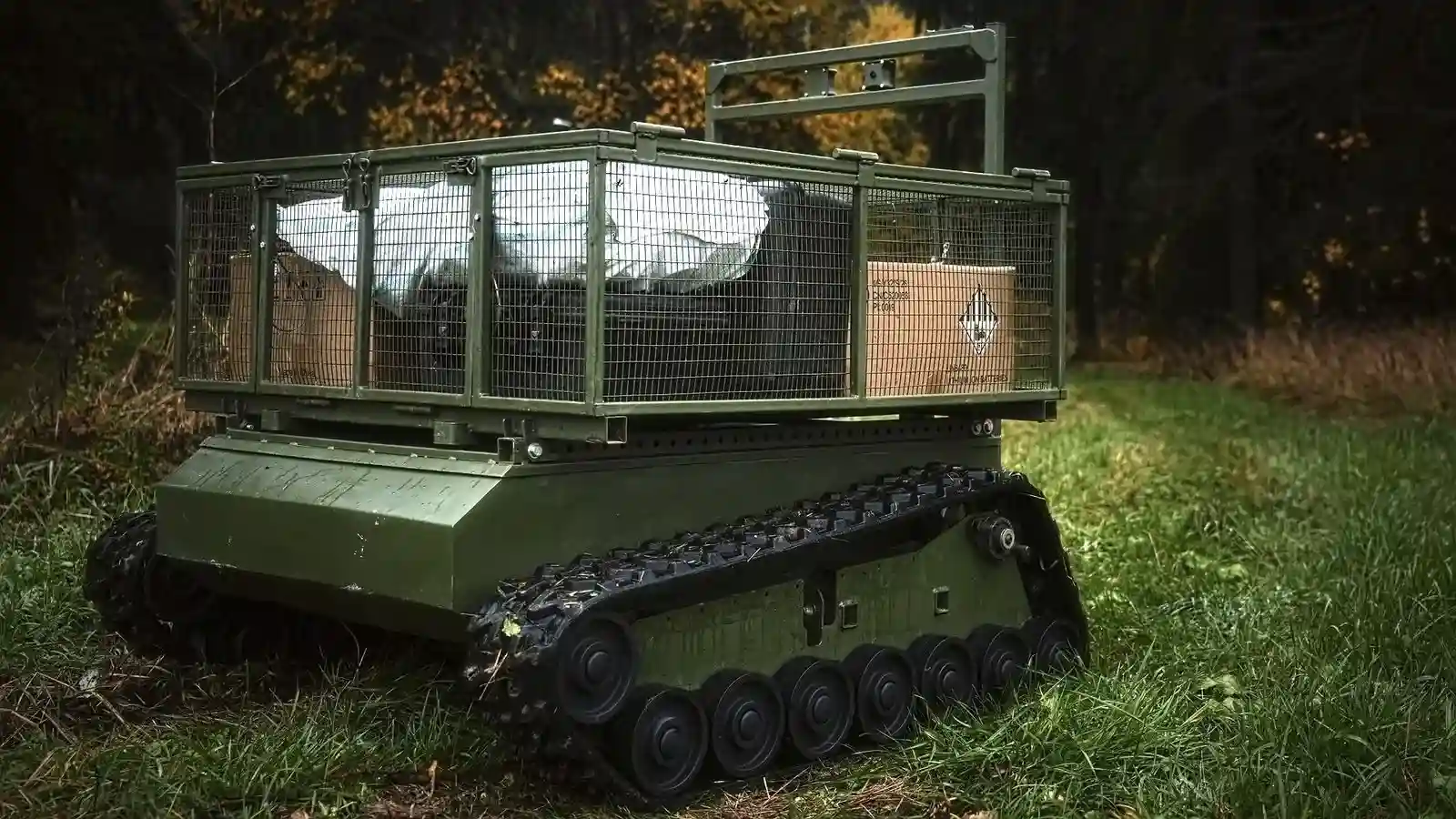
Russia’s state defense conglomerate Rostec has unveiled the Depesha-MK, an enlarged, higher-powered variant of its Depesha unmanned ground vehicle (UGV) built to haul larger loads over medium distances behind the front line. Announced on November 16, 2026, by Rostec’s High-Precision Systems holding, the new robot features a larger cargo compartment, uprated motors, longer operating time on a single charge, and the ability to tow heavier trailers.
The announcement extends a product line that has evolved rapidly under combat conditions in Ukraine. Rostec first presented the tracked Depesha in June 2024, promoting it as a multipurpose robot able to carry supplies, evacuate casualties, lay mines, or serve as a ground-based kamikaze vehicle. Since then, Russian units have increasingly relied on small UGVs to move ammunition and food across the last kilometers to forward positions, where massed FPV drones have made crewed vehicle runs extremely costly. The Depesha-MK is the first member of the family explicitly sized for volume rather than concealment.
Depesha-MK UGV Joins the Depesha Ground Robot Family as a Medium-Range Hauler
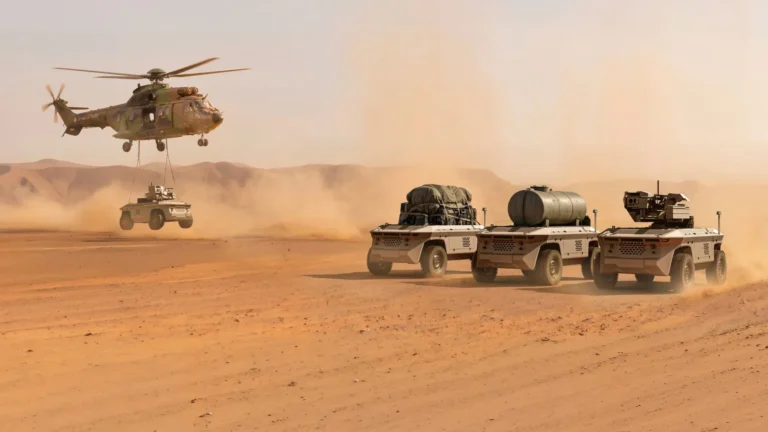
Rostec presents the Depesha-MK as a complement to the compact Depesha-3, not a replacement. According to the company, commanders and operators will be able to match the vehicle to the task by combining both models within a single logistics system, depending on the cargo, the route, and the tactical situation. The Depesha-3 stays assigned to the final kilometers, where stealth and mobility matter most, while the Depesha-MK takes over intermediate distances, where transport volume becomes the priority.
The company’s rationale centers on exposure. Greater payload and power let the robot “take more and deliver further” without repeat runs, Rostec said, adding that “with each new trip, the risk of detection increases.” Like the rest of the family, the MK accepts interchangeable mission modules and can carry provisions, fuel, and equipment, tow trailers, and evacuate personnel.
Rostec released no performance figures. Payload, vehicle weight, dimensions, top speed, range, battery capacity, and running gear for the Depesha-MK were not disclosed, nor was any production or delivery timeline. The company describes the vehicle only as larger than earlier models, with a more spacious cargo bay and more powerful motors.
Depesha-3 Baseline: Payload, Speed, and Combat Use in Ukraine
The Depesha-3, developed by the Tula-based KBP Instrument Design Bureau within High-Precision Systems, provides the only reliable yardstick for the new variant. Publicly available specifications indicate that the Depesha-3, shown at the St. Petersburg International Economic Forum in June 2026, measures about 2 meters long and 1 meter wide, runs on two battery-powered electric motors and rubber tracks with three road wheels per side, and reaches a maximum speed of 15 km/h. Its payload was raised from 100 kilograms on earlier production models to 150 kilograms, and the robot remains small enough to fit in the bed of a pickup truck or SUV.
A single operator drives the vehicle over a radio link, viewing a camera feed on a monitor or VR goggles. A fiber-optic variant fitted with a cable spool is offered to resist electronic warfare, mirroring the shift toward wired control seen among aerial FPV drones on both sides of the front.
Russian sources have reported a growing list of mission fits on the same chassis, including a version armed with the PMZ-7 Moskit turret and a 7.62 mm machine gun intended to engage small drones, a training target carrier, and a strike configuration carrying an explosive charge. In May 2026, Russian sources claimed that a Depesha-3 delivered 70 kilograms of cargo over 30 kilometers in six hours while absorbing ten direct FPV drone hits. That claim has not been independently verified.
Analysis: The Depesha-MK signals that Russia is moving from ad hoc use of robotic mules toward a tiered logistics chain, with different UGV classes assigned to different depths of the battlespace. The logic is sound: in a zone saturated by FPV and reconnaissance drones, the number of vehicle movements, not only their speed, drives losses. The trade-off is signature. A bigger, more powerful platform is easier to detect and a more valuable target per sortie, which likely explains why Rostec confines it to intermediate distances rather than the forward edge. Without disclosed payload and endurance figures, the MK’s real value against Ukrainian ISR coverage cannot be assessed. The concept nonetheless parallels Ukraine’s own large-scale adoption of logistics UGVs and Western efforts such as the US Army’s Small Multipurpose Equipment Transport (S-MET) program, confirming that robotic resupply is becoming a standard layer of land warfare.
The key unknowns are the Depesha-MK’s specifications, its production status, and whether it has already been tested in the Ukraine war zone, as earlier Depesha models were before serial deliveries. Rostec has shipped several batches of Depesha robots since late 2024, so the next indicators to watch are a published technical data sheet, a first delivery announcement, and combat footage showing how the MK is employed alongside the Depesha-3 in Russian supply chains.