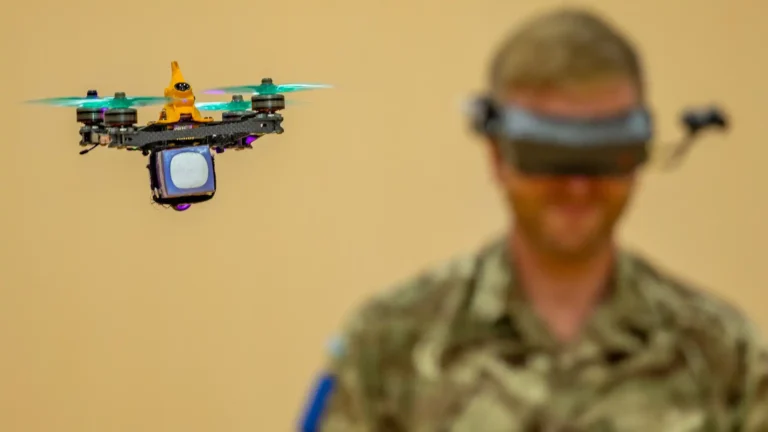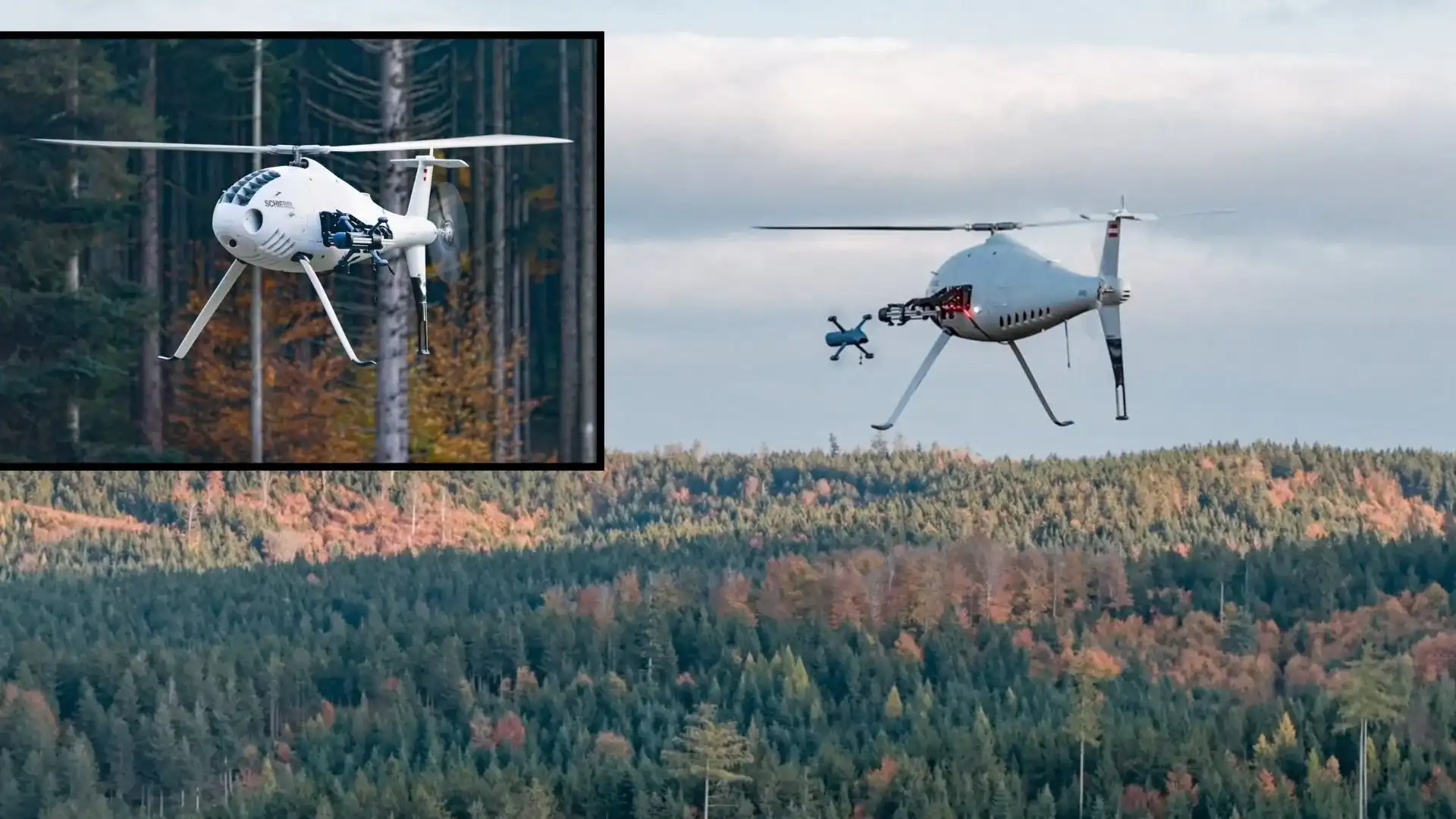
Schiebel’s CAMCOPTER S-100 drone mothership air-launched an OSIRIS HSCD-1 High-Speed Camera Drone in forward flight and relayed its control and video links during a trial in Austria, the company announced on November 18, 2026. The Austrian manufacturer ran the proof-of-concept with OSIRIS Poland to test the S-100 unmanned air system (UAS) as a carrier and airborne relay for smaller drones. The S-100 flies for more than 6 hours with a 34 kg payload and has a datalink range of up to 200 km.
The trial targets a structural limit of small unmanned air systems (sUAS) and interceptor drones: short endurance and line-of-sight control range tie them to their ground launch point. Schiebel frames the concept primarily around counter-unmanned air system (C-UAS) missions.
How the S-100 Drone Mothership Trial Worked
During the flight, the S-100 carried the HSCD-1 and released it while in forward flight rather than in a hover. After separation, the small drone was flown through a communications link relayed via the S-100, which acted as an airborne control and video relay. Imagery released by Schiebel shows the HSCD-1 carried on a side mount of the helicopter.
The HSCD-1 used in the test was an inert variant with no effector. Schiebel has not disclosed the test date, the exact site, release altitude or airspeed, the distance the small drone flew after release, or the effective range of the relayed link. No performance specifications for the HSCD-1 have been published, and the demonstration involved a single carried drone.
Schiebel states that the same approach can support high-speed interceptor drones fitted with effectors, as well as loitering munitions and other sUAS types.
Payload, Endurance, and Datalink Behind the Carrier Concept
Publicly available specifications indicate the S-100 has a maximum takeoff weight of 200 kg (440 lb) and a 50 kg main payload bay, with side hardpoints rated at 10 kg each. Endurance exceeds 6 hours with a 34 kg payload and passes 10 hours with an optional external fuel tank. The airframe has a never-exceed speed of 130 knots, a loiter speed of 55 knots, a service ceiling of 18,000 ft, and a datalink range of up to 200 km. It runs on heavy fuel, including JP-5 and Jet A-1, which simplifies shipboard operations.
Those figures define the carrier envelope. A 10 kg side hardpoint caps the mass of each externally carried drone, while every kilogram of carried sUAS trades directly against fuel and sensor payload. For comparison, Ukrainian developer OSIRIS AI, which has factories in Ukraine and Poland and an R&D center in Kraków, quotes its UEB-1 interceptor at 315 km/h, more than 10 minutes of endurance, an 18 km line-of-sight range, and a 0.5 kg warhead. Interceptors in that class have speed but little reach; the S-100 offers reach but not speed.
Schiebel names the S-100, the larger S-300, and the S-101 and S-301 precision strike variants as potential carriers, launch platforms, and relays for smaller drones and loitering munitions.
Analysis: The value of the concept lies in the relay more than the release. A ground-launched interceptor with an 18 km line-of-sight link defends a point. An S-100 loitering for hours with a 200 km datalink can position interceptors forward along a threat axis and keep them under control beyond the radio horizon, turning a point-defense weapon into a forward picket. The S-100 already operates from warships in several navies, which points to a naval C-UAS role against one-way attack drones. Detection and cueing, carried drone mass, and the cost of risking a helicopter UAS forward remain unresolved.
Schiebel has not announced a follow-on trial, a live-effector demonstration, multi-drone carriage, or a customer for the capability. Integration with an armed interceptor and published data on release conditions and relay range are the next markers to watch.