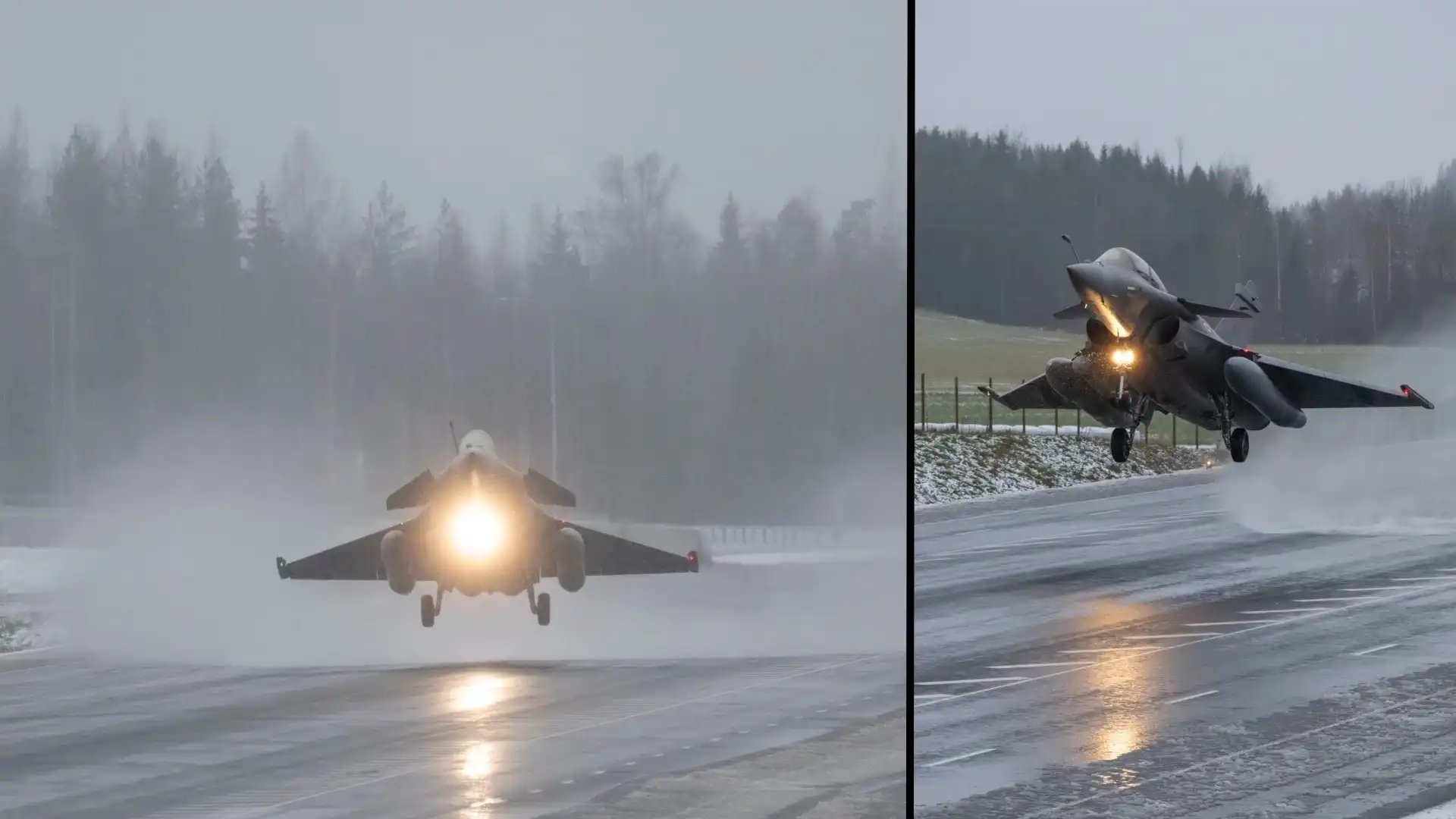
French Air and Space Force Rafale fighters have flown touch-and-go landings on the Jännevirta highway strip in eastern Finland during the Finnish Air Force exercise Protective Fence 26, the French service announced on November 22, 2026, calling it a first for the force. The Finnish Air Force said it was also the first time the Rafale had operated from a Finnish highway.
The drill comes as European air forces rebuild the ability to fight from dispersed locations, a requirement that exercise director Colonel Vesa Mäntylä, the Finnish Air Force’s chief of operations, says lessons from the war in Ukraine have reinforced. Protective Fence 26, the Finnish Air Force’s main exercise of the year, runs from November 19 to 27 and involves more than 40 aircraft and about 4,100 personnel across 10 operating bases in Finland and Sweden. Finland has flown fighters from highways since the 1960s.
Rafale Highway Landing at Jännevirta During Protective Fence 26
The French detachment operates from Lapland Air Wing’s Rovaniemi Air Base. Photos of the sorties show Rafales from Escadron de Chasse et d’Expérimentation (ECE) 1/30 “Côte d’Argent”, according to French defense site Zone Militaire. ECE 1/30 is the service’s trials and evaluation squadron, tasked with assessing weapon systems and defining their conditions of employment, which points to a validation purpose rather than a pure demonstration. The number of aircraft deployed and the variant used have not been disclosed.
Jännevirta lies on Highway 9 just south of Kuopio Airport, which shares its runway with the Karelia Air Wing’s Rissala Air Base. Authorities closed the road to civilian traffic from November 18 to 25. The strip was upgraded under a broader Highway 9 project; a 2022 planning decision covered adapting it to EU civil-military dual-use requirements and adding two aircraft parking positions, and the wider road works received €25.13 million from the EU Connecting Europe Facility military mobility program. Strip length and width have not been published.
Manufacturer data give the Rafale an approach speed below 120 knots and a landing ground run of 450 meters without a drag chute, well within the envelope of a prepared road segment. A touch-and-go validates approach, touchdown, and go-around procedures, but it does not test the refueling, rearming, and maintenance that a full forward operation requires.
How MORANE Shapes French Air Force Dispersed Operations
Unlike Finland and Sweden, France does not maintain highway strips as secondary airfields. The French Air and Space Force has instead built its dispersal model around MORANE (Mise en Œuvre Réactive de l’Arme Aérienne), also called FRA-ACE, its counterpart to the US Air Force’s Agile Combat Employment concept. MORANE aims to move aircraft quickly to secondary sites or allied bases with a light logistics footprint, complicating enemy targeting. Exercises including JADE, TOPAZE, and BASEX-PROFOR have tested short-notice redeployments to civilian and military airfields.
In 2023, General Philippe Moralès, then commander of the Air Defense and Air Operations Command (CDAOA), argued that national territory could no longer be treated as a sanctuary immune to strikes. Allied jets have already used Finnish roads: US Air Force F-35As landed on the Hosio strip in September 2024, and Dutch F-35As followed during Baana 25 in May 2025.
Analysis: The sortie matters less as a feat of airmanship than as a doctrinal marker. By recovering onto a Nordic road strip, the Rafale community extends MORANE beyond French airfields and into the dispersed basing network that Finland and Sweden have maintained for decades, a network NATO’s northern flank would depend on if main operating bases came under missile attack. The binding constraint remains ground support: without fuel, munitions, and maintenance teams at the strip, a touch-and-go stays a proof of concept rather than an operational capability.
The exercise’s main phase runs from November 22 to 24 before Protective Fence 26 closes on November 27. Whether French crews will progress to full-stop landings and hot-pit refueling on road strips, and whether France will designate road segments at home, remain open questions.